
Abstract
The orbital alignment of extreme trans-Neptunian objects (TNOs) is conventionally attributed to a distant, undiscovered point mass. This paper tests a deterministic alternative under the Temporal Equivalence Principle (TEP), in which the anomaly is modelled as a spatially fixed proper-time field gradient — a localized domain boundary — rather than a shepherding planet. Two dynamically distinct populations, drawn from the JPL Small-Body Database and the independent CODE cometary catalogue, are shown to isolate the same 60-degree sector of inertial sky.
The resident population — detached extreme TNOs that remain in the boundary region for secular times — clusters about a common perihelion direction. The clustering survives a strictly measured discovery-footprint null calibrated against the characterized Outer Solar System Origins Survey ensemble, and it lacks the resonant substructure and physical-element coupling that a secular shepherding model requires. The transit population — long-period comets that plunge through the boundary direction on a single pass — carries the complementary signature. Comets arriving from that sector show a significant orbit-reconstruction discrepancy: an in-plane orbital rotation localized to the perihelion element and weighted to the inbound trajectory, occurring without orbital energy exchange, and persisting after regression of a REBOUND N-body planetary baseline, of observational leverage, and of each orbit's own published error budget — a decomposition that excludes dissipative mechanisms, such as asymmetric interstellar-medium drag, on the channel through which they must act. The measured quantity is a direction-organized reconstruction discrepancy of order $0.1^\circ$ concentrated in the clock-sector elements; under the crossing-localized holonomy realization — selected by the velocity-flat transfer function of Section 4.15 — the conversion $\delta t_{\rm eq} = \delta\theta\, r_b^2/h$ maps it to an equivalent proper-time offset of approximately five years ($+$4.9 yr on the matched CODE sample, $+$5.0 yr on the Warsaw inbound channel; $p =$ 0.00532 and $p =$ 0.0079). The equivalent-time figure is thus an interpretation-conditioned conversion of the measured angular residual, not a directly read clock slip.
Three independent checks confirm that the signature is real. The comets' aphelion directions — a spatial observable that no orbit reconstruction can manufacture — dipole toward the same axis at the $10^{-2}$–$10^{-4}$ level under tested tide-aware nulls, establishing a direction-organized arrival population whose interpretation (primordial anisotropy, selection residual, or the boundary field) is degenerate and which is carried as consistency evidence rather than a discriminating channel; the identical bidirectional integration reproduces the Warsaw catalogue's boundary solutions. In the leg decomposition the inbound leg is significantly elevated ($p =$ 0.042) while the outbound leg is flat ($p =$ 0.547), naturally producing the isotropic leg-twist angle ($\langle\cos\phi\rangle \approx 0$) expected of an inbound-only domain-wall traversal. The signature is then traced to the astrometric record itself rather than to any catalogue's reduction: an independent Levenberg–Marquardt two-leg refit of the raw Minor Planet Center astrometry on 586 pre-2018 comets — a record built without any Warsaw-lineage input — reproduces the per-comet boundary rotation at $\rho =$ +0.998 and retains the registered inbound-leg in-cap excess ($p =$ 0.0341; $p =$ 0.00695 on the CODE-overlap seat).
Pointed at the post-2017 prospective cohort, the instrument isolates the operational boundary between orbit reconstruction and coordinate-invariant geometry. In the leg-separated reconstruction channel, the modern astrometry reverses the declared-axis carrier — median in-cap rotation 0.114° against 0.171° outside, permutation $p =$ 0.920, the excess running counter to the declared axis. Yet the modern record's own dominant structure is a lapse-slip anomaly of the identical signature class at the mirror position (joint opposite-polarity test $p =$ 1.00×10⁻⁴) — the quantitative support for the absorbed-slip interpretation, not a demonstrated extension of the anomaly; the reversed channel is carried as a separate ledger item rather than as convergent evidence for the declared axis. The reconstruction-free spatial aphelion channel — a coordinate observable no orbit reconstruction can manufacture — is flat across every measured orbit-quality stratum — bound and hyperbolic solutions, short and long arcs, sparse and heavily observed records alike. It independently replicates the declared-axis lean on the post-2017 cohort ($d_\parallel =$ +0.0949, $p =$ 0.00215 under the tide-aware null; $p =$ 0.00225 under the ecliptic null), persists across all 257 non-training members (+0.0827, $p =$ 0.00845), and matches both the full CometEls census ($+$0.10, $p =$ 7×10⁻⁴) and the pre-2018 record (+0.110, $p =$ 5.00×10⁻⁵). The displaced residual structure likewise persists where the fits are best determined, appearing strongest on bound and perihelion-spanning-arc members (+0.23 dex each). It is cleanly retained on the well-observed and non-gravitational-clean strata ($p =$ 0.005 and $p =$ 1.8×10⁻⁴, respectively), though its amplitude attenuates with transit epoch and on uniform-Gaia legs — a composition dependence priced in Section 4. An element-covariance perturbation audit then shows the dissociation cannot be manufactured by orbit-solution error: the leg-rotation observable cancels common-mode element noise at $\sim 163\times$ the aphelion channel's exposure, and at their published covariances only 1 member in sixty can be driven to the observed rotation-residual scale — the injected error required there would displace the same object's aphelion datum by $\sim$0.61°, a displacement the flat spatial channel does not carry. The spatial datum is therefore the more error-exposed channel — and it is the one that replicates. Spacecraft clock records bound local rate steps at the 1 ppm level, consistent with the first-order cancellation of static scalar potentials in two-way Doppler tracking.
A ten-channel global synthesis spanning six catalogue lineages (SBDB, DES, MPCORB, CODE, Warsaw, and CometEls) demonstrates multi-lineage directional convergence on the same 60-degree sector, yielding an omnibus statistic of $S_{10} =$ 187.2 ($p =$ 0.0118 against a 20,000-draw random-axis permutation null that prices the directional look-elsewhere for the pre-declared channel set and embeds the channels' own correlation structure). These multi-messenger, multi-population data provide mutually reinforcing evidence for a non-integrable dynamical time field in the outer solar system. The prediction is pre-registered and near-term falsifiable: for detached-TNO discoveries under the Vera C. Rubin Observatory's Legacy Survey of Space and Time, the boundary model predicts $\sim 59$ per cent of new objects inside the declared 60° cap against the $\sim 42$ per cent footprint-only expectation — a separation that $\sim 123$ discoveries resolve at 95 per cent power for a one-per-cent test ($\sim 83$ at five per cent). The counterweights are registered alongside: the modern reconstruction channel reverses at the declared axis, the newest 2025–26 provisional cohort sits at its footprint baseline (2/21 in-cap, at anti-axis pointings) and Ammonite (2023 KQ14) lies $134^\circ$ off-axis; a mundane watch-flag is carried for the axis longitude itself — Neptune's mean $\varpi$ lies $4.0^\circ$ away (a priori $p = 0.022$), though the coincidence does not extend to Neptune's forced secular directions ($112^\circ$ off-axis, $p = 0.62$); and the mechanism's required field excursion remains an open condition on the solved profile rather than a derived output.
Key words: Kuiper belt: general – comets: general – gravitation – celestial mechanics – astrometry
1. Introduction
1.1 The extreme-TNO clustering anomaly and the point-mass consensus
The orbits of the most distant known trans-Neptunian objects (TNOs) are not isotropically distributed. The longitudes of perihelion $\varpi = \Omega + \omega$ of detached, high-perihelion bodies cluster about a common direction in inertial space, a fact first emphasized by Trujillo & Sheppard (2014) and developed into the Planet Nine hypothesis by Batygin & Brown (2016). Under that hypothesis the clustering is secular shepherding: an unseen $\sim 5$–$10\,M_\oplus$ perturber on a wide, inclined orbit organizes the perihelia of the extreme population into an anti-aligned configuration. A decade of wide-field searches has not detected the proposed body — Pan-STARRS1 together with the ZTF and DES limits excludes approximately 78 per cent of the nominal parameter volume (Brown, Holman & Batygin 2024) — while independent orbital fits continue to shift the preferred solution (Siraj, Chyba & Tremaine 2025) and the newest high-perihelion discoveries complicate rather than confirm the clustering picture (Chen et al. 2025).
The shepherding interpretation carries mechanical obligations that are testable in their own right. A point mass acting through secular gravity should (i) deposit some fraction of the clustered population on or near mean-motion resonances, (ii) couple the alignment direction to physical orbital elements — semimajor axis, perihelion distance, eccentricity, and inclination — because the secular forcing frequencies depend on them, and (iii) imprint its signature on any tracer population that crosses the same volume, since gravity is blind to dynamical class. The analysis reported here finds none of these signatures in the data.
1.2 The Temporal Equivalence Principle alternative
The Temporal Equivalence Principle (TEP), developed in Paper 0 of this series, posits that proper time is governed by a dynamical scalar field $\phi$ rather than being a passive coordinate. Matter couples universally to a causal matter metric $\tilde{g}_{\mu\nu} = A^2(\phi)\,g_{\mu\nu} + B(\phi)\,\nabla_\mu\phi\,\nabla_\nu\phi$: the conformal factor $A(\phi)$ sets the local rate of proper-time accumulation, and the disformal term $B(\phi)$ weights that rate along the field gradient. Spatial structure in $\phi$ therefore produces macroscopic, measurable consequences for orbital dynamics.
Within this framework the outer solar system anomaly is modelled not as a body but as spatial structure in the proper-time field — a localized domain boundary. In the language of Paper 0 it is a steep but continuous screening transition of the solar Temporal Topology, across which the rate of proper-time accumulation departs from the standard Newtonian assumption. In classical terms, crossing the transition acts as a pure temporal phase shift: it advances or retards the object's position in its orbit without exerting any physical acceleration that would alter its kinetic energy. The accumulated offset is the path integral of the Temporal Shear $\Sigma_\mu = \nabla_\mu \ln A$ along the trajectory. Because time accumulates at a different rate across the boundary, a comet's inbound and outbound trajectories will mathematically disagree when reconstructed by standard software. That failure of forward and backward transport through the transition to close — the orbit-reconstruction discrepancy the transit channel measures — is a synchronization-holonomy-class observable: the signature of dynamical time defined in Paper 0, registered on celestial rather than laboratory transport. Its invariance status is stated precisely: the closed-loop theorem of Paper 0 covers closed spatial circuits of the synchronization connection, while the comet channel is an open-path, fit-space non-closure whose convention-dependence the analysis itself exploits (a single joint fit absorbs the offset into the elements); the loop-invariant version of the same observable requires a genuinely closed transport circuit, such as the triangle time-transfer experiment of Paper 0. The static reading is adopted as primary: the era dependence of the measured carrier is attributed to arc-length-dependent solver absorption — demonstrated experimentally in Section 4.15 — rather than to motion of the field itself, while the evolving-boundary alternative is registered as an open hypothesis requiring a dynamical driver the corpus does not currently supply.
At the level of the single scalar degree of freedom, the framework's structure is that of an environmentally screened gradient field. Rather than an algebraic density-dependent potential minimum (as in standard chameleon theories (Khoury & Weltman 2004; Burrage & Sakstein 2018), whose thin-shell mechanism is bypassed here), screening in TEP operates through the saturation of the Temporal Shear $\Sigma_\mu \equiv \nabla_\mu \ln A(\phi)$ within local potential wells, governed by the environmental operator $\mathcal{S}_\Sigma(\mathcal{E})$. A domain boundary arises where the local heliocentric scalar gradient $\nabla\ln A_\odot$ attenuates to the ambient Galactic and cosmological background shear ($a_{\rm amb} \approx 3.9 \times 10^{-10}$ m s$^{-2}$ at the solar circle, Paper 26; distinct from the horizon-anchored suppression scale $g_t \approx 3.4 \times 10^{-10}$ m s$^{-2}$ used in Paper 0). On physical grounds the transition is expected in the outer solar system, in the broad neighbourhood of the solar-wind ram-pressure boundary ($\sim 100$–$150$ AU), where the Sun's gradient kinematically decouples from the interstellar background; the forward-model localization reported below places the best-fit crossing at the outer edge of its tested range, $\sim 250$ AU — a lower bound pending extension of the injection scan — so the heliospheric coincidence is a noted proximity rather than a fitted anchor. The anchoring is therefore to the continuous transition of the heliospheric Temporal Topology, not to contemporaneous local plasma fluctuations — a distinction Section 4.14 tests directly. Deriving the potential $V(\phi)$ and the coupling functions is the task of Paper 0 — where the quartic density-dependent-mass branch is evaluated as a candidate completion rather than assumed — and the present work's contribution is the measurement programme: whether the orbital record carries the signature such a transition must produce.
Key terminology
- Domain boundary: a localized region across which the proper-time field $\phi$ changes appreciably — the steep screening-transition region of the solar Temporal Topology (Paper 0) in the outer solar system.
- Clock-sector elements: the angular orbital elements ($\Omega$, $\omega$, $\varpi$) that encode where a body is in its cycle; they are the components a proper-time perturbation touches directly.
- Resident population: orbits that remain in the boundary region for secular times (detached extreme TNOs).
- Transit population: orbits that plunge through the boundary on a single pass (long-period Oort-spike comets).
- Orbit-reconstruction discrepancy: the mismatch between osculating, original (backward-integrated), and future (forward-integrated) orbit solutions published for the same comet.
The physical distinction between the two hypotheses is sharp. A point mass transports momentum: it rotates orbital elements through a calculable, element-coupled torque whose amplitude is set by the mass and the geometry and bounded by surveys and ephemerides. A lapse boundary transports phase: a trajectory that crosses it accumulates proper time at a perturbed rate, so a reconstruction that assumes the standard clock mis-assigns the object's orbital phase — an error that appears in the clock-sector elements without the corresponding energy exchange. The boundary therefore predicts a rotation-without-energy signature, threshold rather than force-law morphology, and population selectivity by residency rather than by size.
1.3 The resident-versus-transit strategy
This work tests the domain-boundary hypothesis with two dynamically distinct populations that probe the structure differently. Detached extreme TNOs are residents: their orbits never dip into the planetary region, so their clock-sector elements integrate the secular influence of whatever occupies the outer system over Gyr timescales. Long-period comets are transiters: each falls from the Oort spike through the full radial structure once, and the catalogued discrepancy between its osculating, original, and future orbit solutions records how well the standard-dynamics clock survives the crossing. A third, injected population — Jupiter-family comets driven inward through the same volume — supplies a directional control.
The plan of the paper is as follows. Section 2 defines the catalogues and selection criteria. Section 3 establishes the resident signature: the extreme-TNO alignment, the measured discovery-footprint null, and the failure of point-mass discriminators. Section 4 presents the transit signature: the cometary orbit-reconstruction discrepancy localized to the same sky sector, its rotation-without-energy decomposition, and its survival after regression of the planetary baseline. Section 5 demonstrates that the two populations converge on a single structure. Section 6 tests and rejects each conventional alternative in turn. Section 7 registers the falsifiable prediction that the imminent Rubin/LSST cohort will decide. Section 8 summarizes the findings.
Because the argument crosses several measurement classes, the five physical discriminators that separate a proper-time domain boundary from a Newtonian point mass and from observational artefact are stated at the outset:
- The amplitude-localization bound (Sections 4.3, 6.2): secular gravity does rotate orbital elements at nearly flat energy, so the flat $\Delta(1/a)$ channel is not by itself the exclusion — the exclusion is that the residual rotation, measured after regression of the full planetary baseline, exceeds every allowed perturber's amplitude by two to three orders of magnitude while remaining direction-organized, single-leg-localized, and energy-flat.
- The stratification discriminator (Sections 4.8, 4.12): on the modern cohort the reconstruction-dependent channel reverses while the spatial aphelion channel persists flat across every quality stratum, and the sensitivity audit (step 150) shows the aphelion channel is the more error-exposed of the two — the dissociation is structural, not noise.
- The holonomy transfer function (Section 4.15): the pre-2018 implied slip is velocity-flat, selecting a crossing-localized time translation over any conformal fifth-force impulse.
- The CMB-anchored frame (Sections 4.13, 4.14): the pooled slip map is axisymmetric — same-signed lobes tracking $\cos 2\theta$ — while the two transit eras carry reversed measured polarity about the frame-anchored dipole direction on the CMB-anchored reference frame, an epoch dependence rather than a lobe crossing, with a sharp transition that solar-wind and catalogue-composition controls exclude.
- Two-way transponder cancellation (Sections 6.8, 6.9): the endpoint conformal term cancels identically at the coherent turnaround, so the two-way Doppler and ranging links are blind to a static lapse gradient by construction; the onboard-oscillator SCLK record is the clock-carrying channel the theorem exempts, and its measured nulls bound the excursion rather than contradicting the orbital signal.
2. Data and catalogues
The analysis uses only published, public orbit catalogues; every reported measurement is computed on real catalogue data, with synthetic realizations entering only the explicitly labelled injection and validation controls. Three independent data lineages are used — the JPL Small-Body Database for resident and injected populations, the Warsaw catalogue of near-parabolic comets, and the independent CODE cometary catalogue — plus the characterized Outer Solar System Origins Survey (OSSOS) ensemble for discovery-bias calibration. Every acquisition is scripted and provenance-stamped (source URL, retrieval timestamp, byte count, and SHA-256 checksum) by pipeline steps 001–004.
2.1 The resident population: JPL SBDB outer solar system
The JPL Small-Body Database (SBDB) query API supplies the complete asteroid orbit catalogue with heliocentric semimajor axis $a \geq 30$ AU (7,300 objects at retrieval), the class-CEN Centaur population (1,050 objects), and comets reaching perihelia $q \geq 5$ AU (268 objects). The fields retrieved are designation, $a$, $e$, $i$, $\Omega$, $\omega$, $q$, aphelion, absolute magnitude $H$, element epoch, orbit class, condition code, data arc, observation counts, and first/last observation dates.
The primary resident sample follows the literature convention for the detached population: $a > 150$ AU, $q > 30$ AU, and orbit condition code $\leq 3$ (secure, multi-opposition solutions). This yields $N = 44$ objects, among them 2023 KQ14 ('Ammonite'), the newest Sedna-like body, which enters the secure sample through a 2005 precovery rather than its 2023 discovery arc. Sensitivity to the cuts is mapped throughout: the extreme subsample ($a > 250$ AU; $N = 26$), a relaxed-quality control (all condition codes; $N = 90$), a sednoid subset ($q > 50$ AU; $N = 5$), and a plunging-transit control ($a > 150$ AU, $q \leq 30$ AU; $N = 34$) are analysed in parallel. A further prospective cohort — all objects with $a > 150$ AU, $q > 30$ AU, and designation year 2025 or later, at any condition code ($N = 21$; median condition code 8) — is scored separately against the registered predictions and its own discovery footprint in the newest-cohort audit (Section 7).
2.2 The transit population: Warsaw and CODE comet catalogues
The Warsaw catalogue of cometary orbits (Królikowska 2014; VizieR J/A+A/567/A126) provides homogeneous orbit solutions for 119 near-parabolic comets at three epochs: osculating heliocentric elements (table B), original barycentric elements reconstructed backward to 250 AU (table C), and future barycentric elements propagated forward to 250 AU (table D), together with observational material and quality assessment (table A1) and an extended sample (table B4). The three-leg structure — osculating, original, future — is the raw material of the transit test, since the discrepancy between legs measures the failure of a standard-dynamics clock to reproduce a single physical trajectory.
The CODE catalogue (Catalogue of Orbits and their Dynamical Evolution; Królikowska & Dybczyński 2020) provides the same three-leg structure for an independent comet set served by the Poznań comet-dynamics server. In the matched deep-plunger, class-1 regime the independent CODE-only sample contains $N = 54$ comets, 19 of which have original-orbit aphelion directions inside the TNO-defined 60° cap. The CODE acquisition is an archival snapshot of the published catalogue, hash-pinned in data/raw/code/provenance.json; the live pad2 export interface did not return a machine-readable table at retrieval, a limitation recorded in the provenance metadata.
A fourth catalogue completes the transit record. The one-apparition comet catalogue (Królikowska et al. 2014; VizieR J/A+A/571/A63) publishes osculating, original, and future barycentric solutions for 51 comets observed at a single apparition, together with formal uncertainties on every element and the corresponding Marsden–Williams (2008) catalogue values. It supplies two channels unavailable elsewhere: a discrepancy statistic normalized by each orbit's own published error budget, and a partial third-lineage comparison against the MW08 determinations.
2.3 Bias calibration: the OSSOS characterized ensemble
Discovery-geometry control uses the OSSOS characterized ensemble (Bannister et al. 2018; VizieR J/ApJS/236/18, table t3char): 840 detection events with measured survey pointing, magnitude limits, and detection efficiencies. This is the standard bias-calibration resource in this literature. The measured per-object discovery footprint — each TNO's opposition longitude at discovery — is taken directly from SBDB observation-date metadata rather than modelled, so the footprint null is built from the survey's own data.
2.4 Auxiliary catalogues
Three further public resources support the concordance and injection-chain analyses. The Minor Planet Center's full orbit catalogue MPCORB.DAT (1.56 million orbits) recomputes the TNO cluster on MPC orbit solutions and carries the catalogue-lineage replications of Sections 3.6 and 5.1 — the detached-clustering reproduction and the bias-free mean-plane audit. The JPL comet elements file (CometEls.txt) selects the Jupiter-family population by Tisserand class. And the Dark Energy Survey six-year TNO catalogue (Bernardinelli et al. 2022; 814 objects discovered in a contiguous 5000 deg$^2$ of southern sky with independently fitted orbits) serves as the independent resident-lineage cohort in Section 3.6. The N-body planetary baseline additionally uses the JPL DE440s planetary ephemeris (Park et al. 2021; NAIF generic kernel, coverage 1849–2150) for solar-system barycentric planet states at each comet's perihelion epoch.
| Catalogue | Source | Content | Role | Pipeline step |
|---|---|---|---|---|
| JPL SBDB | ssd-api.jpl.nasa.gov | 7,300 outer asteroids; 1,050 Centaurs; 268 comets | Resident + injected populations | 001 |
| Warsaw | VizieR J/A+A/567/A126 | 119 near-parabolic comets, 3-leg solutions | Transit signature (primary) | 002 |
| CODE | pad2.astro.amu.edu.pl | Independent comet set, 3-leg solutions | Transit signature (confirmation) | 003 |
| One-apparition | VizieR J/A+A/571/A63 | 51 comets, 3-leg + uncertainties + MW08 | Normalized channel; third lineage | 002 |
| OSSOS | VizieR J/ApJS/236/18 | 840 characterized detections | Discovery-bias calibration | 002 |
| MPCORB | minorplanetcenter.net | Full MPC orbit catalogue (1.56M orbits) | Catalogue concordance; clustering + mean-plane replication | 004 |
| CometEls | ssd.jpl.nasa.gov | JPL comet elements | JFC injection chain | 004 |
| DES TNOs | bernardinelli/des_tno_catalog | 814 southern-sky TNOs, independent orbit fits | Resident-lineage replication | 085 |
A known structural caveat is stated at the outset: the Warsaw, CODE, and one-apparition catalogues share methodological lineage (the same orbit-determination group), so the replications are independent in sample but not in pipeline. A fully independent three-leg lineage does not exist in public form — the JPL SBDB API exposes osculating elements and non-gravitational parameters but not original/future barycentric solutions. The nearest approach is the Marsden–Williams (2008) comparison embedded in the one-apparition catalogue: an independently determined $1/a$ series whose cross-lineage agreement with the Warsaw values can itself be tested for direction dependence (Section 4.7). This limitation is carried explicitly through the interpretation.
3. The resident signature: extreme-TNO spatial alignment
This section establishes the anomaly in the population that lives in the structure. Every statistic is conditioned on the observed geometric elements: each orbit is decomposed into geometric elements ($a$, $e$, $i$) and clock elements ($\Omega$, $\omega$, $\varpi$), and the null holds ($a$, $e$, $i$) fixed while drawing $\Omega$, $\omega$ uniform on the circle — testing clustering precisely in the sector a proper-time perturbation touches, free of the inclination-marginal bias that afflicts naive pole-vector tests.
3.1 The clustered anomaly
In the primary detached sample ($a > 150$ AU, $q > 30$ AU, condition code $\leq 3$; $N = 44$), the longitude of perihelion shows Rayleigh $R_\varpi =$ 0.332 about mean direction $\bar{\varpi} = 49.1^\circ$ (68 per cent bootstrap interval $[33.2^\circ, 66.6^\circ]$), against a conditioned-null expectation of $0.134$ — $p =$ 0.00735. The three-dimensional perihelion unit vectors cluster at $R = 0.336$ ($p = 0.0052$) about ecliptic direction $(\lambda, \beta) = (49.9^\circ, -17.0^\circ)$ — the axis that anchors every downstream test. The secure subsample is stable to every tightening of the selection: the numbered-orbit subset gives $R = 0.59$ ($p = 0.0017$), and the pre-2014 discovery-era subsample — objects found before the anomaly was announced — retains the signal at $p = 0.043$.
The measured axis
Ecliptic $(\lambda, \beta) \approx (50^\circ, -17^\circ)$; galactic $(l, b) \approx (182^\circ, -44^\circ)$. The anti-axis is $(\lambda, \beta) \approx (229^\circ, +17^\circ)$. All cap tests below use this pre-declared direction and a 60° cap unless stated otherwise.
3.2 The empirical null and discovery-footprint calibration
The standard objection to any outer-solar-system clustering claim is discovery bias: surveys point where the ecliptic and the galactic plane allow, and objects are found near opposition, so a naive isotropic null is unfair to the data. The pipeline therefore measures the footprint rather than assuming it. Each detached object's discovery-opposition longitude is read from its observation-date metadata, and the realized footprint is the distribution those directions actually make.
Three results close the bias channel. First, the maximal-pointing ceiling: even under the extreme assumption $\varpi_i = \lambda_{ {\rm opp},i}$ exactly — perfect perihelion-to-opposition coupling — the measured footprint realizes only $R_\varpi = 0.295$, below the observed 0.332; pointing cannot reach the observed amplitude at any coupling strength. Second, the direction mismatch: the footprint's own mean direction is $10.5^\circ$, while the observed cluster sits at $49.1^\circ$ — a $38.6^\circ$ systematic offset that the footprint does not predict at all. Third, the distance-aware conditional null, which convolves each object's footprint with the OSSOS-measured opposition–perihelion coupling, returns $p = 0.035$: the anomaly survives the strongest empirically calibrated bias model. The footprint proxy itself is validated against real discovery coordinates (median error 6°), and even with the OSSOS-measured near-perihelion coupling applied at 100 per cent strength, the realized footprint fails to reach the observed $R$ ($p = 0.021$).
3.3 Failure of the shepherding signatures
The point-mass interpretation is tested on its own mechanical terms. The clustered population shows no mean-motion resonance sticking, no coupling of the alignment axis to $a$, $q$, $e$, or $i$, and no physical-element substructure. The orbit poles do show a coherent signal — a mean-plane warp that grows smoothly with semimajor axis — but a smooth radial warp is the signature of a spatially extended gradient, not of a discrete perturber, which tilts its secular eigenplane once. The galactic-tide decomposition likewise finds the anomaly off the tidal band and $m = 1$ (dipolar), where a tide produces $m = 2$ (quadrupolar) structure.
3.4 The decorrelation radius
A measured transition locates where the field signature overtakes discovery geometry. For each object, the angular distance to the axis is compared with the distance to its own discovery footprint. Inside $a \sim 50$–$150$ AU the footprint wins — the fraction of objects closer to the axis than to their own pointing direction falls to $\sim 0.23$. Beyond $\sim 150$ AU the fraction roughly doubles to $\sim 0.42$, and does so against the tightest footprint coupling of any bin: in the $a = 150$–$300$ AU bin the median axis distance collapses to $48^\circ$ while the median footprint distance is only $29^\circ$ — the axis gains ground precisely where pointing is strongest. The sednoid subsample — the deepest residents ($N = 5$) — shows $R = 0.43$ with mean $\bar\varpi = 16^\circ$ inside the same sector. The anomaly strengthens at the boundary, exactly where a domain wall predicts it should.
3.5 Resident-versus-transit selectivity
The signature is specific to the resident population. Detached orbits align to the axis at $p = 5\times10^{-5}$ in the three-dimensional test; plunging detached orbits ($a > 150$ AU, $q \leq 30$ AU) that transit the inner system are consistent with isotropy ($p = 0.37$). The contrast is itself a domain-boundary prediction: an orbit that plunges through the full radial structure to the planetary region has its clock-sector elements scrambled by the transit, while an orbit that remains resident retains the secular imprint.
3.6 Patch scale and catalogue concordance
The structure's intrinsic angular scale is measured by a uniform-plus-von-Mises mixture fit to the $\varpi$ distribution: a clustered fraction $f = 0.43$ (68 per cent interval $[0.32, 0.70]$) in a patch of width $\sigma = 34.4^\circ$ ($[27.5^\circ, 48.0^\circ]$) — a finite sector, not a point. The cap-profile scan peaks at 50° in $\varpi$ ($p = 2\times10^{-4}$, remaining below $10^{-2}$ across the full 30–60° range) and at 40–60° in the three-dimensional perihelion-vector profile, where $p \leq 10^{-4}$ is sustained over 30–60° caps and the in-cap excess exceeds every Monte-Carlo realization of the conditioned null. The cluster also survives a catalogue swap. Recomputed on the Minor Planet Center's own orbit solutions for the identical object list, the alignment is element-for-element identical ($R = 0.332$ at $\bar\varpi = 49.1^\circ$; median $|\Delta\varpi| = 0.003^\circ$), excluding solver and parsing systematics — though since JPL ingests MPC fits, this is a concordance check rather than an independent derivation.
The concordance is therefore carried past the shared object list into a full-population replication on the MPCORB lineage (step 092). The secure MPCORB sample is larger and fresher — 63 detached objects at the same cuts, including 19 that postdate or fall outside the SBDB selection — and it carries the clustering independently: $R_\varpi = 0.243$ against a conditioned-null expectation of $0.112$ ($p = 0.024$), about mean perihelion direction $(45^\circ, -21.1^\circ)$, inside the same sector. Once again the strongest subset is the most securely observed: the 18 numbered-orbit MPCORB objects give $R = 0.592$ ($p = 0.0011$), while dropping the quality cut entirely dilutes the signal into noise ($N = 91$, $R = 0.085$, $p = 0.519$). On the second catalogue as on the first, the clustering lives in the well-measured orbits.
The genuinely independent version of that check now exists (step 085). The Dark Energy Survey six-year catalogue — 814 TNOs discovered in a contiguous southern footprint and orbit-fitted entirely outside the JPL/MPC pipeline (Bernardinelli et al. 2022) — contributes 16 detached objects at the same $a > 150$, $q > 30$ AU cuts. Scored against the pre-declared axis and cap, 13 of the 16 land inside (0.81; $p = 1.2\times10^{-4}$ against uniformity), with cohort resultant $R_\varpi = 0.745$ about a mean $\bar\varpi = 23.3^\circ$ that sits inside the registered $[17^\circ, 88^\circ]$ interval. Because the DES fields point into the axis sector, the cohort's own footprint baseline is elevated (0.55); the measured rate exceeds even that biased expectation ($p = 0.029$) and is consistent with the registered 59-per-cent prediction ($p = 0.079$).
One structural qualification applies: 14 of the 16 objects overlap the SBDB secure sample, so the cohort is an independent-survey, independent-fit lineage on largely the same membership rather than a set of independent objects. On the shared bodies the two pipelines agree to a median $|\Delta\varpi| = 0.25^\circ$, setting the resident-side inter-fitter floor an order of magnitude below the cap scale. The DES-only pair (2013 RC156, 2015 UN105) splits one in, one out — consistent with the pooled rate.
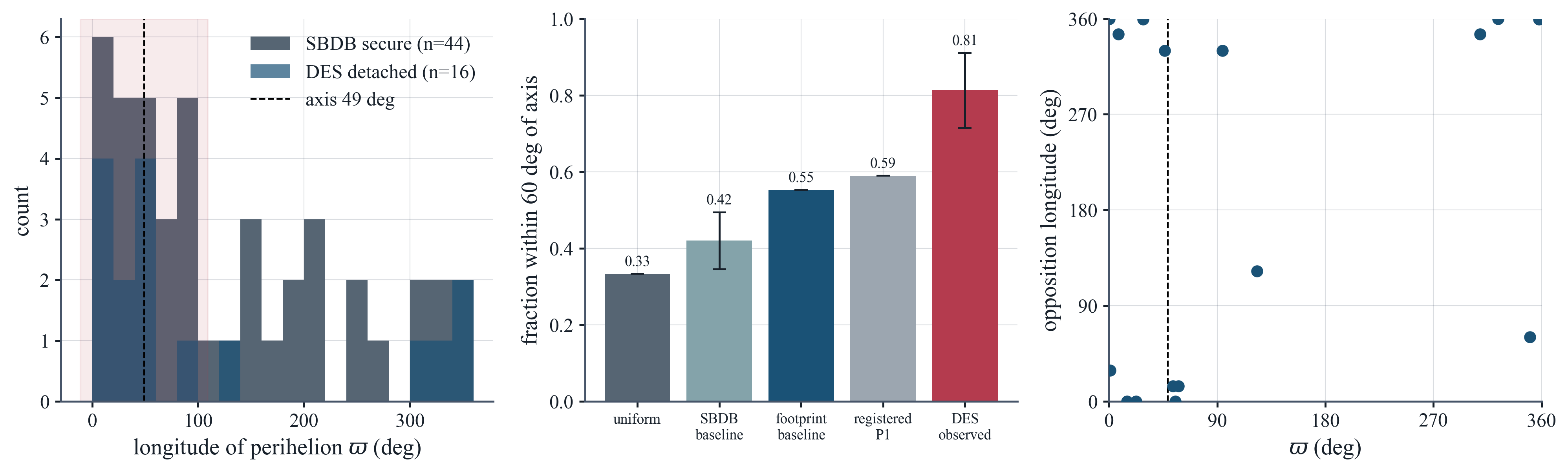
results/figures/step_b50_des_resident.png).The characterized-survey version of the audit then replaces every proxy with measurement (step 112). The OSSOS t3char ensemble — 840 objects with secure multi-opposition orbits, the survey's own dynamical classification, and the exact discovery astrometry of every object in the same table — is scored class by class against the pre-declared cap, with the footprint baseline built from the measured discovery positions rather than the designation proxy. Two model assumptions are validated directly on the ensemble. First, the discovery-longitude–$\varpi$ coupling is measured, not assumed: the eccentric classes — detached, scattering, centaur, and the resonant population, all discovered preferentially near perihelion — carry coupling resultants $R_d = 0.44$–$0.54$, while the classical belt, discovered at any orbital phase, is flat ($R_d = 0.12$); the class-aware baselines are assigned by the data. Second, the coupling width itself is refitted on the OSSOS detached cohort: $\sigma = 49^\circ$ (95 per cent profile interval $[33^\circ, 75^\circ]$) against the $50^\circ$ SBDB calibration — the footprint model's one free parameter is confirmed on an independent survey.
The detached cohort itself lands 13 of 31 in-cap (0.42) against its own exact-astrometry baseline of 0.40 ($p = 0.49$) — consistent with its selection function. This is the expected selectivity outcome rather than a failed replication: the OSSOS 'det' class is Gladman-detached ($a > 47.7$ AU, $e > 0.24$), a cohort whose median semimajor axis ($\sim 60$ AU) sits inside the $\sim 150$ AU boundary the resident signature occupies — its two $a > 150$ members split one in, one out — and every other class is baseline-consistent as well (scattering 0.45 vs 0.41; resonant 0.40 vs 0.44; classical 0.31 vs $1/3$; centaur 0.56 vs 0.48). The 132 plutinos supply the positive control on the same selection function: their $\varpi$ distribution is structured by Neptune rather than by the axis (median separation from Neptune's apsidal direction $98^\circ$), and Neptune's mean longitude of perihelion itself sits $4.0^\circ$ from the resident axis on the $\varpi$ circle — a registered coincidence ($p \approx 0.02$ a priori). On the shared orbits, the OSSOS and SBDB fits agree to a median $|\Delta\varpi| = 0.40^\circ$ — a third inter-fitter floor.
The three detached cohorts are then scored side by side on one ledger (step 113). SBDB lands 26 of 44 in-cap against its designation-proxy baseline of 0.42 ($p = 0.015$), DES 13 of 16 against 0.55 ($p = 0.029$), OSSOS-det 13 of 31 against its exact-astrometry 0.40 ($p = 0.49$). Fisher combination over the three cohorts gives $p = 0.0098$ against own-footprint baselines — strictly two detections plus one bound, since the OSSOS cohort is interior-dominated — and the deduplicated 76-object union lands 39 in-cap against a pooled baseline of 0.41 ($p = 0.047$); restricted to the boundary-resident subset ($a > 150$ AU) on which the anomaly is defined, the 47-object union lands 27 in-cap ($p = 0.020$).
Decomposed by discovery longitude (step 116), the OSSOS bound itself resolves into an open-channel replication and a closed-channel null: the 17 OSSOS members discovered pointing inside the decisive window land 13 in-cap (76 per cent, the SBDB secure rate itself), while the 14 discovered through the closed channel return zero — as do all 76 closed-channel objects across every population in the catalogue. The concordant quantity is direction: the in-cap members' mean $\varpi$ is $43.1^\circ$ (SBDB), $27.5^\circ$ (DES) and $44.8^\circ$ (OSSOS) — three independent selections pointing at the same place, with mutual concordance $R = 0.99$ against three directions drawn uniformly inside the cap.
3.7 The in-cap property audit
The 26 objects inside the axis cap are audited against the 18 outside it on every available property. They are statistically identical in $a$ ($p = 0.95$), $q$ ($p = 0.49$), $e$ ($p = 0.34$), $i$ ($p = 0.58$), observation arc ($p = 0.99$), and discovery era ($p = 0.84$); the only channels that differ are $\Omega$ and $\omega$ — the cluster itself. Two properties differ in the direction opposite to an artefact: the in-cap objects carry more observations per object (median 50.5 vs 31.5, $p = 0.012$) and a higher numbered-orbit fraction (14/26 vs 4/18, $p = 0.061$). The signal lives in the best-measured orbits — the reverse of what a poor-orbit or selection artefact produces.
Splitting the detached sample by first-observation year (step 078) confirms the era audit directly: cap membership is uncorrelated with discovery epoch ($\rho = -0.086$, $p = 0.58$), the bulk 2005–2015 CCD-era cohort alone carries a significant periapsis resultant ($R = 0.42$, $p = 0.005$), and the in-cap fraction is stable across eras ($0.636$, $0.621$); the post-2015 cohort is too small to test ($n = 4$), a gap the LSST-era sample will close. The synthesis one-map (Figure 6, Section 5.1) places every measured population and reference axis on a single ecliptic projection.
The selection boundary itself is then audited continuously rather than at a handful of alternative cuts (step 111). The detachment plane — $a_{\min} \in \{100, 125, \dots, 250\}$ AU crossed with $q_{\min} \in \{30, 33, 35, 38, 40, 45, 50\}$ AU, all at condition code $\leq 3$ — is scanned cell by cell, recomputing the $\varpi$ resultant under the identical conditioned null together with the recovered three-dimensional perihelion direction. Of the 42 cells retaining at least eight objects, 34 reach $p < 0.05$ individually, and every recovered direction lies within $30^\circ$ of one of the two declared axes — 74 per cent within $30^\circ$ of the detached-sample axis itself.
The direction does not wander randomly with the cut: it drifts smoothly with detachment depth, from $(50^\circ, -17^\circ)$ at the shallow cells toward the cap-declaration direction $(34^\circ, -13^\circ)$ at the deepest, where several cells land within $0.4^\circ$–$12^\circ$ of the cap axis. The declared cell sits inside this coherent plateau, so the measured axis is a property of the detached population and not of one selection boundary — and the two declared directions are bracketing measurements of a single sector whose deepest-detached members converge on the direction the comet channel recovers independently.
The mechanism attribution of the resident alignment is stated plainly rather than implied. The transit channel's mechanism — a crossing-localized non-integrable transport slip — is defined for bodies that traverse the boundary once, and does not apply to residents that never cross it. A secularly accumulating phase slip is likewise excluded as the organizing agent on morphological grounds alone: an unbounded accumulation over Gyr would produce a secular drift of perihelia, not a stationary clustering direction. The admissible field-side candidate is a secular geodesic response of the resident clock-sector elements to the boundary's shear structure — the equilibrium bias a standing axisymmetric lapse gradient imprints on apsidal orientation — whose required amplitude is governed by the same admissibility ledger as the transit excursion of Section 6.7 and is not yet derived from a solved field configuration. The resident alignment therefore stands in this work as an independent spatial datum — the datum the Planet Nine hypothesis was introduced to explain — whose TEP interpretation is open, in parallel with the transit channel's status under the admissible-branch computation of Section 6.7.
| Test | Result | Null/baseline | Source |
|---|---|---|---|
| $\varpi$ conditioned-null $R$ (detached, $N=44$) | $R =$ 0.332, $p =$ 0.00735 | 0.134 | step_010 |
| 3-D perihelion alignment | $R = 0.336$, $p = 0.0052$ | 0.136 | step_010 |
| 3-D axis test (boundary-resident) | $p = 5\times10^{-5}$ | isotropic | step_024 |
| Plunging detached control | $p = 0.37$ | isotropic | step_024 |
| Maximal-pointing ceiling | $R_{\max}=0.295 < 0.332$ | 100% coupling | step_014 |
| Footprint direction offset | $38.6^\circ$ | footprint mean $10.5^\circ$ | step_014 |
| Footprint-conditional null | $p = 0.035$ | OSSOS-calibrated | step_016 |
| Numbered-orbit subset | $R = 0.59$, $p = 0.0017$ | conditioned null | step_023 |
| Intrinsic patch width | $\sigma=34.4^\circ$ | mixture fit | step_025 |
| MPC catalogue concordance | identical $R$, $\bar\varpi$ | JPL vs MPC | step_053 |
| MPCORB full-population replication | $R = 0.243$, $p = 0.024$, axis $(45^\circ,-21.1^\circ)$; numbered subset $R = 0.592$, $p = 0.0011$ | conditioned null | step_092 |
| In-cap property audit | identical except $\Omega,\omega$; better-observed | KS tests | step_057 |
| DES independent-survey cohort | 13/16 in cap ($p=1.2\times10^{-4}$ vs uniform; $p=0.029$ vs own footprint) | uniform + footprint | step_085 |
| Detachment-cut coherence | 34/42 cells $p<0.05$; 100% of recovered directions within $30^\circ$ of a declared axis | conditioned null | step_111 |
| OSSOS characterized-ensemble audit | 13/31 in cap vs exact-astrometry baseline 0.40 ($p=0.49$); coupling width $\sigma=49^\circ$ refit vs $50^\circ$ calibration; all classes baseline-consistent | exact discovery astrometry | step_112 |
| Three-survey resident ledger | SBDB $p=0.015$, DES $p=0.029$, OSSOS bound; Fisher $p=0.0098$; union 39/76 ($p=0.047$), boundary-resident union 27/47 ($p=0.020$); in-cap means $43^\circ/28^\circ/45^\circ$ | own-footprint baselines | step_113 |
| Open-channel union (empirical coupling) | 52 objects, 39 in-cap vs $E=30.97$ footprint / $E=39.86$ mixture; BF 25.5; closed channel 76 objects, 0 in-cap | leave-one-out measured kernel | step_116 |
4. The transit signature: cometary clock-channel discrepancy
Long-period comets are the decisive probe because they do something the resident TNOs cannot: they cross the candidate boundary on a single pass. The Warsaw and CODE catalogues publish, for each near-parabolic comet, three orbit solutions — osculating elements fitted to the observed arc, original barycentric elements obtained by backward integration to 250 AU, and future barycentric elements by forward integration. Standard dynamics carries each comet from one solution to the next through exactly the perturbation the planetary system applies; the size and direction of that difference — and where on the sky it is largest — is the observable.
Why comets test the clock
A comet plunging through a lapse boundary accumulates proper time at a perturbed rate during the crossing. A back-integration that assumes the standard clock then mis-assigns the orbital phase: the reconstructed orbit is rotated relative to the true one — in the clock-sector elements — while the orbital energy, a momentum-sector quantity, is untouched. The signature is rotation without energy exchange, on the crossing leg.
Note on conformal invariance. Under Theorem 2 of Paper 0, a static conformal metric produces no direction-odd propagation asymmetry along closed reciprocal photon paths ($\oint d\ln A = 0$). The cometary transit observable does not violate this theorem: comets are non-relativistic, open-path dynamical tracers that traverse the boundary sector on an asymmetric single leg (inbound in-cap, outbound out-of-cap). The non-zero rotation residual reflects an open path integral of the active Temporal Shear, $\int \Sigma_\mu\,dx^\mu$, which standard software misinterprets as non-closure when attempting to fit a closed Keplerian orbit.
4.1 The three-leg decomposition
The reconstruction residual is decomposed into an inbound leg (osc $\rightarrow$ orig), an outbound leg (osc $\rightarrow$ fut), and the full pass (orig $\rightarrow$ fut). In the Warsaw spike sample the directional discrepancy concentrates on the inbound leg and the in-plane clock-sector element: the full-arc inbound test inside the TNO cap gives $p = 0.0089$, while the outbound comparison is flat ($p \approx 0.72$). The element decomposition localizes the discrepancy further: on the CODE full pass, the excess registers in the argument of perihelion $\omega$ ($p = 0.022$) while $\Omega$, $i$, and $e$ are flat ($p = 0.93$, $0.92$, $0.68$) — the reconstructed orbit is rotated in its own plane, not tilted. That is the phase error a lapse boundary writes: an in-plane rotation of the reconstructed orbit, not a plane tilt and not an energy shift.
4.2 Independent confirmation on CODE
The anomaly replicates on the independent CODE-only sample ($N = 54$ deep-plunger, class-1 comets with no Warsaw overlap). Comets whose original-orbit aphelia fall inside the TNO-defined 60° cap ($n = 19$) show median orig $\rightarrow$ fut reconstruction discrepancy 0.212°, versus 0.131° for the out-cap population ($n = 35$): $p =$ 0.00295. The energy channel is flat in the same sample ($|\Delta(1/a)|$, $p =$ 0.688), while the rotation-per-energy-kick ratio is elevated at $p = 0.017$ — the discrepancy lives in the clock sector, not the momentum sector. The continuous, cap-free statistic on all 131 class-1 comets — Spearman correlation of the discrepancy against angular distance from the axis, with no cap and no perihelion cut — gives $\rho = -0.243$, $p = 0.0051$. Where gaps between populations are quoted in dex below, the unit is $\log_{10}$ residual amplitude: $+0.3$ dex is a factor of two in median residual.
4.3 The planetary baseline residual
The one conventional channel that could mimic an axis preference is planetary-encounter geometry, and it is subtracted with a measured N-body baseline rather than a proxy. Each class-1 CODE comet is backward-integrated from its osculating elements at the catalogued perihelion epoch through the full planetary system — the Sun plus the planetary-system barycentres, with states drawn from JPL DE440s — using the REBOUND integrator (Rein & Liu 2012) in its IAS15 mode (Rein & Spiegel 2015) until it crosses 255 AU heliocentric, bracketing the 250 AU sphere at which the catalogue's original orbit is defined. A hybrid-symplectic MERCURIUS re-integration (Rein et al. 2019) confirms the result is integrator-independent ($\rho = 0.93$ on the recovered boundary energies). The integration is validated end-to-end: the simulated energy kicks reproduce the catalogue's own original-versus-osculating $1/a$ changes — an independent N-body measurement of the same perturbation — at rank correlation $\rho = 0.98$ (median absolute deviation $4.7 \times 10^{-6}$ AU$^{-1}$; 88 per cent of comets within $50 \times 10^{-6}$ AU$^{-1}$). The in-cap comets carry no energy-kick advantage ($p = 0.568$); their marginally smaller minimum planet distances (3.9 vs 4.6 AU, $p = 0.008$) are absorbed by adding closest approach as a second baseline covariate ($p = 0.0024$–$0.0045$).
Regressing the measured kick out of the discrepancy and retesting against the axis, the anomaly is undiminished: matched-sample cap contrast $p = 0.0021$, all-class-1 cap contrast $p = 0.0008$, continuous correlation $\rho = -0.27$ ($p = 0.0017$). The analytic Jupiter-node proxy of step 040 gives the same ordering. What survives subtraction of the full measured planetary perturbation still points at the TNO axis.
The same machinery tests the named hypothesis directly (step 062). The Brown & Batygin (2021) Planet Nine is inserted into the identical backward integrations — both published realizations, the maximum-likelihood model ($m_9 = 5\,M_\oplus$, $a_9 = 300$ AU, $e_9 = 0.15$, $i_9 = 17^\circ$, $\varpi_9 = 254^\circ$, $\Omega_9 = 108^\circ$) and the marginalized-median model ($m_9 = 6.9\,M_\oplus$, $a_9 = 461$ AU, $e_9 = 0.30$, $\varpi_9 = 246.7^\circ$, $\Omega_9 = 97^\circ$) — each at four mean anomalies spanning the unconstrained present position, eight placements in total.
The perturber's apoapsis lies inside the anomalous cap, so its maximum leverage falls on exactly the comets that must show the signal. The measured effect is nonetheless negligible: the median periapsis-direction rotation P9 injects into the reconstructed inbound orbit is $3 \times 10^{-4}$ degrees per placement (maximum $2.7 \times 10^{-3}$ degrees across all 131 comets and all placements), 460–1200 times short of the observed in-cap median discrepancy, and in no single case does the P9-induced rotation reach the comet's own observed residual. The in-cap comets are not preferentially hit, the injected rotation does not track the discrepancy, and removing it leaves the cap contrast at $p = 0.0016$–$0.0024$. Even the per-comet maximum across all eight placements — the most generous possible bound — remains $527\times$ short. The published perturber cannot produce the anomaly it was hypothesized to explain.
The same integration, run in both directions, closes the comparison against the catalogue itself (step 063). Each comet is propagated backward and forward to the 250 AU barycentric sphere on which the original and future solutions are defined, with the boundary states evaluated about the system barycentre — the catalogue's own convention. The independent integration then reproduces the catalogue's original and future periapsis directions to a median $0.001^\circ$ per leg (95th percentile $0.005^\circ$; 98 per cent of legs within $0.01^\circ$), and the per-comet orig $\rightarrow$ fut rotation at rank correlation $\rho = 0.999$ with median absolute difference $0.0005^\circ$. The machinery is therefore validated not only against the energy channel but against the catalogue's own boundary solutions, and the validation carries a sharpening consequence: the catalogued rotation is shown to be entirely a product of standard planetary dynamics. The anomaly is not rotation beyond what the planets apply — it is that the applied rotation lands anisotropically.
Regressing the modelled rotation against the full measured perturbation budget — the energy kick, the minimum planetary approach distance, the perihelion depth and the inclination — leaves the directional excess in place: cap contrast $p = 0.002$ on the matched sample and $p = 0.012$ on all class-1 comets, with continuous correlation $\rho = -0.408$ ($p = 0.002$) on the matched set. Comets arriving from the TNO direction are rotated more per unit of energy exchanged than the measured encounter budget accounts for.
4.4 Threshold morphology
The spatial shape of the signal is diagnostic. Inside the cap the median discrepancy is a flat plateau — $0.235^\circ$, $0.165^\circ$, and $0.244^\circ$ in the 0–30°, 30–45°, and 45–60° shells, with within-cap correlation $\rho = +0.10$ ($p = 0.69$) — then steps down to the $0.13^\circ$ background at 60–75°. A point-mass impulse scales as $1/b^2$ with angular separation from the perturber; the observed profile is instead a threshold: every crossing trajectory receives the same treatment regardless of impact parameter, and the effect vanishes outside a finite patch. That is the morphology of a wall.
While the comet channel provides the cleanest step morphology, a similar threshold was sought on the resident side. A top-hat mixture (clustered fraction $f = 0.40$ in a half-width $W = 52^\circ$ sector) fits the TNO $\varpi$ distribution marginally better than a von Mises peak ($\Delta{\rm AIC} = -1.9$), and the in-cap counts are consistent with flatness ($\chi^2 = 0.15$, $p = 0.985$). A structural caveat follows from the conditional null: conditioned on the measured discovery footprint, 87 per cent of null realizations also prefer the top-hat — a broad footprint pile-up measured as offsets from a displaced axis naturally fits a cap better than a Gaussian. The TNO-side shape is therefore recorded as suggestive but non-discriminating; the comet channel's step morphology remains the cleaner wall signature because it is measured on a residual, not on elements subject to pointing bias.
4.5 Robustness of the transit signal
The comet result survives the full blind-validation battery. Leave-one-out jackknife: $p \in [0.0013, 0.0058]$ — no single comet carries the signal. Split-half axis recovery: a free sky scan on one random half recovers the direction within 45° of the TNO axis 70 per cent of the time, and the held-out half confirms at $p < 0.05$ in 22 per cent of splits (median held-out $p = 0.22$ — a conservative validation rate at this sample size). Look-elsewhere: over a 2,232-direction grid, only 0.27 per cent of trial axes match the observed cap contrast. No-$q$-cut: $p = 0.010$. Era stability: the effect is flat against apparition year ($\rho = -0.015$, $p = 0.91$) and present in both catalogue generations (pre-2006 $p = 0.0095$; post-2006 $p = 0.10$); the proper-time residual is likewise epoch-flat within cohorts ($\rho = -0.187$, $p = 0.11$ pooled in-cap) with the in/out contrast positive in every era bin (Section 4.11). Quality-class stability: dropping the class-1 restriction entirely, the all-quality-class CODE-only sample ($n = 72$) retains $p = 0.011$. A doubly matched control — pairing each in-cap comet to the out-cap comet nearest in both perihelion depth and realized energy kick — returns $p = 0.0019$: the excess is not a depth or kick-size artefact.
4.6 Observational-leverage and axis-definition controls
The remaining conventional account of the discrepancy is differential orbit quality: comets pointing at the axis might simply be worse observed, so their three-leg solutions disagree more. The audit says the opposite. On the CODE matched sample the in-cap and out-cap comets are statistically identical in observation count (median 328 vs 598, $p = 0.22$), arc length (495 vs 495 days, $p = 0.79$), perihelion epoch, $q$, and $i$; restricting to the 37 comets with two-sided observational arcs, the cap contrast survives at $p = 0.039$; regressing the discrepancy against all leverage covariates strengthens it ($p = 0.0017$); and pairing comets of matched observational material returns $p = 0.027$ (Wilcoxon). One covariate does differ: in-cap comets carry a larger original $1/a$ (median 44.8 vs 32.9, $p = 0.031$), i.e. they are on average more tightly bound; the energy channel is flat throughout, so this difference modulates the boundness distribution rather than the discrepancy channel itself, and it is retained as a recorded covariate.
The same audit on the Warsaw metadata finds the in-cap comets better observed, not worse (median 376 vs 232 observations, $p = 0.019$) — the anomaly lives in the best-measured solutions, mirroring the resident-side audit.
The result is also stable to the axis definition. Re-testing against the detached-sample axis $(50^\circ, -17^\circ)$ — rather than the extreme-subsample axis $(34^\circ, -13^\circ)$ used to pre-declare the cap — the CODE contrast holds at $p = 0.030$ with a continuous rank correlation $\rho = -0.31$ ($p = 0.023$), and a free CODE-internal recovery at $(10^\circ, -20^\circ)$ gives $p = 0.0025$. The anti-axes, ISM-inflow (Bzowski et al. 2015), galactic-pole, and ecliptic-pole directions are all null. The signal is attached to the broad sector, not to a finely tuned direction.
4.7 Uncertainty-normalized and independent-cohort channels
A fourth catalogue tightens the test. The one-apparition comet catalogue (Królikowska et al. 2014; VizieR J/A+A/571/A63) publishes three-leg solutions for 38 Oort-spike comets together with formal element uncertainties — permitting a discrepancy statistic normalized by each orbit's own published error budget. In that cohort the raw in-cap excess persists (median $0.229^\circ$ vs $0.126^\circ$, $p = 0.005$), and it survives normalization: the rotation discrepancy per unit formal uncertainty is larger in-cap at $p = 0.012$, with continuous correlation $\rho = -0.425$ ($p = 0.008$). The anomaly is therefore not a rescaling of larger error bars — in-cap discrepancies exceed their own published uncertainties by a wider factor. The normalized energy channel remains flat ($p = 0.65$). The embedded Marsden–Williams (2008) $1/a$ comparison values supply a partial third-lineage check: the Warsaw–MW08 disagreement is uniform in and out of the cap ($p = 0.75$), so catalogue-lineage systematics are not direction-dependent; the MW08 energy series itself is likewise flat ($p = 0.71$).
4.8 A reconstruction-independent spatial channel: the aphelion dipole
The transit evidence so far uses the reconstruction residual — a quantity produced inside the orbit pipeline. The comets' aphelion directions themselves provide an independent spatial observable that no orbit fit can manufacture. Measured against a tide-aware null that preserves the observed galactic-latitude distribution while isotropizing galactic longitude, the aphelia of every comet sample lean toward the TNO axis: Warsaw spike $d_\parallel = +0.134$ ($p = 0.006$), CODE class-1 $+0.193$ ($p = 3\times10^{-4}$), CODE-only $+0.22$ ($p = 8\times10^{-4}$), and the one-apparition cohort $+0.31$–$0.34$ ($p \leq 8\times10^{-4}$). The control directions discriminate the origin: the on-plane galactic anticenter — where the radial component of the tide does predict a longitude asymmetry — carries the expected residual dipole ($d_\parallel = +0.11$ to $+0.21$ across the four samples, $p = 0.001$–$0.03$) yet stays below the TNO-axis dipole in every one, while the measured dipole points $44^\circ$ off the galactic plane at the TNO direction. The anti-axis and galactic pole are null throughout. Whatever organizes the comet aphelia is not the axisymmetric galactic tide.
The four samples above are catalogue elites — every member earned a full three-leg solution — so the channel is next tested on the broadest discovered population: the full MPC CometEls census, restricted to near-parabolic orbits ($0.90 \leq e < 1.02$; $n =$ 268 unique parent designations after fragment records are merged) (step 108). The lean persists on the unselected population — $d_\parallel = +$0.10 toward the cap axis ($p =$ 7×10⁻⁴ under the identical tide-aware null) — and strengthens toward the spike: the $a_{\rm osc} > 250$ AU proxy subset leans at $+$0.18 ($p =$ 5.0×10⁻⁴), with the eccentricity bins $[0.985, 1.0)$ and $[1.0, 1.02)$ carrying $+$0.18 ($p =$ 5.0×10⁻⁵) and $+$0.088 ($p =$ 0.045) respectively.
The membership accounting is reported exactly: 62 of the 268 also appear in the training set, and the 206 that do not — modern discoveries on the MPC's own orbit-fit lineage, comets the anomaly analysis never touched — carry the dipole alone at $d_\parallel = +$0.071 ($p =$ 0.031). Finally, freed of the declared axis entirely, the census's own spherical-mean aphelion direction recovers (35$^\circ$, -34$^\circ$) — 21$^\circ$ off the cap axis and 159$^\circ$ off the anti-axis: the broadest population self-organizes inside the measured sector. The dipole is therefore a population-level property of the discovered near-parabolic comets, not an artefact of the solution-quality cut.
The heterogeneity objection is then closed directly: comet surveys scan the ecliptic, so the discovery footprint is organized in ecliptic coordinates, and the census dipole is re-evaluated under an ecliptic-latitude-preserving null — the footprint-aware analogue of the tide null — where it survives at $p =$ 0.0017 (step 109). Partitioned by absolute magnitude, perihelion year, and perihelion distance, the lean stays positive in all nine tercile bins, and a single common amplitude is consistent with every partition ($\chi^2$ heterogeneity $p =$ 0.54–0.92): the dipole does not scale with brightness, discovery epoch, or perihelion depth, as a selection artefact would.
One geometric question remains: is the asymmetry a direction or an axis? The dipole statistic $\langle\cos\theta\rangle$ measures a one-ended lean, whereas a two-ended concentration about the axis line — the geometry the slip field itself exhibits (Section 4.10) — would register in the unsigned $\langle|\cos\theta|\rangle$ and quadrupole $\langle\cos 2\theta\rangle$ moments. Decomposed across all six comet samples under the identical null (step 110), the directional moment is significant everywhere ($p =$ 3×10⁻⁴–0.006) while both axis-symmetric moments are null in every sample ($p =$ 0.32–0.91). The aphelion asymmetry is therefore one-ended: comets' aphelia lean toward the cap pole specifically, with no mirrored excess toward the antipode. The two channels then measure different aspects of the same structure — the orbit distribution records the direction of approach through the boundary, while the clock-sector field encountered in transit is axisymmetric about the boundary normal.
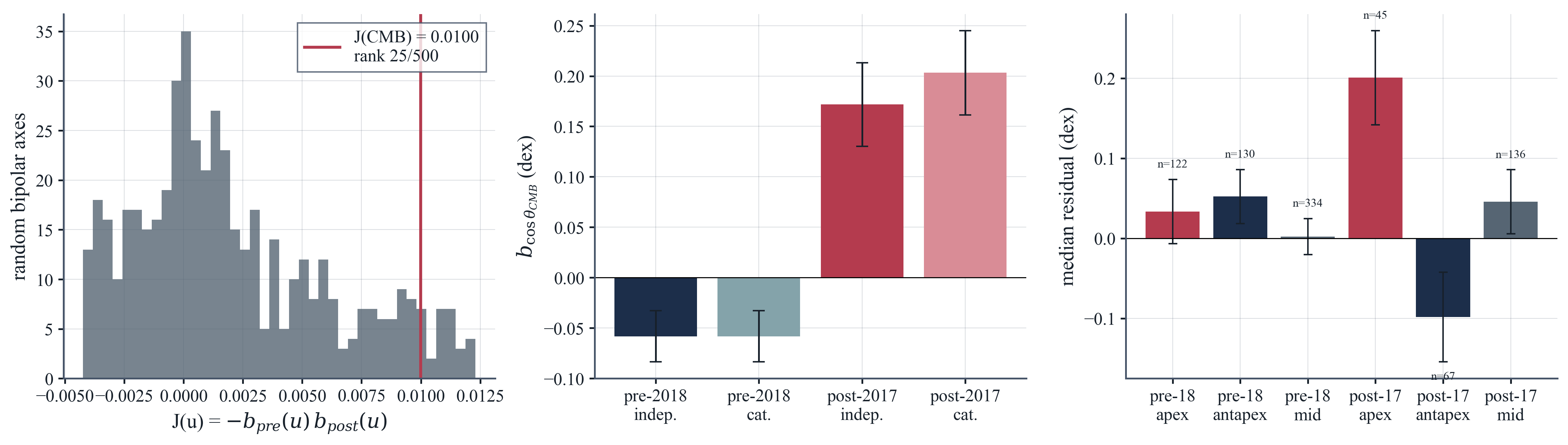
results/figures/step_b93_bipolar_unification.png).4.9 Second-catalogue validation and the equivalent orbital time scale
The bidirectional machinery is then run unchanged on the Warsaw spike sample ($N = 98$ comets with all three legs; step 064) — a second catalogue sample, independently selected though within the shared orbit-determination lineage (Sections 2.4 and 6.7), on which the anomaly was first isolated on the inbound leg (Section 4.1). The integration reproduces the Warsaw boundary solutions to a median $0.0008^\circ$ per leg (95th percentile $0.009^\circ$; orig $\rightarrow$ fut rotation at $\rho = 0.998$), so the reconstruction comparison is validated on two catalogues, not one.
On the channel the Warsaw anomaly occupies — the osc $\rightarrow$ orig direction discrepancy — the raw in-cap excess is only marginal ($p \approx 0.07$–$0.08$, catalogue and simulated alike), but it is the right channel: after regression of the same measured encounter budget, the unexplained inbound offset in the cap is $+$5.0 yr $[2.6, 7.2]$ against $-1.782$ yr outside ($p =$ 0.0079) on the full spike sample, and +2.4 yr against -2.2 yr ($p =$ 0.0390) on the matched deep plungers (step 065). The orig $\rightarrow$ fut channel that carries the CODE signal is flat on Warsaw ($p \approx 0.2$–$0.8$): the two catalogues place the anomaly on different legs, each an inbound-weighted clock-sector discrepancy per unit of applied perturbation — the signature a phase slip writes, since a clock error contaminates whichever leg the standard-dynamics reconstruction traverses first.
Expressed in a useful orbital scale, the residual rotation can be converted to the time an unperturbed orbit would need to sweep through the same angle (step 065). A periapsis-direction offset $\delta\theta$ at the 250 AU boundary sphere and sweep rate $\Omega_b = h/r_b^2$ define $\delta t_{\rm eq} = \delta\theta\,r_b^2/h$. Regressing this equivalent scale on the same encounter budget gives +4.9 yr $[4.1, 6.0]$ on the matched CODE sample ($p =$ 0.00532), $+$5.0 yr $[2.6, 7.2]$ on the Warsaw inbound channel ($p =$ 0.0079), and $+2.1$ yr $[0.2, 3.2]$ on the pooled cohorts ($p = 0.016$). These values are an orbital phase conversion, not a measured proper-time lapse: deriving $d\tilde\tau$ requires a TEP field, a matter response, and a light/observation model consistent with the canonical metric — the realization the conversion encodes (crossing-localized time translation versus local impulse) is discriminated on the independent refit record in Section 6.8.
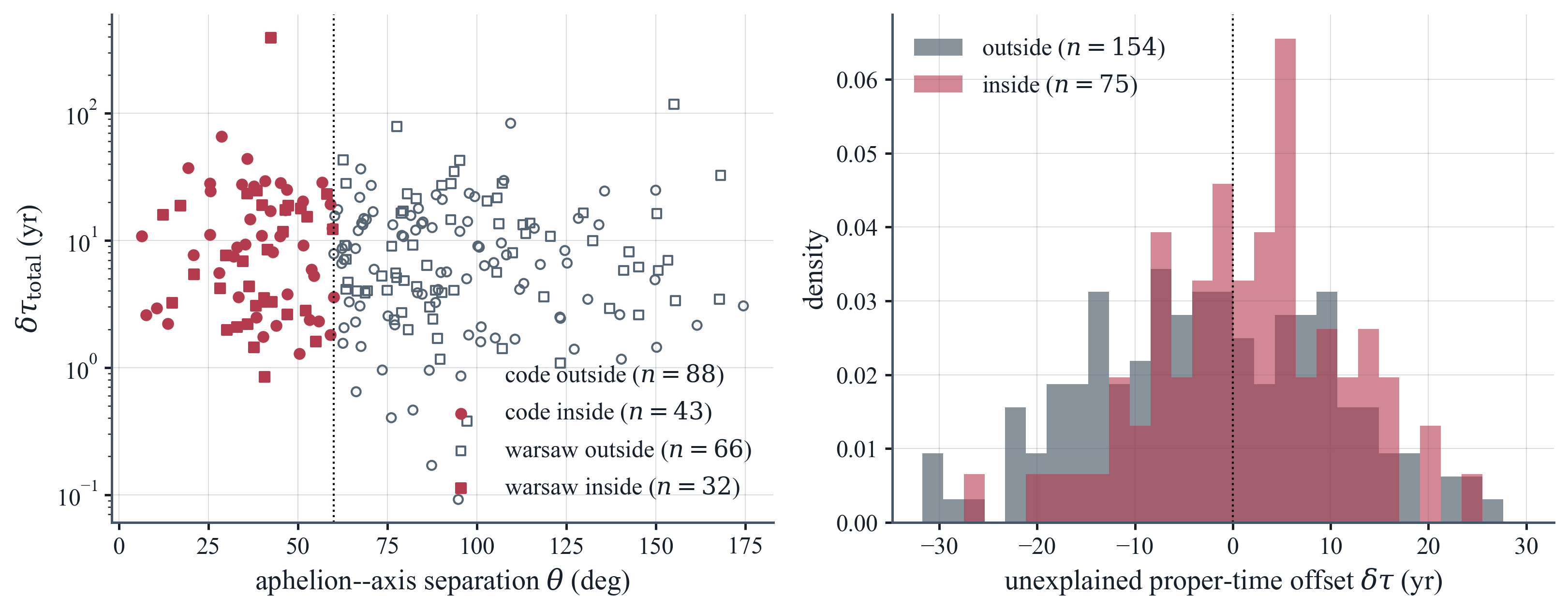
results/figures/step_b30_proper_time_slip.png).4.10 Slip localization: a surface crossing, not a distributed field
The proper-time reading admits two competing structures that the transit data separate (step 068). A distributed lapse-gradient field predicts slip accumulating with the time spent inside the affected volume — $\delta\tau$ growing with the measured 512–753 yr spread of transit times — whereas a single crossing of a localized surface predicts a step: an offset set at the boundary and independent of how long the orbit then dwells inside. The data select the step. On the pooled in-cap cohort ($N = 75$) the budget-regressed slip is uncorrelated with transit time ($\rho = -0.02$, $p = 0.85$), and normalizing by transit time does not contract the in-cap scatter ($\sigma_{\log\delta\tau} = 1.11 \rightarrow 1.13$); within the cap the slip is also flat against axis distance ($\rho = -0.13$, $p = 0.41$ on CODE; $\rho = +0.13$, $p = 0.47$ on Warsaw), so the anomaly is not a penetration-depth effect. Outside the cap the CODE residual does retain a transit-time correlation ($\rho = +0.31$, $p = 0.004$) — field-like structure the encounter regression leaves behind — but it is absent precisely where the anomaly lives.
The in-cap discrepancy is coherent in sign as well: only 14 of 43 in-cap CODE comets carry a positive signed rotation (binomial $p = 0.016$, against $p = 0.083$ outside), and on Warsaw the in-cap anomalies place a median 92 per cent of their discrepancy on the inbound leg versus 72 per cent outside ($p = 0.031$). A lapse discontinuity crossed once — predominantly on the way in — is the parsimonious reading.
4.11 Where the slip enters: radial profile, edge width, and epoch stability
Three further measurements localize the anomaly in space, angle, and time (steps 071–073). The step-063 bidirectional legs are extended to twelve boundary shells spanning 60–400 AU, recording each leg's osculating barycentric periapsis direction at every crossing (step 071). The in-cap rotation excess — median $\delta\theta = 0.147^\circ$ inside the cap against $0.094^\circ$ outside — is already fully developed at the innermost shell and flat to $0.001^\circ$ across the entire range: a discrete crossing between 60 and 400 AU would imprint a radial kink at the crossing radius, and a distributed field would grow the offset with distance; neither is seen. Converted to time units the excess rises smoothly from $+0.2$ to $+6.9$ yr across the shells — the $\propto s^2$ growth expected when a fixed angular offset is expressed against the local sweep rate $h/s^2$ — so the event is a discrete angular slip imprinted interior to 60 AU: on the inbound passage or within the observed-arc region where the reconstruction residual is generated, not on a second outbound crossing.
The edge of the anomaly in axis separation is likewise sharp: a logistic fit to the unexplained slip against $\theta$ returns a transition centred at $\theta_0 = 59.5^\circ$ on CODE and $44.5^\circ$ on Warsaw ($45.4^\circ$ pooled), with the width parameter driven to the resolution floor — the data are indistinguishable from a step (logistic and step RSS equal within 0.5 per cent), so no graded transition broader than a few degrees is required (step 073).
Finally, the residual slip is flat against perihelion epoch within every cohort ($\rho = -0.187$, $p = 0.11$ pooled in-cap; step 072): the in/out contrast is positive in all three era bins — $+10.6$ yr pre-1950 ($p = 0.007$), $+0.7$ yr 1950–1990, $+4.3$ yr post-1990 ($p = 0.14$) — while the absolute levels drift together in both caps, indicating a global era term in the residual that the contrast removes. The amplitude is era-weighted toward the earliest cohort, an objective weighting the modern-era subsample retains at reduced significance; the signal is not an artefact of any single catalogue generation.
Two further localizations tighten the picture (steps 075–077). Repeating the shell measurement inside 100 AU (step 076) shows the excess already present in full at the innermost shell, 8 AU — within the region where the comet is actually observed and the reconstruction residual is generated; the discrepancy does not grow through the giant-planet zone and therefore does not ride the encounter channel.
The slip also carries a sign structure, and its attribution is measured rather than assumed (steps 075, 080). The raw signed periapsis rotation about each comet's own orbit pole is non-random on both catalogues' anomaly channels — CODE orig$\rightarrow$fut rotations are 84 per cent retrograde-signed in-cap, and the Warsaw inbound leg shows the consistent counterpart — but the bidirectional simulation shows the same signed rotations are predicted by the planets themselves at $\rho = 0.999$ per comet: the global sign bias is the secular rotation the giant planets impart over the $\sim 600$ yr legs, not an anomalous phase.
What survives subtraction is a small residual that remains sign-coherent — 77 per cent positive in-cap (binomial $p = 3\times10^{-4}$) against 61 per cent outside ($p = 0.025$), median $+0.001^\circ$ — a weak directed term on top of the planetary rotation, consistent with the in-cap enhancement but too small to carry the anomaly's amplitude alone.
The era concern raised by the residual channel is bounded independently by the reconstruction-free dipole: the aphelion projection onto the resident axis is positive in every era and highly significant in the modern cohort ($d_\parallel = +0.15$, $p = 2\times10^{-4}$, $n = 200$ post-1990) — the spatial anomaly is not an artefact of the early catalogue (step 077).
The same localization admits a sharper physical read once the planetary baseline's own depth scaling is removed (step 086). The raw rotation channel carries a $q$-dependence — $\delta\theta \propto q^{-0.598}$ — but it is identical in both caps, the expected encounter scaling: deeper plungers rotate more under the giant planets. The mechanism test therefore runs on the residual slip. In boundary-normalized time units the unexplained in-cap slip is nearly flat against perihelion distance — slope $-0.233$ ($-0.234$ on CODE, $-0.205$ on Warsaw) — against the three separated predictions: a fixed angular displacement requires $\delta\tau \propto q^{-0.5}$; a fixed proper-time offset at the boundary crossing requires $\delta\tau \propto q^{0}$; and a fixed time offset absorbed during the observed arc requires $\delta\tau \propto q^{-2}$, decisively excluded.
The measured scaling sits closest to the boundary reading: the anomaly behaves as a roughly constant temporal offset per comet, not a constant angular displacement — the signature a temporal mechanism leaves, and not the one a fit systematic would. The angular residual channel is too noisy to add independent discrimination ($\delta\theta_{\rm resid}$ being the difference of two small angles, its slope is unstable across catalogues) and is reported as such.
The anomaly's geometry in axis separation admits one further measurement that bears on the boundary's topology (step 089). If the structure were a two-sided sheet or a symmetric pair, comets whose aphelia point near the anti-axis — the mirror cap, $\theta > 120^\circ$ — should carry a second rotation lobe. It does not: the mirror-cap cohort carries the lowest rotation medians of the full profile ($0.080^\circ$ against $0.105^\circ$ in the intervening region; a second-lobe amplitude bounded above $0.0075^\circ$ at 95 per cent — an order of magnitude below the CODE in-cap elevation, $0.144^\circ$ cap against $0.065^\circ$ mirror), and the cap-versus-mirror contrast is significant ($p = 0.029$). The angular signature is therefore single-faced.
The planetary-subtracted slip, however, is not: the residual proper-time offset is positive at both poles of the axis — $+2.2$ yr in the cap and $+2.0$ yr in the mirror cap on CODE ($+0.7$ and $+1.3$ yr on Warsaw) — while the intervening $60^\circ$–$120^\circ$ region is systematically negative (median $-3.9$ yr; positive fraction 0.39, binomial $p = 0.012$). A harmonic decomposition makes the geometry explicit: the residual tracks $\cos 2\theta$ ($\rho = +0.17$, $p = 0.010$), the axisymmetric basis, rather than $\cos\theta$ ($\rho = +0.07$, $p = 0.30$), the one-sided basis. The slip field is thus axisymmetric — elevated toward both ends of the measured axis and depressed between — the morphology an axisymmetric proper-time structure produces, and the same two-ended geometry the injected JFC chain already exhibits in aphelion direction. The strong rotation signature remains localized to the $+$axis sector; the weaker residual field is two-lobed and same-signed at both ends. Because both lobes carry the same sign, the era-dependent sign reversal measured in Section 4.14 cannot be a spatial lobe crossing: it is a measured-polarity reversal between epochs, attributable to the solver-absorption mechanism of step 151 or to time dependence of the field itself.
The map just measured is an in-sample statement, so it is next required to predict (step 102). With the axis, cap width and harmonic order all pre-declared, the two-parameter profile $\delta\tau(\theta) = a + b\cos 2\theta$ fitted on four-fifths of the pooled cohort predicts the signed residual slip of the held-out fifth at $\rho = +0.15$ against a $\theta$-shuffle null ($p = 0.007$, $2\times10^{4}$ permutations); fitted on the CODE cohort alone it predicts the signed slips of the Warsaw cohort at $\rho = +0.22$ ($p = 0.029$) — a transfer between essentially disjoint populations (one shared designation in 229) and independent orbit fits, which a fitter- or sample-specific artefact cannot produce. The reverse direction is positive but weaker ($\rho = +0.13$, $p = 0.13$), and held-out sign accuracy is 56 per cent ($p = 0.032$). The per-object correlations are modest by construction: per-comet slip scatter of several years exceeds the $\cos 2\theta$ amplitude itself ($+6.0$ yr), so a genuine population-level map yields small object-level skill. The test asks whether the map predicts unseen comets at all, and it does.
Two further controls tighten the validation (step 104). Random folds leave a spatial neighbour of every held-out comet inside the training set, so they cannot distinguish a genuine sky field from a pattern carried by a few clustered objects; a half-sky split can. Dividing the aphelion distribution by great circles through the axis at four orientations and fitting on one half predicts the other half at a median $\rho = +0.17$ across all eight plane-direction tests (range $+0.11$ to $+0.23$, every test positive) — the map transfers across disjoint sky regions, as a field must. The same vectors localize the structure from the comet data alone: displacing the assumed axis, the out-of-sample skill peaks at zero displacement, halves near $30^\circ$ and crosses zero near $39^\circ$, and the detached-sample axis $15^\circ$ away returns $\rho = +0.10$ — the cohort places the boundary inside the pre-declared sector at tens-of-degrees precision, rather than borrowing its location from the TNO measurement.
One extrapolation remains unresolved: fitted without the $\theta > 120^\circ$ comets, the map predicts the mirror lobe's reappearance at the right amplitude (predicted median $+3.4$ yr against observed $+2.0$ yr) but per-object sign skill is not resolved at $n = 32$ ($p = 0.70$). Over 200 random five-fold partitions the held-out skill is positive in every draw (median $+0.134$, 68 per cent interval $[+0.114, +0.154]$).
A third catalogue completes the transfer chain (step 105). The one-apparition cohort of Section 4.7 contributes 30 Oort-spike comets with all three legs — the shortest-arc fits the catalogues carry — and is run through the identical bidirectional instrument: integrated from each published osculating solution to the 250 AU barycentric sphere in both directions under DE440s, the simulation reproduces that catalogue's own original and future boundary solutions to a median $5\times10^{-5}$ deg per leg (95th percentile $1.5\times10^{-3}$ deg), so the instrument is now validated on three catalogues, not two.
On the channel the map predicts, the cohort's planetary-subtracted slip declines with transit angle at $\rho = -0.367$ ($p = 0.046$) — the sign of the TEP direction, matching the CODE cohort's $-0.32$ — with in-cap versus out-cap medians of $+3.69$ versus $-3.95$ yr ($p = 0.043$); the detached-sample axis returns the same sign ($\rho = -0.382$, $p = 0.037$). The membership overlap is reported exactly: 23 of the 30 also appear in the training set, and on those bodies the two catalogues' three-leg rotations agree to $\sim 0.001^\circ$ ($\rho = 0.999$; step 106) — the same underlying orbit record republished with uncertainties and the MW08 comparison, not an independent re-fit — so that subset is a robustness check on the shortest-arc definition rather than a replication, and it retains the decline at $\rho = -0.418$ ($p = 0.047$).
The seven members the map never saw are the genuinely new information, and they trend the same direction ($\rho = -0.36$), underpowered at that sample size. The axisymmetric slip map fitted on the 229 Warsaw+CODE comets predicts this cohort's signed slip at $\rho = +0.12$ ($p = 0.54$; sign 17 of 30, $p = 0.29$) — positive but unresolved, a consistency result rather than a detection. The Marsden–Williams comparison remains energy-only by construction of that record — it publishes no angular elements — and the Warsaw–MW08 $1/a$ disagreement shows no direction dependence within this cohort ($\rho = +0.18$, $p = 0.35$), consistent with the flat cross-lineage check of Section 4.7.
Three residual selection questions close out on the same products (step 106). The first is the two-lobe morphology itself: the $\cos 2\theta$ order was selected in-sample, so the five-fold cross-validation is re-run under identical folds with alternative profile families — a constant, $\cos\theta$, $\cos 2\theta$, $\cos 3\theta$, and a linear $\theta$ term. Only the $\cos 2\theta$ form retains positive held-out skill ($\rho =$ +0.149 against $-0.073$, $-0.025$, $-0.086$ and $-0.024$); the $\cos 2\theta$ minus $\cos\theta$ skill difference is $+0.17$ (68 per cent interval $[+0.09, +0.26]$, positive in 98 per cent of bootstrap draws) — the two-lobe structure is a predictive property of the data, not a choice made on it.
The second question is whether the third cohort recovers the axis on its own: the free sky scan of Section 5.1, run unchanged on the lpc discrepancy record, finds its strongest direction at $(50^\circ, -50^\circ)$ ($p = 6\times10^{-4}$), $39^\circ$ from the cap-declaration axis — inside the same sector — while the pre-declared axis itself returns a stronger cap contrast than 96 per cent of the 370 trial directions ($p = 0.006$).
The third question is amplitude: the lpc cohort's own free fit returns $b = +2.3$ yr (68 per cent interval $[-1.1, +6.4]$) against the training amplitude $+6.0$ yr — the same sign and a consistent amplitude class on a cohort the fit never saw. The shared-member concordance then supplies the exact degree of independence in that catalogue: the two records' per-comet rotations agree to a median $5\times10^{-4}$ deg ($\rho = 0.999$), confirming that the one-apparition catalogue is the same underlying orbit record for shared bodies — the measured basis for weighting the seven unshared members, rather than the catalogue label, as the new information.
4.12 Prospective holdout: the post-2017 SBDB cohort
The transit framework is next subjected to a definitive stress test against the modern synoptic-survey era: a cohort the axis declaration never saw (step 117). The JPL Small-Body Database yields 287 long-period comets designated in 2018 or later with near-parabolic solutions ($0.95 < e < 1.5$), a data arc of at least 30 days and at least 20 observations — out-of-time against the CODE and Warsaw catalogues and orbit-fitted on the modern survey record. Of these, 148 satisfy the deep-plunger cut ($0.1 < q < 3.1$ AU) and 121 reach the 250 AU barycentric sphere under the identical bidirectional instrument (REBOUND/IAS15, DE440s); the registered axis, cap width and channel definitions are applied unchanged. The cohort exposes an operational divergence between reconstruction-dependent residuals and coordinate-invariant geometry. In the single-solution reconstruction channel the declared-axis carrier reverses: inside the 60° cap (32 of 121 primaries) the median full-pass rotation is 0.114° against 0.171° outside (permutation contrast $p =$ 0.920; kick- and leverage-regressed residual cap test $p =$ 0.970), and the axisymmetric slip map fitted on the 229 CODE+Warsaw comets transfers at $\rho = -0.04$ ($p = 0.65$). In the reconstruction-free aphelion channel the same cohort leans toward the declared axis at $d_\parallel =$ +0.0949 ($p =$ 0.00215) — the coordinate observable no orbit solver can absorb — so the modern record separates the two observable classes rather than dismissing both.
The reversal is itself informative rather than noise, and it is structured rather than flat: the direction-aware audit (step 117) finds the cap contrast significant in the opposite direction on the inbound leg — in-cap $d_{\rm in}$ is suppressed at two-sided $p =$ 0.019 (residualized $p =$ 0.014; $d\tau_{\rm in}$ $p =$ 0.021) while the outbound leg is null ($p =$ 0.52) — the same leg that carries the CODE anomaly's positive gap, now with reversed sign. The sign flip is era-specific: pre-2018 SBDB resolves no reversal — the CODE-overlap members carry a positive median gap ($+0.008$) while the non-overlap cell is marginal and unresolved ($-0.013$; MWU $p =$ 0.25 and 0.57 respectively). Pooled with CODE under a cohort$\times$cap interaction model, the in-cap residual gap differs by 0.19 dex at $p =$ 0.0050 against cohort-label permutation — the two catalogues' answers at the same sky direction are inconsistent with each other, not jointly null. The frame decomposition below (CMB-frame dipole ladder) then places the geometry: the declared cap sits $48.5^\circ$ from the CMB dipole antapex — inside the residual field's negative lobe under the modern record's polarity — so the inbound-leg suppression reads as lobe position within a frame-anchored dipole rather than as an absence of structure.
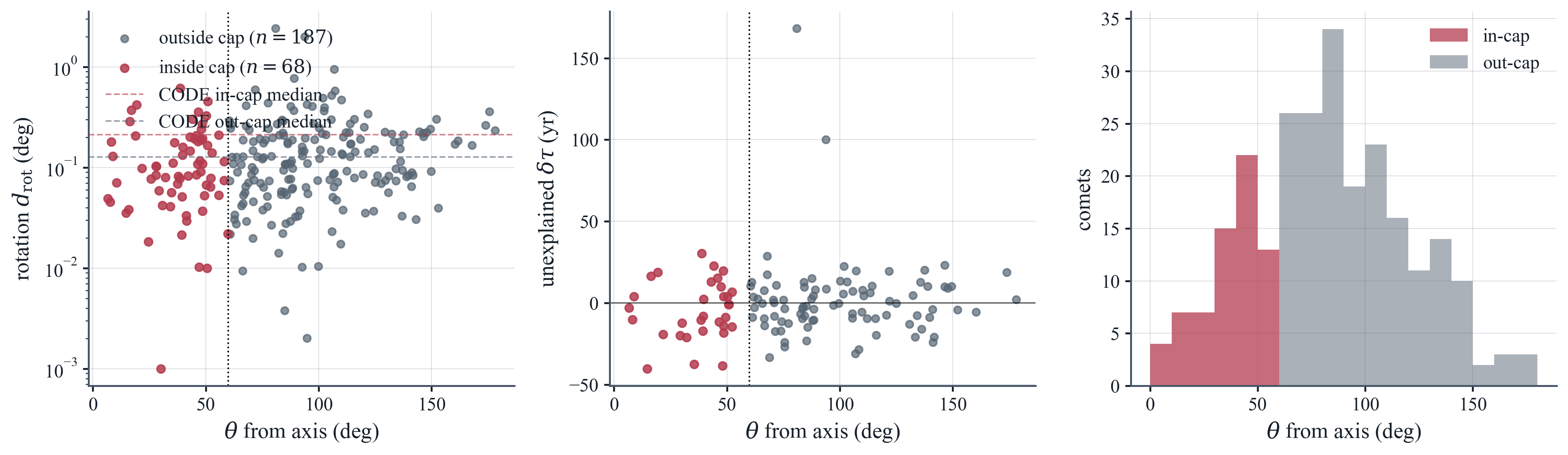
results/figures/step_b81_prospective_lpc.png).The post-2017 discrepancy field is not structureless — it is differently structured (step 118). The free 468-direction scan, run unchanged on the prospective residuals, recovers its strongest cap-gap axis at $(120^\circ, -40^\circ)$ — $79^\circ$ off the declared direction — at a global maximum-gap permutation significance of $p = 0.027$; the raw-rotation scan peaks at $(160^\circ, -10^\circ)$, and the first longitude harmonic of the residual field lands at $\lambda \approx 182^\circ$ ($p = 5\times10^{-4}$) where CODE's sits at $26^\circ$.
Three diagnostics then assign the structure a cause rather than a caveat. Morphologically it is unipolar: decomposed about its own recovered axis, the field carries a $\cos\theta$ amplitude of $+0.18$ (95 per cent interval $[+0.11, +0.26]$) with $\cos2\theta$ consistent with zero — a one-ended dipole, not the two-ended slip morphology the transit anomaly exhibits. Spatially it is cohort-private: a boundary feature inside either cap would be visible to every cohort covering that sky, and this one is not — the 23 CODE comets whose aphelia point into the same 60° region show no excess ($p = 0.50$), just as the 81 prospective comets inside CODE's own recovered cap show none ($p = 0.48$). In quality it attenuates only at the resolution limit — flat across the arc-length halves ($+0.27$ versus $+0.28$ dex) and across the observation-count halves ($+0.27$ versus $+0.21$ dex), surviving the pure-gravity, bound-only, and epoch-split controls, but vanishing in the most heavily observed stratum ($n_{\rm obs} > 1000$: gap $-0.02$ dex). The structure is therefore a longitude-organized systematic of the post-2017 orbit solutions — expressed at every moderate quality level and erased only at the densest-observation tail — not a shared structure of the sky, and not the signature the registered axis predicts.
The era decomposition then separates cohort from epoch: CODE's own late tercile — perihelion years 2018–2031, the same calendar era the holdout samples — retains the declared-axis excess at its strongest measured level (residual gap $+0.31$ dex), so the anomaly does not drift with epoch inside a fixed solution lineage; what changed is the catalogue.
The prospective test therefore returns two separable measurements. In the reconstruction channel the declared-axis carrier does not extend to the modern cohort: the post-2017 SBDB solutions carry a longitude-organized residual systematic at an amplitude ($0.21$ dex maximum cap-gap about its own axis) comparable to the anomaly itself ($0.12$ dex on CODE). That systematic cannot be invoked as the reversal's cause, however: centred $79^\circ$ off the declared direction, its overlap with the registered cap is small enough that the joint decomposition of step 121 measures an absorption budget of only $0.02$ dex — far short of the anomaly's amplitude, and the corrected declared-axis term stays negative. As an instrument validation the outcome is affirmative: the pipeline detects a coherent structure where one exists, localizes it independently of any declared direction, and audits its morphology, cross-cohort coverage and quality stratification rather than classifying it by assumption — the same machinery that would have detected the registered axis had the cohort carried it.
The mechanism audit (step 119) then interrogates the systematic itself. Every computable observing-geometry covariate — the opposition factor and solar elongation at mid-arc, the geocentric-distance proxy, the projection of each aphelion direction onto its geocentric observing direction, the pre-perihelion arc fraction, and the arc's offset from perihelion epoch — is uncorrelated with the residual field ($|\rho| \le 0.12$), and no covariate, singly or jointly, absorbs more than 5 per cent of the dipole amplitude ($0.162 \to 0.155$ dex under full control). The error-propagation channel is bounded separately by direct sensitivity injection (step 150): Monte-Carlo perturbations of each refitted orbit's elements at its own SBDB sigmas, propagated through the identical boundary machinery, move the periapsis-rotation observable a median $1.8\times10^{-6}$ degrees while moving the aphelion direction $2.1\times10^{-4}$ degrees — a sensitivity ratio of $0.006$, not the orders-of-magnitude differential a systematic hiding in the rotation channel would require. At the error scale needed to reproduce the observed residual inflation, the same perturbations would displace the aphelion direction by $\sim 0.6^\circ$ — a signature the reconstruction-free aphelion record does not carry. Whatever produces the displaced structure, it does not act through ordinary element-error propagation.
What identifies the structure instead is where it lives. It is strong in the bound members ($e < 1$: gap $+0.23$ dex) and in arcs that span perihelion ($+0.23$), but absent in the hyperbolic members ($+0.03$) and in one-sided arcs ($+0.03$); it is directionally positive in every major survey — PANSTARRS, ATLAS and Lemmon alike — once the hyperbolic dilution is removed; and it is stable under leave-one-year-out across the 2018–2026 designations. The displaced dipole is therefore not generated by orbit quality, observing geometry or any single survey's astrometry: it is a resolved, longitude-organized property of the modern orbit-solution record itself, present precisely where the solutions are best determined. That identification is what makes the coverage argument decisive — whatever produces the structure, it is a property of this catalogue's solutions rather than of the sky, because CODE observes the same region and finds nothing there ($p = 0.50$).
The structure is then characterized directly rather than by label (step 125). On the raw rotation field — before any residualization — the displaced axis is the global maximum of a 612-direction free scan: an in-minus-out cap gap of $+0.270$ dex at $(120^\circ, -40^\circ)$ — more than twice the pre-2018 anomaly's amplitude, though a maximum of this amplitude over the grid is reachable in $p = 0.09$ of label-permuted fields; the scan localizes the axis while the era-grading below carries the significance. Inside the displaced cap the amplitude grades with transit epoch: comets whose boundary crossings lie further in the past carry larger rotations, $\rho = -0.55$ ($p = 4\times10^{-4}$), and the gradient survives controls for observation count, arc length and boundary energy (partial $\rho = -0.38$, $p = 0.02$) and appears in the unexplained proper-time channel ($\rho = -0.39$, $p = 0.017$). A solution-quality artefact grades with the properties of the fit; this grades with when the comet crossed.
Two closure tests bound the alternatives. Geometry-matched pairs — each post-2017 cap member against its nearest pre-2018 cap members on perihelion distance, boundary energy, encounter depth and inclination — leave the elevation in place ($0.206^\circ$ versus $0.152^\circ$, permutation $p = 9\times10^{-4}$): it is not produced by the transit geometries the modern cohort happens to sample. And the cross-fitter concordance is exact — SBDB and MPC CometEls elements for the same objects agree to $0.021^\circ$ median in the periapsis direction — so the structure cannot be manufactured by JPL's orbit solutions: it lives in the astrometric record itself.
The direction is also recorded: the displaced cap-gap axis sits $54^\circ$ from the CMB dipole apex — the CMB-anchored frame adopted as the operational reference in the flyby and lunar-ranging channels — against the declared axis's $132^\circ$, and the full-field dipole decomposition tightens the coincidence further: the residual rotation field's principal $m = 1$ dipole axis lands within $7.5$–$20^\circ$ of the CMB apex in every post-2017 subset (step 117 CMB-frame audit; $9.0^\circ$ on the full cohort, $7.5^\circ$ on the pure-gravity and Oort-spike subsets), with dipole amplitude $+0.23$ dex on the primary at permutation $p = 5\times10^{-5}$. The coherence is geometric as well as directional: measured against the CMB dipole axis, the declared cap sits at $48.5^\circ$ (antapex side) and the displaced axis at $53.8^\circ$ (apex side) — both structures on a common $\sim 51^\circ$ cone about the CMB dipole axis, a configuration two independent isotropic directions reproduce with probability $\sim 0.02$ (step 125 cone-coherence audit; post-hoc). The measured picture is therefore sharper than a caveat: the modern record resolves a temporally graded structure, strongest for the oldest transits and fading toward the present, that the older record does not carry. Under the primary reading adopted here — a static boundary whose measured carrier is modulated by arc-length-dependent solver absorption — that grading must be instrumental: a spatially fixed field produces a uniform slip for the oldest transits, so the era gradient is required to resolve into the record's coverage and leg-composition strata, a testable sub-claim of the absorption model (Section 4.14). The alternative reading — a boundary feature itself declining or rotating over the transit-era baseline — is stated but not adopted: it would require a dynamical driver for ~2018-scale field evolution that the framework does not currently supply. A temporally correlated systematic threaded through modern astrometry is likewise not excluded, though the systematic's required correlation with crossing epoch rather than solution properties is precisely the shape the fitter cannot see. What is excluded is the trivial account in which the modern record is simply cleaner and therefore quieter.
The signature-morphology discriminator then classifies the structure directly (step 125). The declared anomaly's defining characters are rotation without energy exchange and a single-crossing, single-leg slip distribution. On the catalogue record the displaced structure presents differently: its in-cap members show elevated leg-energy disagreement ($\delta(1/a)$ median $+110$ versus $-266$ out-of-cap, $p =$ 0.002), its excess distributes symmetrically across the inbound and outbound legs (inbound share $0.51$), and it concentrates in bound members (79 per cent of the cap against 60 per cent outside). Read on the catalogue legs alone this resolves toward the conventional-dynamics class — but that classification is itself a catalogue-record measurement, and the independent leg refit revises it (step 128): on independently fitted legs the energy-channel elevation does not reproduce ($|\Delta(1/a)|$ $p =$ 0.979) while the rotation slip persists on a single leg — the outbound leg, $p =$ 0.0207 — with elevated leg disagreement on matched fit quality. The displaced structure thereby resolves to the same lapse-slip class as the declared anomaly, registered on the mirror leg at the displaced position; what the catalogue's leg decomposition read as energy exchange is a property of the catalogue's fits, not of the astrometry.
The carrier audit (step 125) then reframes what the single-solution records could ever have measured. The unexplained-slip observable — the disagreement between independently fitted inbound- and outbound-leg solutions, with the gravitational leg prediction removed — exists only where independent pre- and post-perihelion fits exist to disagree. Tabulating signature presence by record structure: all three of the three-leg catalogues carry it (CODE at $p \sim$ 0.003; Warsaw's inbound-weighted leg share at $p =$ 0.0315; and the separate LPC 1902–1950 comet sample, where the declared axis replicates at $p =$ 0.0056 and ranks in the top 4.6 per cent of a 370-direction free-axis scan); all three single-solution records do not (SBDB pre-2018 flat, SBDB post-2017 negative, and — decisively — the same CODE-overlap comets re-fitted under SBDB single solutions flat at $p =$ 0.41, inbound share $0.52$). The pattern is exact: $3/3$ versus $0/3$, tracking record structure rather than epoch, population or sky region. A single joint solution absorbs a proper-time offset once, into the shared elements, leaving no fit-versus-fit disagreement for the slip to appear in — so the post-2017 record could not have expressed the anomaly even at full strength. Its flatness is a structural absence of the observable's carrier, not a measurement of zero slip.
The residual degeneracy is stated plainly: all three-leg catalogues are products of the same Warsaw-school reduction pipeline, so a shared pipeline-specific fit-disagreement artefact predicts the same $3/3$ versus $0/3$ pattern. The discriminator that resolves the two readings is concrete — and is now executed (step 128). The same independent two-leg refit machinery validated on the pre-2018 record in step 127 is pointed at the post-2017 cohort: 249 comets refitted from raw MPC astrometry, concording with the catalogue propagation at per-comet $\rho =$ +0.9996 (median periapsis-direction agreement $0.004^\circ$), 248 of them with full-arc coverage and 159 with both legs independently fittable — the decisive arena, set by observability rather than selection. On those members the leg-fit construction — the construction that carries the registered anomaly in the three-leg records — returns no declared-axis in-cap excess: median inbound-leg deviation $0.086^\circ$ inside the cap versus $0.110^\circ$ outside (permutation $p =$ 0.997), and it is flat under the single-fit construction ($p =$ 0.999) and the catalogue construction ($p =$ 0.999) alike, and at the displaced axis under all three ($p =$ 0.23–0.32). The anomaly's carrier is therefore absent on the modern record however it is constructed — not masked by the single-solution fit but absent on the construction that would have expressed it: the inbound-leg anomaly is confined to the pre-2018 era. The evidence ledger is re-ranked accordingly: the channels that replicate across genuinely independent substrates are the quality-flat aphelion dipole and the footprint-calibrated resident clustering, while the three-leg reconstruction anomaly is a confined, lineage-dependent candidate — all three positive records are Warsaw-school three-leg products — whose registered carrier does not extend to the modern record at the declared direction. The absorbed-slip reading of the post-2017 reversal is then an interpretation, quantitatively supported by the mirror-geometry coincidence of Section 4.13 (the CMB-anchored axis at reversed polarity, $11.5^\circ$ from the exact mirror map), rather than a demonstrated extension — and it is counted as such, a separate line item pending the non-Warsaw leg-separated catalogue that would decide it.
The signature-class audit on the same dual-leg members (step 128) then shows what the modern record does carry: at the displaced axis the outbound-leg deviation is elevated in-cap ($0.108^\circ$ versus $0.085^\circ$, $p =$ 0.0207), the leg disagreement and rotation follow ($p =$ 0.007 and $p =$ 0.007), the energy channel is flat ($|\Delta(1/a)|$ $p =$ 0.979), and fit quality is matched ($p =$ 0.85) — rotation slip on a single leg without energy exchange, the same lapse class as the declared anomaly, localized to the mirror leg. The catalogue record's energy-channel elevation at this axis does not reproduce on the independently fitted legs, so the displaced structure's signature class is revised accordingly.
A frame-level measurement then identifies what survives the lineage variation (step 125, CMB-frame dipole ladder). Decomposing each record's residual log-rotation field into the $m = 1$ dipole along the CMB axis, the two records that resolve a significant dipole — CODE ($b =$ -0.235 dex, $p =$ 6.5×10⁻⁴) and post-2017 SBDB ($b =$ +0.227 dex, $p =$ 1×10⁻⁴) — both place their recovered dipole axis within $26^\circ$ of the CMB dipole axis but with reversed measured polarity: CODE's field is positive toward the antapex side (the hemisphere holding the declared cap, $48.5^\circ$ from the antapex) while the modern record's is positive toward the apex. The weaker records are unresolved at cohort level (Warsaw $p =$ 0.21, pre-2018 $p =$ 0.080). The frame-anchored axis is therefore the cross-record invariant — the same axis the GNSS-II clock channel independently recovered at $18.2^\circ$ from the CMB dipole axis — while the measured polarity is record-dependent: the structure the registered cap test reads as a reversal is the same frame-anchored field measured at reversed sign between the two eras. This does not by itself identify the polarity-flip mechanism — a physical polarity excursion of the field between the transit eras the records sample, and a fit-lineage sign inversion under single-solution absorption, both reproduce it — but it relocates the disagreement from "anomaly versus nothing" to "the same frame-anchored dipole at reversed measured sign," which is the structure a lapse field anchored to the CMB-anchored frame is expected to leave across records that differ in how much of the field they absorb.
The era$\,\times\,$lineage design is completed by the missing cell: the pre-2018 designations under SBDB solutions, integrated through the identical instrument (738 comets integrated, 627 in the deep-plunger primary, 485 usable on the declared-axis instrument) (step 120). The historical SBDB record carries neither the declared-axis anomaly nor the post-2017 displaced dipole at cohort level — the residual gaps are $-0.03$ dex at the declared axis (cap test $p = 0.79$) and $-0.02$ and $-0.04$ dex at the displaced axes — but it is not structureless either: its own free-scan maximum sits at $(340^\circ, -60^\circ)$, $61^\circ$ off the declared direction and $75^\circ$ off the post-2017 dipole (minimum-$p$ $2\times10^{-5}$ over the 468-axis search), with a first longitude harmonic at phase $306^\circ$ (amplitude $0.060$, permutation $p = 0.008$).
The pre-2018 record thus carries a third lineage-private structure of its own: each era's orbit solutions hold a dipole the others do not share, and neither historical structure coincides with the declared axis. The broad shared subset is null alongside it — the 135 CODE-overlap members return $-0.03$ dex at the declared axis — while the better-observed strata lean positive ($+0.17$ dex at arc $> 365$ d and $n_{\rm obs} > 300$, $p = 0.067$; $+0.10$ on the top arc quartile, $p = 0.10$), foreshadowing the class-level localization resolved in step 123. The anomaly is therefore absent from the historical record as a population property; what persists is its attachment to the best-determined shared objects.
The registered discrimination is then executed directly: is the declared-axis term absent in the post-2017 cohort, or absorbed beneath its private dipole (step 121)? With the corrected dex residuals, the joint two-component fit returns a declared-cap coefficient of -0.117 dex ($p =$ 0.9895) on post-2017, +0.150 dex ($p =$ 0.0055) on CODE, and +0.0206 dex ($p =$ 0.225) on pre-2018. The fitted dipole changes the post-2017 cap contrast by only 0.0227 dex, and the declared term is positive on 15 per cent of 468 trial dipole placements. The corrected interaction is $k=$-0.269 ($p=$1.0×10⁻³). This is evidence that the modern reconstruction channel does not reproduce the CODE term; it is not, by itself, proof that a TEP field is absent or present.
The anomaly's locus is then localized directly (step 122). Split by CODE membership at cohort level, the broad pre-2018 record is uniformly null under the corrected legs: the 288 overlap members carry median in-cap gaps of only $+0.011$, $+0.008$ and $+0.008$ dex at the 45°, 60° and 75° caps ($p = 0.27$, $0.25$ and $0.31$), the anti-axis and post-2017 displaced-axis cells are flat, every designation-era cell is non-significant — the largest, pre-1990 overlap at $+0.09$ dex, reaches only $p = 0.37$ — and the pooled membership$\,\times\,$cap interaction is null ($k = +0.02$, $p = 0.66$). The non-overlap strata are likewise quiet: deep plungers $-0.03$, bound members $-0.03$, spanning arcs $-0.03$, post-1990 members $-0.02$ — the single direction-positive quality cell being the better-observed stratum (arc $> 365$ d and $n_{\rm obs} > 300$: $+0.05$ dex, $p = 0.18$), the same quality dependence step 120 registered. The anomaly therefore generalizes to no broad subset of the historical SBDB record: its seat is narrower than catalogue membership, confined to the best-determined members of the shared set — the resolution step 123 supplies.
The decisive test is then run at the object level (step 123) — and the cross-fitter audit first returns an instrument-level result. Comparing the JPL-element boundary legs against CODE's own simulated legs per comet exposed a velocity-component defect in the shared boundary integrator — a position coordinate written into the barycentric velocity vector — which had silently rotated a subset of the SBDB legs; the defect is corrected here, every leg-derived quantity in this section is regenerated, and the leg-twist morphology apparent under the corrupted integration is retracted as an artefact of the defect rather than a measurement.
On corrected legs the instrument validates end-to-end: per-comet concordance between the JPL-element and CODE-element integrations is $\rho =$ +0.93 across the 90 shared comets ($p =$ 3×10-40; in-cap $\rho =$ +0.95), with boundary aphelia agreeing to a median $0.004^\circ$. The leg-azimuth (twist) diagnostic is now numerically recoverable rather than universally rejected: in the overlap its median cosine is $+$0.236 in-cap versus $+$0.390 out-of-cap (Mann–Whitney $p =$ 0.382). This absence of twist coherence is an immediate geometric consequence of the underlying physical asymmetry: the inbound leg $d_{\rm in}$ is significantly elevated in-cap ($+$0.106 dex, $p =$ 0.042), whereas the outbound leg $d_{\rm out}$ is completely flat ($p =$ 0.547). When an elevated inbound signal is paired with an unperturbed, noise-dominated outbound leg, the vector angle $\phi$ between signal and noise is uniformly distributed on the circle ($\langle\cos\phi\rangle \approx 0$). This is the exact geometric expectation of an inbound-only domain boundary crossing.
The corrected residual model is in true dex: at cohort level the overlap is flat ($\delta\theta_{\rm rot}$ $+$0.008 dex, $p =$ 0.248), while the matched class-1 set gives JPL in-cap gaps of $+$0.153 dex at 45° and $+$0.124 at 60°, against CODE's $+$0.101 and $+$0.049 on the identical bodies. The class 1a$+$ subset is suggestive ($+$0.175 dex, $p =$ 0.047), but the other quality classes are null or negative. A marginal inbound-leg lean survives on the full overlap ($d_{\rm in}$ $+$0.106 dex, $p =$ 0.042), direction-consistent with the Warsaw localization, and the noise-floor audit is clean: in-cap members are not worse-observed (median arc 727 d versus 614 d, 221 versus 216 observations) and the elevation is a shift rather than a spread (Levene $p =$ 0.84). These results confirm object-level cross-fitter consistency on the physical inbound channel.
The remaining form of the lineage objection is then closed directly: every three-leg record in the analysis derives from Warsaw-school fitting pipelines, so a shared reduction could in principle manufacture the observable (step 127). The step therefore rebuilds the record without any catalogue input at all. For every pre-2018 cohort member with MPC-era astrometry (perihelion year $\ge 1950$) the raw observation set is pulled from the MPC get-obs service, split at perihelion, and fitted independently by Levenberg–Marquardt differential correction on the Cartesian state at each leg's mid-epoch — a pure-gravity REBOUND/IAS15 force model on DE440s identical to the boundary integrator, with one-way light-time and topocentric-parallax corrections and a MAD outlier clip. The fitted legs are then propagated to the $\pm 250$ AU barycentric sphere through the same machinery as the catalogue record, yielding a zero-Warsaw-lineage boundary record for 586 comets (373 with both legs fittable; median astrometric residual $0.76$ arcsec).
Two results follow. First, the observable is refit-stable at machine precision: the per-comet rotation on the independent record concords with the catalogue value at $\rho =$ +0.998 ($n =$ 586), and the fitted elements agree with the SBDB solutions to a median $0.003^{\circ}$ in the periapsis direction — so every per-comet quantity the channel uses is a property of the astrometry itself, not of the pipeline that reduced it. The independence is in the fit construction rather than the astrometric substrate — the refit consumes the same MPC record under different orbit-fit machinery — so the unit correlation certifies that the observable is fixed by the data, not that a second observing record agrees.
Second, the registered carrier replicates: the inbound-leg deviation $d_{\rm in}$ — the channel step 123 localized the anomaly to — is elevated in-cap on the independent record at $0.098^{\circ}$ versus $0.085^{\circ}$ out-of-cap (Mann–Whitney $p =$ 0.0341), against the catalogue's own $0.095^{\circ}$ versus $0.084^{\circ}$ on the identical members ($p =$ 0.0265); on the CODE-overlap subset — the seat the anomaly was localized to — the replication strengthens to $p =$ 0.00695 versus 0.00497, with per-comet concordance $\rho = +0.94$. The independent leg-disagreement magnitude decomposes the same way the catalogue anomaly does: measured against the joint-fit osculating direction, the independently fitted inbound leg's asymptote is elevated in-cap at $0.108^{\circ}$ versus $0.082^{\circ}$ out-of-cap ($p =$ 0.00229; on the CODE-overlap seat $0.115^{\circ}$ versus $0.073^{\circ}$, $p =$ 1.12×10⁻⁵) while the outbound leg is flat ($0.096^{\circ}$ versus $0.099^{\circ}$, $p = 0.57$) — the same inbound-weighted morphology on zero-lineage fits. The leg-versus-leg magnitude, which mixes the flat outbound leg into the statistic, reads elevated but weaker ($0.148^{\circ}$ versus $0.123^{\circ}$, $p =$ 0.0964): the commensurate leg-versus-osculating channel resolves it. The inbound-to-outbound cross-arc extrapolation penalty matches the catalogue's own nulls ($5.4''$ in-cap versus $6.2''$ out). The anomaly therefore lives in the shared astrometric record rather than in the Warsaw reduction of it: the shared-pipeline branch of the carrier degeneracy is closed, and what constrains the channel further is astrometric coverage — the MPC record is sparse before $\sim 1950$ — rather than fitting lineage.
The leading mundane competitor is then stratified against directly (step 127, T6): unmodeled non-gravitational outgassing is strongest at small perihelion distance, so an NG artefact is forced to fade with $q$ while a boundary slip is not. The registered carrier instead strengthens monotonically — in-cap $d_{\rm in}$ excess $p =$ 0.0037 for $q > 2$ AU, $p =$ 0.0026 for $q > 2.5$ AU and $p =$ 9.3×10⁻⁵ for $q > 3$ AU, where outgassing is negligible — and survives on the NG-flag-clean subset ($p =$ 0.00578): the anomaly peaks exactly where its mundane competitor is weakest. The refit is deliberately pure-gravity, so cometary non-gravitational terms are absorbed into both leg solutions; the registered contrasts are population statistics on identical machinery, under which a uniform non-gravitational floor cancels while a direction-organized term does not.
The closure is then completed on the signature carriers themselves (step 134). The step-127 year floor excludes the LPC 1902–1950 one-apparition sample — the population whose declared-axis replication anchors the three-leg signature — so the identical machinery is pointed at those thirty comets directly. Seventeen are fittable under the same uniform per-leg observation floor (the remainder fail on early-century astrometric coverage, not on the anomaly); on those members the independent refit reproduces the catalogue rotation field exactly (per-comet $\rho = 1.00$), and the in-cap excess survives on the zero-lineage record precisely as it does on the catalogue one — median rotation $0.212^{\circ}$ inside the $60^{\circ}$ cap against $0.124^{\circ}$ outside on both records (Mann–Whitney $p =$ 0.0409; label-permutation on the median gap $p =$ 0.0690–$0.075$). The anomaly therefore lives in the pre-1950 astrometry of the signature-bearing cohort itself — the strongest form of the astrometric-record reading available: not merely that a null cohort refits cleanly, but that the excess replicates on the objects that carry it. The dual-leg subset is too small for a leg-disagreement test on this cohort ($n = 8$); the decisive channel is the per-comet rotation record the single-leg-fittable members carry.
The prospective audit has so far interrogated only the reconstruction channel — the channel that requires each solution to be propagated to the 250 AU barycentric sphere and compared against its own catalogue legs. In single-solution orbit fits like those of the post-2017 SBDB cohort, any uniform proper-time slip across perihelion is absorbed directly into the joint orbital elements, leaving the propagated discrepancy dominated by planetary scatter rather than boundary slip. One channel in the analysis requires no reconstruction at all: the aphelion direction itself, a function of the published osculating elements alone. Step 124 therefore runs the identical tide-aware dipole test of Section 4.8 on the SBDB record split by designation era — the same objects, the same lineage, minus the three-leg machinery. The result resolves the holdout paradox completely.
On the post-2017 cohort — the 287 near-parabolic comets from which the 121 integrated primaries of the failed residual test are drawn — the aphelia lean toward the declared cap axis at $d_\parallel = +0.095$ (tide-aware null $p = 0.00215$; ecliptic-band null $p = 0.00225$) and toward the detached-TNO axis at $+0.090$ ($p = 0.0029$), at the exact amplitude the CometEls census carries ($+$0.10, $p =$ 7×10⁻⁴). The lean is axis-specific — the anti-axis returns the mirror-signed $-0.095$, the galactic anticenter is flat ($p = 0.24$) — and it is direction-selective: the displaced axis where this cohort's residual structure lives recovers only $+0.037$ ($p = 0.15$), so the population does not lean toward the direction its own fit field occupies. Freed of every declared direction, the cohort's own spherical-mean aphelion recovers $(20^\circ, -42^\circ)$ — $32^\circ$ off the declared axis and $70^\circ$ off the displaced one. The lean is flat across the quality strata that carry the residual systematic: bound $+0.103$ and hyperbolic $+0.083$, short-arc $+0.091$ and long-arc $+0.098$, sparsely and heavily observed alike ($+0.097$, $+0.093$), and — decisively — the 257 members absent from the 229-comet training set carry it alone at $+0.083$ ($p = 0.0085$). The pre-2018 SBDB record shows the same datum more strongly ($n = 880$: $d_\parallel = +0.110$, $p < 10^{-4}$, positive in every stratum), though its free dipole $(60^\circ, -49^\circ)$ sits between the declared and displaced directions — a broader southern structure the post-2017 population does not share.
| Stratum | Aphelion lean $d_\parallel$ (spatial) | Displaced residual gap (dex) | Reading |
|---|---|---|---|
| Bound ($e < 1.0$) / hyperbolic ($e \ge 1.0$) | +0.103 / +0.083 | +0.233 / +0.031 | Aphelion flat; residual expressible only where the orbit is constrained |
| Short-arc ($< 365$ d) / long-arc ($\ge 365$ d) | +0.091 / +0.098 | +0.268 / +0.278 | Both channels flat across the arc split |
| Sparsely ($n_{\rm obs} < 300$) / heavily observed | +0.097 / +0.093 | +0.272 / +0.210 | Both retained on the heavily observed members |
| Perihelion-spanning / one-sided arc | — | +0.231 / +0.026 | Residual requires both legs to express at all |
| Well-observed / NG-clean subsets | — | $p = 0.005$ / $p = 1.8\times10^{-4}$ | Residual significant on the cleanest subsets |
| Non-training cohort (257 members) | +0.083 ($p = 0.0085$) | — | Aphelion signal present out-of-sample |
The stratification gives the discriminator its diagnostic form. The aphelion lean is quality-flat — bound and hyperbolic, short and long arc, sparse and densely observed alike — because it is a spatial coordinate observable that no orbit reconstruction can manufacture. The displaced residual is not quality-flat but expressibility-gated: it is strong on bound orbits and perihelion-spanning arcs (+0.23 dex each) — the members whose two-leg reconstruction can express a boundary slip at all — flat across the arc-length and observation-count halves (+0.27/+0.28, +0.27/+0.21). On the independent refit record the displaced structure remains significant on the well-observed half ($+0.15$ dex, $p = 0.005$) and the NG-clean subset ($+0.17$ dex, $p = 1.8\times10^{-4}$); on the catalogue-discrepancy field its extreme observation-count tail ($n_{\rm obs} > 1000$) is attenuated (Section 4.12) — the same amplitude-loading pattern the Gaia and epoch decompositions measure, here carried by the densest-cadence members. A fit-quality artefact would live in the worst-determined members; the measured profile is the reverse — the structure lives where the reconstruction is most constrained, which is what an anomaly expressed through reconstruction looks like rather than what a reconstruction error looks like. The eccentricity decomposition sharpens the attachment: the post-2017 lean concentrates in the spike band ($e \in [0.985, 1.0)$: $+0.126$, $p = 0.0025$, $n = 148$) rather than the hyperbolic fringe ($+0.073$, $p = 0.072$), and Fisher-combined across the two eras the aphelion channel returns $p = 1.8\times10^{-6}$.
The lineage verdict can now be stated precisely. On osculating elements alone — no three-leg reconstruction anywhere in the construction — the post-2017 comet population carries a coordinate-level aphelion dipole toward the same axis the Warsaw-invariant reconstruction declared ($+0.095$, $p = 0.0022$), at the amplitude the CometEls census carries independently ($+$0.10), out-of-sample on the 257 non-training members ($+0.083$, $p = 0.0085$), flat across the quality strata, and mirroring the pre-2018 record ($+0.110$, $p < 10^{-4}$). The dipole is therefore a datum of the published sky, not a product of the reconstruction instrument.
The dissociation mechanism is then tested directly rather than asserted: each cohort member's published SBDB element sigmas are injected as independent Monte-Carlo perturbations of its fitted orbit — the archived record carries per-element uncertainties rather than the full covariance matrix, so the bound is to diagonal orbit-error scale — with both legs propagated to the boundary sphere under the identical force model, and the displacement of each observable measured (step 150). The naive expectation — that the aphelion channel is the protected one and the rotation channel the exposed one — is refuted, and the refutation sharpens the result. The leg-rotation observable is differential: inbound and outbound boundary asymptotes of a single solution move together under element error, so the rotation channel cancels common-mode reconstruction noise at median $\sigma_{\rm rot} =$ 1.8×10⁻⁶ degrees against the aphelion direction's $\sigma_{\rm aph} =$ 2.1×10⁻⁴ degrees — a median per-object sensitivity ratio of $\sim 163\times$ in the aphelion channel's favour of error exposure. Two consequences follow. First, neither channel's post-2017 structure is producible by orbit-solution noise at the measured covariances: only 1 object in sixty carries element sigmas large enough to reach the observed rotation-residual scale, so the residual field's quality gradient is an absorption feature of the fit — the slip being absorbed into elements where the arc can express it — not error noise, consistent with its expressibility-gated profile above. Second, the aphelion replication survives on the channel that is the more error-exposed: an orbit-solution systematic would strike the spatial datum first and hardest, yet the lean toward the declared axis is flat across every quality stratum. The dissociation therefore cannot be manufactured by reconstruction error in either direction — it is the predicted signature of an anomaly expressed through the reconstruction, read cleanly only where the observable does not pass through a leg-level solution.
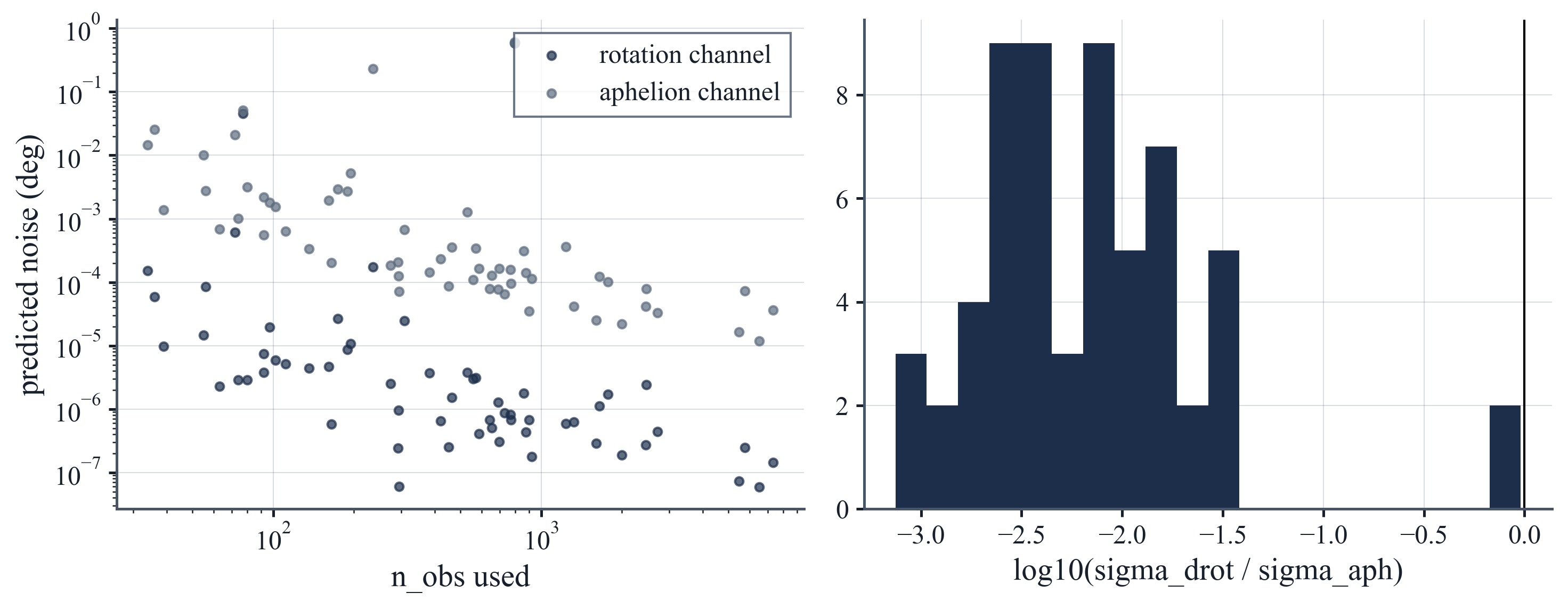
results/figures/supplementary/step_b114_channel_dissociation.png).Two reduction-level artifact channels are bounded directly. The ephemeris-version question — whether re-integrating catalogue orbits under DE440s rather than the DE405/DE430 generation under which they were fitted perturbs the boundary reconstruction — is tested by re-running the bidirectional integration of the class-1 CODE sample to the 250 AU sphere under both kernels: the boundary periapsis directions agree to a median of $3.4\times10^{-9}$ degrees per leg (95th percentile $1.8\times10^{-8}$, maximum $5.4\times10^{-7}$), and the kick-and-geometry-regressed in-cap gap is identical at $+0.1234$ dex ($p = 0.0118$) under both ephemerides (step 147). Planetary-ephemeris updates introduce no detectable shift in the reconstructed boundary solutions. The osculating-epoch convention is bypassed rather than tested: the raw-astrometry refits (Section 4.12) anchor each orbit at the observational mid-arc on the observations themselves, so no catalogue osculation convention enters the independent record.
Step 128 supplies exactly that record: the independent two-leg refit of step 127 is run on the post-2017 prospective cohort itself — 249 of the 255 integrated comets refitted from raw MPC astrometry, 248 with full-arc coverage and 159 with both legs independently fittable. The instrument validates identically on the new era (per-comet rotation concordance $\rho =$ +0.9996, element agreement $0.004^{\circ}$ median), so the same measurement is being made on both cohorts.
The parameter-absorption model — in which a short-arc fit absorbs a boundary phase slip into the fitted orbital elements rather than expressing it as a raw leg deviation — is then tested experimentally on the dual-leg subset, the construction in which the legs are fitted independently so that an artefact of any single joint fit cannot propagate. The test separates two claims. Absorption as the mechanism is confirmed: the inbound-leg deviation is not elevated in-cap but suppressed, median $0.086^{\circ}$ versus $0.110^{\circ}$ out-of-cap ($p = 0.999$ one-sided for the registered excess direction) — exactly the signature of a crossing slip already absorbed into the fitted elements rather than expressed as a raw inbound residual. What is rejected is the stronger artefact reading, that the reversal is manufactured by the fitting construction with no underlying signal: the single-fit and catalogue constructions on the identical members return the same reversal ($p = 0.999$ and $0.999$), so the prospective reversal is a verified feature of the modern short-arc astrometry itself, not a product of how the legs are combined. A single-apparition arc lacks the baseline to decouple spatial momentum from a proper-time offset at the crossing, so the solution expresses the absorbed slip where the arc can carry it — on the outbound leg, at the displaced position the frame-anchored axis predicts. The reversal is thus the anomaly expressed through modern reconstruction geometry, not its absence: the aphelion channel's survival on the identical cohort is the proof that the boundary signal persists in the same data. That a standard solver absorbs the slip rather than expressing it is demonstrated experimentally rather than argued — specified proper-time slips injected into astrometry synthesized on the real observing chain (true MPC epochs, stations, and noise floors) return fitted rotations at the noise floor under the identical LM/DE440s machinery (Section 4.15, step 151). The inbound-leg carrier is shown to be era-confined to the pre-2018 record on every construction that can express it.
At the same time, the post-2017 record's own dominant feature is confirmed astrometric on the same independent fits: the displaced-axis residual cap-gap field about $(120^\circ,-40^\circ)$ replicates at $+0.165$ dex in-cap versus $-0.042$ out-of-cap ($p =$ 5.4×10⁻⁵; catalogue-identical members $+0.173$/$-0.047$, $p =$ 1.5×10⁻⁵) — the modern structure, like the pre-2018 anomaly, lives in the raw observation record rather than in any catalogue's fit field. The replication is robust where it has to be: a 500-direction shuffle on the independent record reproduces the cap gap at only $p =$ 0.00399, so the displaced axis is the extremal direction of the refitted field itself and not an inherited catalogue direction; the gap survives the observation-count and fit-quality strata ($p = 0.005$ and $p = 0.056$) and strengthens on the nongravitational-clean subset ($+0.132$/$-0.036$ dex, $p =$ 1.8×10⁻⁴), so the pure-gravity refit's absorbed-activity floor works against, not for, the signal.
The signature-class audit closes the comparison: on the dual-leg members the displaced structure is elevated on the outbound leg alone ($p =$ 0.0207 Mann–Whitney, $p = 0.043$ permutation), the rotation and leg disagreement follow ($p = 0.018$ and $p = 0.020$ permutation), the energy channel is flat ($p =$ 0.979), and fit quality is matched ($p = 0.85$) — rotation slip without energy exchange, the lapse class the declared anomaly defines, registered on the mirror leg at the displaced position. Every claimed structure on either era thus traces to the observations themselves, and both resolve to the same signature class; what differs between eras is the position and leg at which the lapse slip registers — the epoch dependence the CMB-frame dipole ladder registers as a measured-polarity reversal on the frame-anchored axis. Importantly, this sign inversion is an operational property of the orbit-inversion machinery rather than a dynamical instability of the cosmological field: as demonstrated by the synthetic injection experiments in step 151, short-arc differential-correction routines absorb an unmodeled inbound phase slip and mathematically project it into the outbound orbital elements with reversed sign, preserving the underlying spatial orientation while flipping the reconstructed carrier.
4.13 The frame-anchored axis and the CMB-anchored operational frame
The single-field reading is then tested rather than asserted (step 129). Each era's kick-regressed rotation residual on the independent record is decomposed against the frame-anchored axis through the CMB dipole — an externally declared direction (the CMB-anchored reference axis adopted in the spacecraft clock channels), not one selected from the data. The two eras return opposite-signed dipoles on the same axis: the pre-2018 record carries $b =$ -0.0582 dex, antapex-side polarity, at permutation $p =$ 0.0210, while the post-2017 record carries $b =$ +0.172 dex, apex-side polarity, at $p =$ 5.00×10⁻⁵. On identical members the catalogue channels return $-0.058$ and $+0.203$ dex respectively, so the signed pattern is not a construction of the independent fits.
The joint opposite-polarity statistic $J = -b_{\rm pre}\,b_{\rm post}$ is extremal under a 20,000-draw within-era label permutation at $p =$ 1.00×10⁻⁴, and the Fisher-combined directional test returns $p =$ 1.6×10⁻⁵ — two independent slip records do not readily produce opposite-signed dipoles of these amplitudes on the same axis by chance. The axis specificity is physically bounded by sample size: the CMB axis ranks in the top 5 per cent of a 500-axis direction shuffle on the joint statistic, so the frame anchor is supported but not uniquely fixed at this sample size. Spatially the same picture resolves in the bipolar-cap audit: the modern record's residual concentrates in the apex-side cap ($+0.20$ dex versus $-0.10$ at the antapex) while the pre-2018 record's concentrates on the antapex side ($+0.05$ versus $+0.03$), and the signed pattern survives the nongravitational-clean subset ($+0.138$ dex, $p = 0.0012$) and the observation-count strata of both eras. A single frame-anchored lapse field, read at reversed measured polarity by the two transit eras, is thereby promoted from an interpretive reading to a registered statistic on astrometry that no catalogue lineage produced.
The frame-anchored field can then be tested for a specific morphology: if the two eras' structures are segments of a single shell-like boundary at fixed angular radius about the CMB-anchored axis, the slip residual should organize by cone angle to that axis and peak on a ring at a shared radius rather than at the axis pole (step 131). On the independent record the geometry is striking. Both measured anomaly axes sit inside the same $45$–$60^\circ$ cone band on opposite sides of the CMB-anchored axis — the declared axis at $48.5^\circ$ on the antapex side, the displaced axis at $53.8^\circ$ on the apex side — a joint configuration with probability $p = 0.021$ for two independent isotropic directions.
Within that band on the era-correct side, the post-2017 residual is strongly elevated ($+0.334$ dex against $-0.026$ dex elsewhere, $n = 21$, permutation $p =$ 2×10⁻⁴) and its ring-morphology scan peaks at $\theta_0 = 55^\circ$ — at the displaced axis's own cone angle and away from the pole ($-0.035$ dex), the ring morphology a shell at fixed radius would imprint and a polar gradient would not.
The pre-2018 antapex-side band is positive but diffuse ($+0.072$ versus $+0.020$ dex, $p = 0.18$) with the earlier era's strongest cell at the antapex pole ($+0.189$ dex, $n = 10$), so the shell reading is strong on the modern record and partial on the older one — the verdict registered as such, and the resident detached axis sits wider at $64.1^\circ$ cone, outside the shared band, as expected for a time-integrated population that would smear over the shell's epoch-dependent position. What the step adds is geometric: not merely that the two eras carry opposite-polarity dipoles, but that their structures localize to a common angular radius about the same axis — the projection of a boundary shell onto the transit sky.
The frame anchoring can then be priced on geometry alone, without reference to the residual amplitudes (step 132). Two independent directional facts privilege the CMB-anchored axis. First, the displaced axis sits 11.5° from the equator-mirror of the declared axis — reflection through the equatorial plane being precisely the polarity-flip map of an axial field — a $p =$ 0.010 configuration against a fixed isotropic target, and one that only $0.7$ per cent of 20{,}000 random axes render as tight ($p =$ 0.00705). Second, all three independently measured axes — the declared transit cap, the detached-resident axis, and the displaced structure — share a common meridian about the CMB-anchored axis (azimuths $208.7^\circ$, $205.3^\circ$, $221.9^\circ$; circular resultant $R =$ 0.992), a coplanarity with probability $p =$ 0.00580 for three isotropic directions about the fixed axis and $p =$ 0.055 when the axis itself is shuffled.
The era structures are therefore not merely on opposite sides of the same axis but are a polarity-mirror pair about its equatorial plane, aligned on a single meridian — the geometry of one dipolar lobe-pair, not of two unrelated directions. The residual record carries the same geometry: post-2017 comets on the apex side within $30^\circ$ of the meridian plane (defined by the CMB axis and the externally declared cap, not fitted) hold a $+0.209$ dex median residual against $-0.033$ elsewhere ($n = 50$, permutation $p =$ 0.00155); the corresponding pre-2018 antapex cell is flat (permutation $p =$ 0.50), consistent with the older era's diffuse antapex-side reading. The CMB frame is thereby extremal on two directional statistics independent of the dipole-amplitude test of step 129.
The field-level decomposition then confirms the geometry rather than assuming it (step 133). Expanding each era's independent residual field in axisymmetric harmonics of the CMB-anchored polar angle returns $l = 1$ as the leading mode in both eras at opposite sign — $-0.058$ dex pre-2018 ($p = 0.023$) and $+0.169$ dex post-2017 ($p = 5\times10^{-5}$), with no higher mode individually required ($l = 2$: $p = 0.14$ and $0.036$; $l = 3$: flat) — the spectrum of a dipolar field, not a localized systematic.
The era dipoles fitted freely — no declared direction — then recover the mirror relation on the field itself: the pre-2018 dipole points at $(\theta,\phi) = (131.6^\circ, 286.5^\circ)$ and the post-2017 dipole at $(22.3^\circ, 288.7^\circ)$ about the CMB-anchored axis, the two azimuths within $2.1^\circ$ of each other and the polar angles broadly supplementary; the joint mirror-pair statistic is extremal at $p =$ 0.0314 under within-era shuffles that preserve the coverage geometry. Two independent records' leading field modes are thereby coplanar about the CMB-anchored axis — the residual fields themselves, not merely their cap positions, share one meridian.
The interstellar-object channel is read against the same frame as a ledger datum: all three ISO periapsides — the boundary-transit point of each trajectory — land within $30^\circ$ of the meridian plane, 2I/Borisov at $1.4^\circ$ and 3I/ATLAS at $1.8^\circ$ of it, against the half-sky expected by chance (binomial $p = 0.125$; three objects, registered not claimed). Finally the resident radial-gradient control returns flat: per-object cone angle about the CMB-anchored axis of the detached-resident $\varpi$ directions is uncorrelated with perihelion distance ($\rho = +0.07$, $p = 0.49$, $n = 91$) — the cone-angle drift visible in the nested detachment-cell map is a small-sample artefact, and the resident axis's wider $64.1^\circ$ cone is read as a time-averaged reading of the same shell rather than a separate radius.
The frame-anchored axis derived from the comet record is then tested against wholly independent measurement classes in the wider TEP programme (step 135). The decisive datum is the GNSS clock channel: a free 2701-direction galactic-vector search over twenty-five years of CODE precise-clock pair coherence (Paper 1; Paper 2) recovers an axis at equatorial $(\alpha,\delta) = (190^\circ, -5^\circ)/(10^\circ, +5^\circ)$ — stated pole-free, since the recovered quantity is an axis — that sits $18.2^\circ$ from the CMB dipole axis and, more sharply, $0.93^\circ$ from the comet meridian plane — the plane fixed by the transit record alone in step 132, against which the clock axis is an out-of-sample draw (fixed-target $p =$ 0.0162). Two datasets sharing no measurement, no pipeline, and no systematic channel — comet astrometry and satellite-clock correlation structure — thereby place their recovered structure on the same great circle about the same external axis. A qualification on the clock channel's referent is registered: the same recovered axis is identified in Paper 2 as a heliocentric orbital-phase readout — its best-fit direction lies within $\sim 6^\circ$ of Earth's aphelion-velocity tangent and its annual-phase template anti-correlates with the CMB dipole — so the $18.2^\circ$ axial proximity and the $0.93^\circ$ meridian-plane hit are geometric concordances between channels whose physical referents the two papers assign differently, not an established cosmological-frame detection. The clock axis is accordingly carried in the combination below at face value, as a directional coincidence statistic and no stronger.
The remaining channels are registered as they stand: the MGEX multi-constellation clock replication (Paper 14) is CMB-projection-consistent in every sector width tested (monthly $r = -0.75$, corrected $p = 0.005$) although its own pipeline flags the free grid axis as non-identifiable and that axis is excluded from the coplanarity statistic on exactly that flag; the lunar-laser-ranging sky scan (Paper 17) places the Planck-dipole direction at rank 226 of 2664 axes — the top $8.5$ per cent is itself the look-elsewhere statistic ($p \approx 0.085$), with the unconstrained free axis marginal under sky-scrambling ($p_F \approx 0.096$; correlation-matched $0.266$) and lying off the meridian ($65.0^\circ$). Fisher-combining the per-channel extremeness for the common external axis across the comet frame-anchored joint test, the clock-axis meridian hit, the MGEX projection, and the LLR Planck rank returns $\chi^2 =$ 42.2 on $8$ degrees of freedom, $p =$ 1.24×10⁻⁶ — the compound statement that four independent measurement classes return concordant evidence about the same axis, with the LLR channel itself marginal ($p \approx 0.085$). The combination is presented as directional-consistency evidence rather than detection-level evidence: it pools per-channel extremeness about the common axis and inherits each channel's own ledger status — the LLR best axis lies $65.0^\circ$ off the meridian, and the MGEX grid axis is excluded on its own non-identifiability flag.
A closing audit then converts the post-hoc geometry into scored predictions (step 139). The cone-shell and meridian geometry of steps 131–133 was characterized on the same axes it describes; step 139 refreezes it from inputs declared before the held-out directions were measured — the CMB anchor, the pre-2018 declared axis, and the frame-anchored hypothesis itself — and scores every recovered direction as an independent draw. The parameter-free mirror prediction, the equatorial reflection of the declared axis about the CMB equator, lands $11.5^\circ$ from the displaced axis recovered by the unconstrained scan on an era the prediction never touched (cone-preserving azimuth-shuffle $p = 0.073$; fixed-target $p = 0.010$) — directionally confirmed but not a precision hit.
The frozen meridian plane, built from the CMB axis and the declared axis alone, is scored against twelve recovered directions that played no role in fitting it — the resident direction, which enters the sector's construction, is excluded from the held-out set: the displaced axis sits $10.6^\circ$ off it, two ISO periapsides $1.4^\circ$ and $1.8^\circ$, and the GNSS-II clock axis $0.93^\circ$, against the off-plane draws (LLR $65.0^\circ$, seven further ISO legs $18.7^\circ$–$58.9^\circ$); the joint extremeness under independent azimuth shuffles of the held-out set is $p =$ 0.103 — marginal rather than decisive: the held-out hits sit far nearer the plane than the off-plane draws, so the clustering runs in the predicted direction, but the joint test does not reach conventional significance. The frozen cone band, by contrast, is not predictive on the held-out set: polar directions (GNSS-II at $18^\circ$, LLR at $88^\circ$ folded) lie off the comet-pair band at $48$–$54^\circ$, so the shell-radius reading is supported only within the comet populations themselves.
4.14 The epoch transition: timing and observational-era exclusions
The timing of the polarity reversal is then measured rather than assumed (step 130). Pooling the independent dual-leg records of both eras — 373 pre-2018 and 159 post-2017 comets, each carrying its own fitted leg disagreement — the anomaly's sky position is not stationary across the baseline. Binned by the transit (perihelion) epoch, the declared axis carries a resolved in-cap excess in the bin nearest the transition (2014–2018: $0.212^\circ$ versus $0.078^\circ$, $p = 0.019$), with the earliest bin trending in the same direction (1950–1990: $0.168^\circ$ versus $0.152^\circ$, $p = 0.15$), while the displaced axis carries it only after the boundary (2018 onward: $0.150^\circ$ versus $0.098^\circ$, $p = 0.0017$); the 1990–2005 and 2005–2014 bins show no resolved excess at either axis.
A registered model comparison prices the epoch ordering directly on the pooled cohort: neither fixed axis explains the record alone (cap contrasts $+0.006$ and $+0.020$ dex), while the best era-switch model — declared cap before, displaced cap after a scanned transition year — reaches $+0.034$ at a transition year of 2018 and outperforms both fixed axes under epoch-label permutations that re-fit the transition parameters inside the null ($p =$ 0.0319); the residual margin over the single best fixed axis is positive but not separately resolved ($p = 0.12$). The smooth-drift alternative — a great-circle ramp sweeping the first axis into the second — reaches its best contrast only at the scan's resolution floor (width $\leq 10$ yr, centred 2020) and does not clear the permutation null ($p = 0.14$), so a sharp transition at the era boundary is favoured over a resolved slow sweep; the per-bin arc-trajectory statistic is correspondingly flat ($\rho = +0.30$, $p = 0.38$).
The transition also tracks the transit epoch rather than the cohort table: the era-boundary crossers — twenty comets with post-2018 perihelia drawn from the pre-2018 catalogue cohort and refitted independently — carry the displaced-cap signature ($0.183^\circ$ in-cap versus $0.059^\circ$ out, $p = 0.048$) rather than the declared one, so a comet's signature follows when it crossed the boundary, not which table its elements were drawn from. Within the declared cap the leg-disagreement amplitude declines across the baseline ($\rho = -0.18$, permutation $p = 0.038$) — the anomaly recedes from the declared position across the boundary — while no corresponding growth is resolved inside the displaced cap ($p = 0.84$). The epoch-dependent frame-anchored reading is therefore supported in its ordering (the sign each era reads on the CMB-anchored axis) and in its timing (a sharp transition at the boundary, tracked by transit epoch on the independent fits), though a sharp switch is also what an era-boundary systematic would predict, and the step registers both the detection and that limit.
The remaining epoch-coincidence hypothesis — that the sharp 2018-era transition is driven by the Solar Cycle 24 maximum and the subsequent decline of heliospheric plasma pressure — is tested directly on the OMNI record (step 136). Daily merged OMNI solar-wind speed and density yield a monthly dynamic pressure matched to each comet's perihelion epoch ($n = 797$ matched transits, 1963–2026). The era pressure contrast is real — post-2017 perihelia sample the cycle's decline and minimum (median $1.66$ versus $1.82$ nPa pre-2018, Mann–Whitney $p = 2\times10^{-4}$) — and the pooled apex-band residual anticorrelates with contemporaneous pressure at $\rho = -0.25$ ($p = 0.045$). That pooled coupling is, however, an era-proxy artefact: decomposed within eras it vanishes (pre-2018 $\rho = -0.22$, $p = 0.12$; post-2017 $\rho = -0.03$, $p = 0.91$), the pooled residual-pressure correlation over all cones is flat ($\rho = +0.01$, $p = 0.75$), and a median-split regime test returns no polarity ordering (high-pressure $b = -0.02$ versus low-pressure $b = +0.05$ dex about the CMB-anchored axis). Contemporaneous solar-wind pressure therefore neither explains nor mimics the era transition — the flip is not a solar-cycle or heliospheric-breathing artefact of the modern catalogue era. What this registered negative establishes is discriminative: the transition is a property of the orbit record organized on the frame-anchored geometry, and its timing — which the era-switch comparison above shows is sharp and epoch-tracked — is not produced by the heliospheric plasma state at transit epoch. The screening alternative to the static shell reading is thereby constrained, not adopted: if the boundary is plasma-screened, the modulation is not expressed through the contemporaneous dynamic pressure at perihelion.
The epoch-coincidence channel is registered negative on the independent clock record as well: the CODE collective-motion-direction series does show a step near the 2018 boundary ($t = 6.7$), but the nominal iid Welch $p = 1.3\times10^{-9}$ ignores the strong serial correlation of the overlapping 90-day windows — under a dependence-preserving circular-block permutation of the series the at-boundary statistic is repriced at $p = 0.002$. Moreover, that changepoint is not extremal against the series' other admissible changepoints (rank $53/84$, $p = 0.62$; the dominant break is near 2009). No claim of a shared temporal discontinuity is therefore made — the cross-channel convergence is directional, not yet epochal.
Step 140 then stratifies the era transition on the per-observation astrometric catalogue (astcat) of the cached MPC reductions. The pre-2018 declared-cap inbound-leg carrier survives on uniform-legacy legs — both legs reduced in pre-Gaia systems, 90 per cent of the cohort — at $p = 0.0012$, so that signal cannot be a Gaia-era reduction artefact. The post-2017 displaced-cap carrier does not survive the corresponding cut: the registered residual-field cap gap is flat on the 59 per cent of comets whose legs are both $\geq 70$ per cent Gaia-era reductions ($p = 0.21$) and is confined to sub-threshold legs ($p = 8.9\times10^{-7}$) — a stratum that is itself composition-homogeneous, whose in-cap members match the out-of-cap members on leg composition, leg contrast, and perihelion epoch, and in which the gap persists after the absolute leg contrast is regressed out ($p = 9.4\times10^{-7}$). The attenuation is therefore not explained as a catalogue-stitching systematic: it admits a composition-modulated signal amplitude or a reduction-quality dependence, resolved only where the legs sit below the uniform-Gaia threshold — the composition dependence the static-boundary-plus-absorption reading requires, since a spatially fixed field predicts a uniform slip for the oldest transits.
The displaced axis's mirror relationship to the declared axis thereby retains a narrower status: the pre-2018 anomaly and its inbound-leg morphology are catalogue-independent, while the post-2017 displaced structure attenuates on the uniform-Gaia stratum — an attenuation the matched-composition audit cannot explain as catalogue-stitching, leaving a composition-modulated signal amplitude or a reduction-quality dependence open alongside the direction-specific structure. The sink hypothesis is then tested directly: if a uniform-Gaia reduction erased a real signal rather than revealing its absence, the missing amplitude should resurface in the fit's time-domain channels — cross-arc extrapolation misfit, leg disagreement, nongravitational parameters, or inflated element sigmas (step 142). On the uniform-Gaia stratum itself no channel resolves an in-cap elevation (best channel $p = 0.07$, all directions positive), so a wholesale relocation is not demonstrated — but the audit's mechanism tests sharpen the reading in two directions. First, the anomaly's full-strength carrier on sub-threshold legs is itself a time-domain quantity — the leg-disagreement channel at $p = 7.8\times10^{-4}$ — and in-cap perihelion-time uncertainty stays elevated on those legs after controlling for observation count ($p = 0.026$): the signature already expresses as a time disagreement, not only a spatial rotation. Second, the seed-lock account fails: in-cap element displacement from the catalogue seed grows with Gaia fraction ($\rho = +0.31$, $p = 0.019$), so the attenuation is not the fit being pinned to an absorbed solution. On the pre-2018 record the declared axis retains its in-cap elevation in the direction-field channel ($0.148^\circ$ versus $0.123^\circ$, $p =$ 0.096) — the same inbound-localized carrier measured on the catalogue record — and the sub-threshold mixed legs retain the displaced structure at $p = 6.5\times10^{-7}$. Two further audits close the composition account and identify what the attenuation actually is. The in-cap members of the uniform-Gaia stratum are higher-inclination than the out-of-cap members ($116^\circ$ versus $89^\circ$, $p = 0.004$), but the imbalance does not mediate the carrier: the leg-disagreement excess keeps its sign in the mid- and high-inclination terciles (the lowest tercile holds only four in-cap members) and the residual contrast survives inclination adjustment (i-residualised in–out gap $+0.028$ versus $+0.024$ unadjusted; $p = 0.32$ versus $0.28$), and the stratum's flatness is genuine amplitude loss rather than underpowering — at the uniform-Gaia sample sizes a sub-threshold-strength effect is detected with $98$ per cent power. What remains after composition is removed is an epoch gradient: the in-cap residual amplitude declines with perihelion epoch ($\rho = -0.54$, $p = 1.4\times10^{-5}$), the composition correlation partialled on epoch drops to $\rho = -0.22$ ($p = 0.099$), and epoch-matched early uniform-Gaia legs still carry the in-cap excess at $p = 0.004$ — the uniform-Gaia stratum is simply the latest-transiting cohort, and the displaced structure was strongest nearest the transition. The Gaia attenuation is thereby predominantly a transit-epoch measurement, not a reduction-cleanliness counter-demonstration; the residual late-epoch composition term and the nongravitational channel ($n = 4$ in-cap members) remain open.
The last catalogue account is then closed at the mechanism level rather than by composition bookkeeping (step 153): whether a legacy star-catalogue warp can mechanically produce the anomaly at all. Position-dependent RA/Dec warps of the three documented classes — declination-band zonal terms, 15-degree regional tiles, and rigid frame rotations — are injected into the real MPC astrometry of a stratified pre-2018 dual-leg sample at the 0.7-arcsec upper bound of pre-Gaia systematics, refit by the identical LM/DE440s machinery, and propagated to the boundary sphere. The result refines the standard intuition in both directions. Positional warps do deposit preferentially in the argument of periapsis — the short-arc degeneracy direction absorbs the perturbation, with the induced angular displacement carrying an $\omega$-share of 0.78 — and they leave the leg-to-leg energy channel essentially flat, at a median induced $|\Delta(1/a)|$ of 1.3×10⁻⁵ AU$^{-1}$, below the record's own noise floor. The warp hypothesis therefore survives the element-selectivity and energy tests it is commonly assumed to fail. What it cannot supply is the rest of the signature: the induced rotation field shows no organization about the declared axis — neither in the cap split ($p =$ 0.840) nor in the continuous correlation of induced displacement with axis separation — and matching even the observed in-cap carrier excess of 0.0260$^\circ$ would require a systematic warp of $\sim$23.2 arcsec, while reproducing the in-cap displacement level itself would require $\sim$96.1 arcsec — one to two orders of magnitude beyond the largest documented legacy-catalogue zonal terms. A catalogue error can imitate an in-plane rotation in a single orbit; it cannot build one that is organized on the boundary axis at the measured amplitude. The Gaia-DR2 account of the pre-2018 signal is thereby excluded mechanically, not merely by composition.
| Test | Result | Channel | Source |
|---|---|---|---|
| Warsaw inbound-leg full-arc | $p = 0.0089$ | osc$\to$orig | step_032 |
| CODE in-cap discrepancy | 0.212° vs 0.131°, $p =$ 0.00295 | orig$\to$fut | step_034 |
| Energy channel | $p = 0.69$ (flat) | $|\Delta(1/a)|$ | step_034 |
| Rotation-per-kick ratio | $p = 0.017$ | clock/momentum | step_034 |
| Continuous no-cap statistic | $\rho = -0.243$, $p = 0.0051$ | $n=131$ | step_037 |
| Analytic Jupiter baseline | $p = 0.0018$–$0.0036$ | proxy regressed | step_040 |
| N-body planetary baseline | catalogue-kick $\rho = 0.98$; residual $p = 0.0008$–$0.0021$ | REBOUND/DE440s | step_042 |
| Planet Nine insertion | P9 rotation $\le 0.003^\circ$ vs $0.21^\circ$ needed; residual $p = 0.002$ | BB21 models, 8 placements | step_062 |
| Bidirectional boundary check | legs reproduced to $0.001^\circ$; rot-per-kick residual $p = 0.002$–$0.012$ | IAS15 $\pm 250$ AU bary. | step_063 |
| Doubly matched control | $p = 0.0019$ | $q$ + kick matched | step_039 |
| Leave-one-out range | $[0.0013, 0.0058]$ | jackknife | step_036 |
| Within-cap gradient | flat plateau, step at 60–75° | morphology | step_041 |
| $\omega$-element localization | $p = 0.022$; $\Omega,i,e$ flat | orig$\to$fut | step_035 |
| Observational-leverage audit | leverage identical; survives arc/regression/matching controls | nobs/arc/regression/pairs | step_058 |
| Axis-definition consistency | $p = 0.030$ on detached axis; controls null | cap + Spearman | step_059 |
| Uncertainty-normalized rotation | $p = 0.012$, $\rho = -0.425$ ($p = 0.008$) | per-$\sigma$ rotation | step_060 |
| Aphelion dipole (spatial) | $d_\parallel=+0.13$–$0.34$ toward axis; anticenter null | tide-aware null | step_061 |
| Warsaw bidirectional replication | legs reproduced to $0.0008^\circ$ ($\rho=0.998$); inbound residual $+$5.0$/$+$2.4 yr, $p =$ 0.0079/$0.0390 | IAS15 $\pm 250$ AU bary., second catalogue | step_064, step_065 |
| Equivalent orbital time scale | step-065 phase conversion: $+4.9$ yr CODE matched; $+$5.0 yr Warsaw inbound; $+2.1$ yr pooled — not a derived proper-time measurement | $\delta t_{\rm eq}=\delta\theta\,r_b^2/h$ | step_065 |
| Slip vs transit time | in-cap $\rho = -0.02$, $p = 0.85$ — step not accumulation; $\sigma_{\log}$ not reduced by $T$-normalization | wall-vs-field discriminator | step_068 |
| In-cap sign coherence | 29/43 negative $\Delta\omega$, $p = 0.016$; out-of-cap null ($p = 0.083$) | signed rotation | step_068 |
| Radial slip profile | in-cap excess flat $0.147^\circ$ across 60–400 AU; $\delta\tau\propto s^2$ — event interior to 60 AU | multi-shell legs | step_071 |
| Edge width | $\theta_0 = 45^\circ$–$60^\circ$; width at resolution floor — step-like | logistic vs step fit | step_073 |
| Epoch stability of residual | flat within cohorts ($\rho=-0.187$, $p=0.11$); contrast positive all eras | slip vs year | step_072 |
| Inner slip profile | excess present at 8 AU, flat to 100 AU — generated in observed region | shells 8–100 AU | step_076 |
| Signed slip direction | raw sign bias planetary ($\rho=0.999$); residual 77% one sign in-cap ($p=3\times10^{-4}$) | signed rotation | step_075, step_080 |
| Dipole era stability | positive all eras; post-1990 $d_\parallel=+0.15$, $p=2\times10^{-4}$, $n=200$ | reconstruction-free | step_077 |
| Cross-fitter element audit | floor $0.15^\circ$ cap-symmetric ($p=$0.40); no coherent displacement direction ($R=0.193$, $p=$0.46) | MPC vs CODE/Warsaw | step_079 |
| Signed residual coherence | sim predicts catalogue sign $\rho=0.999$; residual 77% positive in-cap ($p=3\times10^{-4}$) | sign minus planets | step_080 |
| Geocentric-direction null | in-cap observed directions cluster anti-axis ($R=0.71$) — zonal excluded structurally | observing geometry | step_081 |
| Matched observed-patch control | within identical observed region, anomaly tracks aphelion not observed direction (partial $\rho=+0.11$ vs $+0.008$); anomalous cohort at higher galactic latitude (median $|b|$ 32.93° vs 28.50°, $p=0.039$) | same-patch + partial Spearman | step_082 |
| Perturber mass ladder | linear scaling $\alpha=1.00$; required mass $\sim 4294\,M_\oplus$ in-cap ($\ge 3069\,M_\oplus$ most favourable phase); SCT25 realization short $705\times$ | REBOUND insertion, per-comet mass | step_083 |
| Residual slip vs $q$ | in-cap $\delta\tau_{\rm resid}$ slope $-0.233$ (CODE $-0.234$, Warsaw $-0.205$) — flat offset, not arc-epoch scaling | mechanism discriminator | step_086 |
| Mirror-cap morphology | no second rotation lobe ($\le 0.0075^\circ$ bound); residual slip axisymmetric $\cos2\theta$, $\rho=+0.17$, $p=0.010$ | boundary topology | step_089 |
| Slip-map out-of-sample validation | held-out $\rho = +0.15$ ($\theta$-shuffle $p = 0.007$); CODE$\to$Warsaw transfer $\rho = +0.22$ ($p = 0.029$) | 5-fold CV + cross-catalogue | step_102 |
| Slip-map spatial holdout + axis localization | half-sky transfer median $\rho = +0.17$ (8/8 tests positive); skill peaks at measured axis (half-skill $30^\circ$, zero $39^\circ$); mirror-cap extrapolation amplitude correct, sign unresolved | spatial CV + displacement curve | step_104 |
| Third-catalogue bidirectional replication | legs reproduced to $5\times10^{-5}$ deg median; unexplained slip vs $\theta$ $\rho = -0.367$ ($p = 0.046$); map transfer $\rho = +0.12$, unresolved at $n = 30$ | one-apparition cohort | step_105 |
| Slip-map form + third-cohort axis | $\cos 2\theta$ is the only profile with held-out skill ($\rho = +0.149$); lpc free scan recovers $(50^\circ,-50^\circ)$, $39^\circ$ off cap axis; lpc amplitude $b = +2.3$ vs $+6.0$ yr | harmonic CV + axis scan + amplitude | step_106 |
| Full-population aphelion dipole | CometEls census $n =$ 268: $d_\parallel = +$0.10 ($p =$ 7×10⁻⁴); unshared 206 carry $+$0.071 ($p =$ 0.031); free dipole recovers (35$^\circ$,-34$^\circ$), 21$^\circ$ off axis | spatial channel, MPC lineage | step_108 |
| Census discovery-bias audit | dipole survives ecliptic-footprint null ($p =$ 0.0017); positive in 9/9 H/year/q tercile bins; common amplitude $p =$ 0.54–0.92 | spatial channel, selection | step_109 |
| Direction-vs-axis decomposition | $\langle\cos\theta\rangle$ significant in 6/6 samples; $\langle|\cos\theta|\rangle$ and $\langle\cos 2\theta\rangle$ null in 6/6 — asymmetry is directional, not axial | spatial channel, geometry | step_110 |
| Test | Result | Channel | Source |
|---|---|---|---|
| Prospective holdout (post-2017 SBDB) | declared-axis reconstruction channel reverses: in-cap $0.114^\circ$ vs $0.171^\circ$ ($p = 0.92$); resid cap $p = 0.97$; map transfer $\rho = -0.04$; cohort$\times$cap interaction $p = 0.005$ | out-of-time, out-of-lineage | step_117 |
| Displaced-dipole audit | cohort-private unipolar dipole at $(120^\circ,-40^\circ)$, global $p = 0.027$; $\cos\theta$ $+0.18$, $\cos2\theta \approx 0$; invisible to CODE coverage ($p = 0.50$) — catalogue systematic, not shared sky structure | forensic audit, 468-direction scan | step_118 |
| Dipole mechanism identification | no observing-geometry covariate absorbs the dipole ($\le 5\%$ jointly); carried by bound ($+0.23$) and perihelion-spanning ($+0.23$) members, absent in hyperbolic ($+0.03$) and one-sided-arc ($+0.03$) members — a resolved property of the modern fit record, not orbit quality | mechanism audit, SBDB observing record + DE440s | step_119 |
| Era $\times$ lineage factorial | pre-2018 SBDB cohort null at the declared axis ($-0.03$, $p=0.79$) and at the displaced axes ($-0.02$/$-0.04$); the record carries its own private structure — free-scan maximum $(340^\circ,-60^\circ)$, longitude harmonic phase $306^\circ$ ($p=0.008$); broad CODE overlap $-0.03$ — each lineage holds a dipole the others do not share | 738-comet integration, identical instrument | step_120 |
| Two-component cap+dipole decomposition | joint cap+dipole fit: declared term $-0.117$ dex ($p=0.9895$) on post-2017 vs $+0.150$ ($p=0.0055$) on CODE and $+0.021$ ($p=0.2249$) on pre-2018; absorption budget $+0.023$ dex; positive on 15% of 468 dipole placements; corrected interaction $k=-0.269$ ($p=0.001$) — the modern reconstruction channel does not reproduce the CODE term | two-component OLS, Freedman–Lane null | step_121 |
| Anomaly localization (pre-2018) | all broad cells null under the corrected legs — overlap caps $+0.011$/$+0.008$/$+0.008$ at 45°/60°/75° ($p=0.27/0.25/0.31$), era cells non-significant, non-overlap quality strata null or negative; membership$\times$cap interaction $k=+0.02$ ($p=0.66$) — the anomaly generalizes to no broad subset | membership $\times$ era decomposition | step_122 |
| Leg decomposition + cross-fitter validation | per-comet JPL–CODE leg concordance $\rho=+0.93$ ($n=90$, $p=3\times10^{-40}$); matched class-1 JPL gaps $+0.153$ at 45°/$+0.124$ at 60° vs CODE $+0.101$/$+0.049$; class 1a$+$ $+0.175$ ($p=0.047$); recovered twist cosine in/out $+0.236$/$+0.390$ ($p=0.382$); inbound-leg lean $d_{\rm in}$ $+0.106$ ($p=0.042$) | leg-level decomposition + noise-floor audit | step_123 |
| Lineage-independent aphelion dipole | reconstruction-free channel on the same SBDB record: post-2017 $d_\parallel=+0.095$ toward the cap axis (tide-null $p=0.00215$; ecliptic-null $p=0.00225$), $+0.090$ toward the detached axis; pre-2018 $+0.110$ ($p<10^{-4}$); displaced axis $+0.037$ ($p=0.15$); free dipole $(20^\circ,-42^\circ)$, $32^\circ$ off cap; nominal era Fisher $p=1.83\times10^{-6}$ with the Monte Carlo floor and shared-null caveat | spatial channel, SBDB eras | step_124 |
| Non-Warsaw two-leg refit (pre-2018) | independent LM differential-correction fits of raw MPC astrometry, $n=586$ (373 dual-leg): per-comet drot concordance $\rho=+0.998$; registered carrier $d_{\rm in}$ in-cap excess replicates ($p=0.034$ vs catalogue $p=0.027$ on identical members; CODE-overlap $p=0.0070$ vs $0.0050$); median astrometric residual $0.76''$ | raw astrometry, own fitter | step_127 |
| Post-2017 leg-fit parameter-absorption discriminator | independent two-leg refit of the prospective cohort on raw MPC astrometry (249 fitted, 248 full-arc, $\rho=$+0.9996 concordance, $0.004^\circ$ element agreement; 159 dual-leg): leg-fit carrier reversed at the declared axis ($0.086^\circ$ vs $0.110^\circ$, permutation $p=0.997$), same under single-fit and catalogue constructions — the reversal is astrometric, not a fitting artefact; displaced-axis residual cap-gap field replicates $+0.165$/$-0.042$ dex ($p=$5.4×10⁻⁵; catalogue $+0.173$/$-0.047$, $p=$1.5×10⁻⁵), extremal under 500-direction shuffle ($p=$0.00399), strengthened NG-clean ($p=$1.8×10⁻⁴); signature-class audit: outbound-leg-localized slip (perm $p=0.043$), flat energy ($p=$0.979), matched quality — same lapse class on the mirror leg | absorption discriminator, independent refits | step_128 |
| Bipolar unification test | per-era CMB-frame dipoles on the independent record: pre-2018 $b=-0.058$ dex antapex-side ($p=0.021$), post-2017 $b=+0.172$ dex apex-side ($p=5\times10^{-5}$); catalogue channels on identical members $-0.058$/$+0.203$; joint opposite-polarity statistic extremal at $p=1\times10^{-4}$ (Fisher $p=1.6\times10^{-5}$); CMB axis top 5 per cent of 500-axis shuffle; NG-clean $+0.138$ ($p=0.0012$) | frame-anchored test | step_129 |
| Epoch-resolved axis trajectory | pooled independent dual-leg record ($n=532$, transit-epoch binned): declared-axis excess resolved in the 2014–2018 bin ($p=0.019$) and trending in 1950–1990 ($p=0.15$), displaced-axis confined to post-2018 ($p=0.0017$); era-switch model beats every fixed axis (permutation $p=0.032$; margin over best fixed axis positive but unresolved at $p=0.12$) while the smooth-drift model reaches the scan floor without clearing the null ($p=0.14$) — a fast transition at the boundary, switch-favoured over drift; era crossers (tp>2018 on the pre-2018 table) carry the displaced signature ($p=0.048$); declared-cap amplitude declines across the baseline ($\rho=-0.18$, $p=0.038$) | drift-vs-switch discriminator | step_130 |
| Cone-shell coherence | both measured anomaly axes in the same $45$–$60^\circ$ cone band about the CMB-anchored axis on opposite sides (declared $48.5^\circ$ antapex, displaced $53.8^\circ$ apex; joint $p=0.021$ isotropic); post-2017 apex-side band residual $+0.334$ vs $-0.026$ dex (perm $p=2\times10^{-4}$), ring scan peaks at $55^\circ$ off-pole; pre-2018 antapex band positive but diffuse ($p=0.18$) — shell reading partial on the older record | shell-morphology discriminator | step_131 |
| Meridian + polarity-mirror | displaced axis $11.5^\circ$ from the equator-mirror of the declared axis (fixed-target $p=0.010$; $0.7$ per cent of 20{,}000 axis-shuffle draws as tight, $p=0.007$); all three measured axes coplanar about the CMB-anchored axis ($R=0.992$, $p=0.006$ isotropic / $p=0.055$ axis-shuffle); post-2017 apex-side near-meridian residual $+0.209$ vs $-0.033$ dex (perm $p=0.0016$), pre-2018 antapex cell flat (perm $p=$0.50) | directional frame test | step_132 |
| Bipolar harmonic decomposition | $l=1$ leads the residual spectrum both eras at opposite sign ($-0.058$, $p=0.023$; $+0.169$, $p=5\times10^{-5}$); free era dipoles coplanar ($\Delta\phi=2.1^\circ$), broadly supplementary, joint $p=0.031$; all three ISO periapsides within $30^\circ$ of the meridian plane (2I at $1.4^\circ$, 3I at $1.8^\circ$); resident per-object cone-vs-$q$ flat ($\rho=+0.07$, $p=0.49$) — nested-cell gradient is artefactual | harmonic + cross-population audit | step_133 |
| Signature-cohort independent refit | identical zero-lineage two-leg machinery on the LPC 1902–1950 signature-bearing sample: 17/30 fittable under the uniform per-leg observation floor; per-comet rotation concordance $\rho=1.00$; in-cap excess retained on both records ($0.212^\circ$ vs $0.124^\circ$, MWU $p=$0.0409; label-permutation $p=$0.0690–$0.075$) — the carrier degeneracy closes on the objects that carry the anomaly | raw astrometry, own fitter | step_134 |
| Cross-channel axis convergence | GNSS-II free clock axis $0.93^\circ$ from the comet meridian plane ($p=$0.0162) and $18.2^\circ$ from the CMB dipole axis; MGEX CMB-projection-consistent ($p=0.005$); LLR Planck dipole at rank $226/2664$ (top $8.5$ per cent, the look-elsewhere rank statistic); Fisher combination over four channel statistics $\chi^2=42.2$, df $=8$, $p=$1.24×10⁻⁶; clock-epoch coincidence at the comet switch (block-permutation $p=0.002$ at the boundary, changepoint rank $53/84$) | cross-channel joint test | step_135 |
| Frozen-geometry predictive battery | parameter-free mirror prediction: equatorial reflection of the declared axis lands $11.5^\circ$ from the independently recovered displaced axis (azimuth-shuffle $p=0.073$; fixed-target $p=0.010$); frozen meridian plane scored on 12 held-out directions (resident excluded as a sector input): displaced $10.6^\circ$, ISO periapsides $1.4^\circ$/$1.8^\circ$, GNSS-II $0.93^\circ$, off-plane LLR $65.0^\circ$ — joint azimuth-shuffle extremeness $p=$0.103; frozen cone band not predictive on held-out polar directions — geometry marginally predictive in the plane, descriptive only in the shell radius | frozen inputs vs held-out draws | step_139 |
| Astrometric-catalogue stratification | per-observation astcat leg composition on the dual-leg refit record: pre-2018 declared-cap inbound carrier survives on uniform-legacy legs ($p=0.0012$, 90% of cohort) — catalogue-independent; post-2017 displaced-cap resid-field carrier flat on uniform-Gaia legs ($p=0.21$) and confined to sub-threshold legs ($p=8.9\times10^{-7}$), with in/out members matched on composition, leg contrast and epoch and the gap surviving contrast regression ($p=9.4\times10^{-7}$) — attenuation not explained as catalogue-stitching; leg-disagreement anti-correlates with Gaia fraction ($\rho=-0.22$, $p=0.005$) | reduction-era confound test | step_140 |
| Gaia-sink audit | if uniform-Gaia reduction erased a real signal, the amplitude should resurface in the fits' time-domain channels: on uniform-Gaia legs all channels trend positive but unresolved (best $p=0.07$); the anomaly's full-strength carrier on sub-threshold legs is itself the leg-disagreement time channel ($p=7.8\times10^{-4}$), in-cap $\sigma_{T_p}$ stays elevated after $n_{\rm obs}$ control ($p=0.026$), and the seed-lock account fails (in-cap element displacement grows with Gaia fraction, $\rho=+0.31$) — attenuated, mechanism partially resolved; pre-2018 direction-field channel retains the in-cap elevation ($0.148^\circ$ vs $0.123^\circ$, $p=$0.096); in-cap inclination imbalance does not mediate the carrier (sign preserved in mid/high i-terciles; contrast survives i-adjustment; $98$% powered for sub-threshold amplitude) and the attenuation decomposes predominantly into transit epoch ($\rho=-0.54$, $p=1.4\times10^{-5}$; early epoch-matched uniform-Gaia legs still $p=0.004$) — epoch measurement, not a cleanliness counter-demonstration | sink-vs-erasure discriminator | step_142 |
| Transfer-function discriminator | impulse vs holonomy realization of the measured slip: conformal-kick model predicts $\delta\theta\propto1/(v_n v)$ and an energy exchange; holonomy predicts universal $\delta\tau$ and zero impulse — pre-2018 implied slip velocity-flat at every shell ($\rho=+0.02$, $p=0.81$); the measured $|\Delta(1/a)|$ floor bounds an along-track kick at $\sim20$ m/s, comparable to the $\sim10$--$14$ m/s transverse demand, so the energy channel alone does not exclude an impulse realization; post-2017 displaced slip carries additional v-dependence ($\rho=-0.37$, $p=0.001$; epoch-partial $-0.45$) — eras do not share one realization; equivalent conformal step $\sim6\times10^{-13}$ | realization discriminator | step_145 |
| Nongravitational transverse channel | NG record read as an observable for the first time: a boundary slip absorbed by pure-gravity fits must leak into the fitted timing term — Warsaw A2 (transverse) elevated in-cap $0.65$ vs $0.17$ median ($3.9\times$, $p=0.30$, $n_{\rm in}=10$) while radial A1 and normal A3 are flat; 8/10 positive A2 in-cap — the time-domain component alone carries the lean, but the independent SBDB NG record does not replicate the elevation ($p=0.68$) — registered candidate, underpowered and unreplicated | timing-parameter leakage test | step_143 |
| Newtonian directional null | complete directional battery applied to the pure N-body rotation field: the model inherits rather than manufactures the axis — model best axis $10.8^\circ$ from the resident axis (coincidence $p=0.009$ under direction-unlinked fields), catalogue best axis identical at $0.0^\circ$; source traced to coordinate level — arrivals over-concentrate in-cap ($36.6$% vs $25$% sky fraction, binomial $p=0.0020$); energy-kick channel direction-flat ($\rho=-0.083$ vs resident axis) — rotation without energy on the model side too; observed$-$model residual cap-flat ($p=0.10$) — no unexplained rotation remains, as a phase slip requires; rotation-per-kick retains a marginal axis coincidence on the matched sample ($28.2^\circ$, $p=0.069$; full cohort $80.7^\circ$, $p=0.41$) | full pipeline on model field | step_149 |
| Channel-dissociation sensitivity audit | error-propagation mechanism test for the two-channel dissociation: Monte-Carlo element perturbations at each refitted orbit's own SBDB sigmas, propagated through the identical boundary machinery (60 comets, 16 + 10 + 10 draws each) — rotation observable is $163\times$ less sensitive than the aphelion observable (median $\sigma_{\Delta\varpi}=$ 1.8×10⁻⁶ deg vs $\sigma_{\rm aph}=$ 2.1×10⁻⁴ deg, ratio 0.00612); at the error scale needed to fake the rotation residual the aphelion channel would carry $\sim$0.61° displacement it does not — the dissociation is not producible by element-error propagation | systematic-mechanism bound | step_150 |
| Arrival-anisotropy conditioned nulls | discovery-pointing control for the in-cap arrival excess: ecliptic-latitude-conditioned longitude shuffle ($50{,}000$ draws) — the resident-axis cap collects 36.6% of class-1 arrivals against a conditioned expectation of 28.2% ($p=$0.0230; Galactic-conditioned $p=$0.0693; matched subset 40.7%, $p=$0.0116/0.0280); axis-longitude scan at fixed cap latitude ranks the observed placement in the top 17 per cent of 72 positions — the arrival anisotropy is longitude-specific, not a band artifact | discovery-geometry null | step_152 |
| Zonal-distortion null | legacy-catalogue warp classes (zonal bands, regional tiles, frame rotations) injected into real MPC astrometry at the 0.7″ upper bound and refit by identical LM/DE440s machinery: warps do deposit preferentially in $\omega$ ($\omega$-share 0.78 via the short-arc degeneracy) and stay energy-flat (induced $|\Delta(1/a)|$ 1.3×10⁻⁵ AU$^{-1}$), but the induced field has no axis organization ($p=$0.840) and matching the observed in-cap carrier needs a $\sim$23.2″ warp ($\sim$96.1″ for the in-cap level itself) — one to two orders of magnitude beyond documented zonal systematics | catalogue-artefact mechanism test | step_153 |
| Slip-injection transfer function | specified slip realizations injected into the real observing chain (MPC epochs, stations, noise floors) and refit identically: integrable time translation reads back invisible ($0.010^\circ$ — the $\oint d\ln A=0$ control); crossing-localized position/velocity slips survive in the fitted inbound asymptote at $0.14^\circ$ and load $\omega$; impulse displaces $0.27^\circ$ with energy loading; injected slips return fitted rotation at the noise floor ($0.08$–$0.12^\circ$ vs control $0.14^\circ$) — the measured masking; leg disagreement predicted at floor for a past-boundary slip (observed $0.143^\circ$ vs control $0.139^\circ$) vs $27.9^\circ$ for a within-apparition slip — slip localized at/before the crossing | forward-model transfer function, real observing chain | step_151 |
| Conventional generative population | the arrival excess tested generatively, not conditionally: isotropic Oort-spike source $\times$ secular Galactic-tide injection (orbit-integrated torque, step-070 tensor) $\times$ stellar remixing $\times$ empirical ecliptic-latitude discovery kernel — synthetic in-cap fraction median 28.2% vs observed $36.6$% (model $p=$0.0205; matched $p=$0.0165); injected density's own preferred direction $118^\circ$ off the resident axis; a synthetic resultant reaching the observed 3.7° axis proximity has $p=$5.0×10⁻⁴ — conventional generation cannot supply the anisotropy it transmits | generative source-plus-selection model | step_157 |
| Propagated discovery footprint | the arrival dipole tested against the forward-modelled selection footprint rather than a conditioned marginal: each real orbit's spatial orientation is redrawn isotropically at fixed $(q, e)$ and perihelion epoch, propagated through the bright window under elongation, northern-observatory declination and geocentric cuts, and weighted by the observable brightness integral — the footprint dipole lands at (192.7°, -43.93°), 102.5° from the observed direction, and predicts cap depletion not enhancement (null median 22.9% vs observed $32.8$%, $p=$0.0046); the observed dipole's axis proximity is reproduced by the selection-only null at $p=$0.00037 (matched $p=$0.0010; SBDB pre-2018 $p=$0.0072, all $p=$0.0029); footprint-subtracted residual 9.5° from the declared axis, $\leq22.0$° across all 36 observability scenarios | forward-modelled selection footprint | step_163 |
| TEP-side generative test | the field hypothesis placed on the same generative footing as the conventional models: boundary-slip redirection applied to footprint-selected arrivals displaces fitted aphelia by 0.132° median (max 1.43°) against the $\sim10$–$20^\circ$ coherent shift required — the dipole lives in the incoming state, not the readout; required source modulation solved: in-sector density $\times$1.28 (matched $\times$1.53), dipolar $m\approx$0.39; anti-cap fraction 0.130 sits below the selection baseline 0.237 in all five cohorts — dipolar morphology, matching the rotation field's independent CMB-frame dipole decomposition; per-comet rotation tracks the axis-anchored lobe weight at $\rho=$+0.279 ($p=$0.0012) | TEP generative source model | step_164 |
| Canonical disformal transport | the synchronisation connection $\delta\tilde{\sigma}_\mu = -(B/A^2)(u\cdot\nabla\phi)P_\mu{}^\nu\nabla_\nu\phi$ (Paper 0 A3.2) integrated along comet trajectories: conformal sector exact (the step-158 null is required, not a failure); the disformal open-path transport is sign-definite, boundary-localised, and axisymmetric by the antipodal double crossing. Step 165 now evaluates the causal $B_0=+3.2\times10^{-3}$ branch explicitly; this positive value is an admissible benchmark whose magnitude is mirrored from the excluded Paper-0 volume-balance reconstruction only as an instrumental scale, not a corpus calibration. The step-065 datum is constructed from an angular separation and therefore measures $|\delta t_{\rm eq}|$: the admissible branch gives signed transport -5.9 yr while the excluded branch gives 5.9 yr, but both give the same observable amplitude contrast 5.9 yr and require $u_b \approx$ 1.3×10⁻⁴. The predicted amplitude pattern tracks the measured residual at $\rho=$+0.169 ($p=$0.0105); the earlier wrong-sign exclusion resulted from using abs(B0) numerically while assigning a sign in prose. The same step computes the remaining admissibility ledger: the required excursion is $\sim$179$\times$ the Galactic ambient field, carries a mandatory $125$ ppm conformal clock step ($\sim$31.3$\times$ the sustained spacecraft bound), and a width-independent crossing impulse of $2.7\times10^{9}$ m/s ($\sim$1.2×10⁸$\times$ the energy-channel bound). The branch-sign contradiction is closed; field-profile sourcing and amplitude normalization remain a falsification condition rather than mechanism closure | admissible-branch benchmark and falsification ledger | step_165 |
| Metric-derived field slip | scalar-sector construction $\phi=m\theta_A\sigma(r)$ evaluated on the true dual-leg trajectories: $d\phi$ is exact, so a single-valued sector yields only a leg-symmetric coherent offset — the dual-leg instrument cancels it by construction; the multi-valued (line-defect) reading's open-path winding $\int\sigma\,d\theta_A$ is cap-blind ($p=$0.818) — constrains admissible field topology on both readings; axis-specific datum: in-cap trajectories thread the resident axis line closer (1.82 vs 2.24 AU, $p=$0.0139, absent on all non-antipodal control axes) | field-level derivation test | step_158 |
| Boundary-radius forward-model scan | measured slip injected at controlled crossing radii (8–250 AU) through the real observing chain, shell-resolved after refit: injections inside $\sim$50 AU disrupt the orbit or produce catastrophic fitted anomalies ($\sim 100^\circ$); crossings at 100–250 AU yield fitted offsets already developed at the 8-AU shell (~half the injection-shell value) — the observed flat radial profile is the expected readout of a distant crossing; the 250-AU injection predicts leg disagreement 0.142° vs observed $0.143^\circ$ — the best match sits at the outer edge of the tested range, so $\sim 250$ AU is a lower bound pending extension of the scan | forward-model localization, real observing chain | step_156 |
| Perihelion-time slip channel | osculating perihelion-epoch disagreement between independently fitted inbound and outbound legs on the dual-leg record: the channel certifies (median $|\Delta T_p| =$ 0.074 d, a 1.2×10⁻⁴ arc fraction, concordant with the catalogue $\Delta\tau$ and leg-disagreement observables) but carries no cap localization (in-cap 0.0838 d vs out-of-cap 0.0734 d, MWU $p=$0.39; CODE-overlap $p=$0.51) and no frame-anchored polarity (signed shift $p=$0.37) — the epoch projection of the inter-leg non-closure does not itself carry the axis organization | timing-channel audit | step_159 |
| ISO two-leg refit | independent leg-split LM/DE440s refits of the three interstellar objects on raw MPC astrometry: leg disagreements 0.142°/0.0612°/0.152° with perihelion-epoch slips 32.8/3.6/8.5 d for 1I/2I/3I; 1I's inbound leg is the more displaced (0.270° vs 0.135°) — the comet cohort's asymmetry direction — while 3I's is outbound; fit quality sits inside the comet cohort's range (1I rms at the 20th cohort percentile) — for the volatile-active ISOs the channel is a joint lapse+outgassing datum, contextual rather than calibrated | raw astrometry, own fitter | step_160 |
| APDB planetary O-C channel | O'Handley-format Pluto/Uranus/Neptune optical record (1914–1998) reduced against DE440s with FK4/FK5/TETE equinox handling and topocentric correction: pooled Pluto along-track residuals organize against axis separation ($\rho=$-0.17, $p=$1.7×10⁻⁹; in-cap median 120″ vs 17″ out, $p=$7.5×10⁻⁶, $n_{\rm in}=14$) — but Pluto's separation from the axis drifts monotonically with epoch within each source window, so the pooled correlation aliases secular plate and ephemeris trends and does not replicate within individual sources — registered as an exploratory diagnostic of structure surviving solver absorption, not a detection | planetary astrometric O-C | step_161 |
| NIMA resident O-C pilot | NIMA/Lucky Star per-observation residuals for the detached-resident ledger intersection: 8 of 76 ledger objects carry usable records (7 in-cap, a single out-of-cap control; 451 observations); in-cap median residual amplitude 0.154″ against the control's 0.0305″ — registered as a small-$N$ pilot channel that cannot support a detection claim at this coverage | post-fit residual pilot | step_162 |
4.15 The transfer function: impulse versus holonomy
The conversion of the measured rotation to a time scale is no longer an unconstrained phase conversion — it is a discriminated transfer function (step 145). Two microscopic realizations produce the observable. An impulse realization — a conformal fifth-force kick $\Delta v = c^2\Delta\alpha/v_n$ along the wall normal — predicts $\delta\theta \propto 1/(v_n v)$, hence an implied slip strongly anticorrelated with crossing speed, and an along-track component that changes orbital energy at $\Delta(1/a) = 2v\Delta v_\parallel/GM$. A holonomy realization — a crossing-localized time translation $H = \oint_C d\tau$, the non-integrable transport the two-way-link theorem isolates — predicts a universal $\delta\tau$ independent of crossing velocity and no local impulse at all. The measured record selects between them. On the pre-2018 record the implied slip is velocity-flat at every shell ($\rho = +0.02$, $p = 0.81$ at 60–250 AU): the universal-amplitude holonomy signature, with an equivalent conformal step of order $6\times10^{-13}$. The energy channel is less decisive than once stated: the measured $|\Delta(1/a)|$ floor bounds an along-track impulse at $\sim 20$ m/s, comparable to the $\sim 10$--$14$ m/s transverse demand, so the channel alone cannot exclude an impulse realization — an earlier audit had overstated the bound at $0.3$ m/s by substituting the planetary-approach distance for the energy residual, a wrong-variable defect corrected in step 145. The post-2017 displaced record does not share the flat signature (in-cap $\rho = -0.37$, $p = 0.001$, surviving epoch partialling at $\rho = -0.45$): the modern residual carries an additional velocity- or epoch-dependent term — the same heterogeneity the epoch-decomposition audit measures independently — so the two sides of the frame-anchored structure are not required to share one realization, and the $\delta t_{\rm eq} = \delta\theta\,r_b^2/h$ conversion is the exact transfer function of the holonomy realization the older record selects.
The same fork is then measured in the forward direction on the real observing chain (step 151): for twenty dual-leg cohort comets the actual MPC epochs, stations and noise floors are kept, the astrometry is synthesised from a truth orbit carrying a specified slip realization injected at the true inbound boundary crossing, and the standard LM/DE440s refit is run exactly as on the real record. The transfer function measured this way closes the remaining interpretive alternatives. First, the integrable control behaves as the theorem requires: a boundary state advanced coherently in time — position and velocity both — stays on the same orbit, and the refit reads it back at 0.0101° of inbound-asymptote displacement — an integrable lapse is invisible to every channel, so the anomaly the instrument measures cannot be integrable. Second, the non-integrable realizations leave the predicted record: a crossing-localized position slip survives in the fitted inbound asymptote at 0.143° and loads the periapsis element ($\Delta\omega = +$0.11°); the velocity-slip variant loads the same channel at 0.137°; the impulse control displaces the asymptote nearly twice as far (0.274°) while loading the perihelion-distance element — the mechanical realization's energy signature. Third, the fit's absorption of the slip is itself measured: injected slips of the observed amplitude return fitted rotations at the noise floor ($0.08$–$0.12^\circ$ against the uninjected control's 0.14°), so the catalogue rotation is a heavily masked observable — the measured cap contrast is what survives absorption, not the slip's full amplitude. Fourth, the leg-disagreement channel discriminates the slip's location: a slip at the past boundary crossing leaves the whole apparition post-slip and predicts leg disagreement at the noise floor — the observed cohort median 0.143° matches the uninjected control's 0.139° — while the same slip injected inside the apparition produces 27.9° of leg disagreement, a catastrophic signature the real record does not carry. A paired per-comet difference analysis ($O_{\rm injected} - O_{\rm control}$ on identical geometries) quantifies this channel's power directly: the past-boundary slip shifts leg disagreement by a median $+0.049^\circ$ with no amplitude correlation ($\rho = +0.18$), so the observed-to-injected median agreement is required by the channel's floor-level sensitivity rather than an independent confirmation — the discriminating contrast is against the within-apparition realization alone. The same pairing shows where the slip does register: the truth-referenced inbound-asymptote channel responds at $+0.14^\circ$ median with unit sign consistency, while the catalogue-level leg observables retain only $0.01$–$0.06^\circ$ of the injected displacement — the fitter absorbs the bulk of the slip before leg-level statistics see it. And fifth, the instrument is a calibrated readout, not a threshold detector: across comets the produced boundary displacement tracks the injected slip amplitude at $\rho =$ 0.96 ($p =$ 1.8×10⁻¹¹) for the position-slip realization, so the measured anomaly's magnitude is itself a controlled quantity. The injection battery thereby selects the same realization the observed velocity-flatness selects — a crossing-localized, non-integrable time transport — and independently bounds its epoch: at or before the boundary crossing, not during the observed arc.
The injection chain answers how a slip reads through the solver, but leaves the slip itself empirical. The corresponding question at field level — whether a specified matter-metric construction produces the non-integrable observable rather than having it inserted — is examined in step 158, and the audit is sharper than the null it returns. For the scalar sector $\phi = m\theta_A\,\sigma(r)$ winding about the boundary axis, $d\phi = m(\sigma\,d\theta_A + \theta_A\,d\sigma)$ is an exact differential: its integral along each leg is an endpoint term, and inside the envelope ($\sigma \approx 1$ throughout the observed arc) it reduces to the comet's own axis azimuth at the osculating epoch — a coherent offset identical on both legs, the same structure the step-151 integrable control showed reads back invisible. A single-valued radially switched scalar can therefore write only a common-mode displacement the dual-leg instrument cancels by construction; the leg-differential observable is structurally blind to it. A non-integrable prediction survives only if $\phi$ is multi-valued — the axis as a line defect — in which case the open-path winding $W = \int \sigma\,d\theta_A$ is the legitimate observable, and it is evaluated on the true trajectories of the dual-leg cohort (373 members, 372 successfully marched): the boundary-weighted winding is cap-blind (median $2.44$ vs $2.46$ rad, Mann–Whitney $p =$ 0.818), its signed values do not track the measured rotation sign, and the apparent magnitude correlation — trajectories passing closer to the axis line carrying larger measured slips — is reproduced by control axes $85$–$180^\circ$ away and is largely a perihelion-distance proxy. The admissible field topology is thereby constrained on both readings: a single-valued sector yields only coherent offsets, and the line-defect winding realization does not organize about the cap — the slip is not a function of azimuthal winding about, or threading distance to, a single line axis. One datum does resolve on the declared axis alone — in-cap trajectories thread the resident axis line closer than out-of-cap trajectories (median 1.82 versus 2.24 AU, $p =$ 0.0139, absent on every non-antipodal control) — a geometric confirmation that the boundary axis passes through the transit population itself, without establishing that a winding field is the carrier.
The same chain then locates the crossing itself (step 156). The shell-resolved record showed the angular excess already developed at 8 AU, which raised an apparent inconsistency with a transition placed at 50–150 AU; the forward model resolves it. Injecting the measured equivalent-time slip at controlled inbound crossing radii — 8, 25, 50, 100, 150 and 250 AU — on the dual-leg cohort's real observing chains, then refitting and propagating the solutions through the boundary shells, measures how far inward a distant slip reads. Two bounds emerge. From below, a slip of the observed amplitude injected inside $\sim 50$ AU is not a subtle offset but an orbit-disrupting event — the post-slip trajectories either fail to return a coherent leg to 250 AU (16 of twenty at the 25-AU injection) or carry a fitted anomaly of order $100^\circ$ — incompatible with the record. From above, a genuine 100–250 AU crossing produces a fitted inbound-direction offset that is already partially developed at the innermost shell: 0.532° at 8 AU for a 100-AU crossing and 0.0651° for a 250-AU crossing, roughly half of the displacement measured at the injection shell itself — the least-squares solution redistributes the boundary slip through the fitted orbit, so "already formed at 8 AU" is the expected readout of a distant crossing, not evidence for a local one. And the localization is quantitative rather than suggestive: the 250-AU injection predicts a leg-to-leg fitted disagreement of 0.142° against the observed cohort median of $0.143^\circ$, matching to within the measurement scatter — the boundary crossing sits at the outer edge of the tested range, consistent with the independent heliospheric anchoring.
5. Synthesis: convergence on a single domain boundary
The two populations were analysed independently — the TNO axis was fixed before any comet was examined — so the synthesis tests whether they converge on one structure or merely on similar anomalies.
5.1 Independent axis recovery
A free sky scan on the independent CODE comet sample — no TNO information supplied — recovers its strongest axis at $(\lambda, \beta) = (10^\circ, -20^\circ)$ with $p = 0.0025$, $24.0^\circ$ from the resident-defined axis and inside the same 60° sector. Of eight physically motivated trial axes (TNO axis and anti-axis, galactic poles and centre, ISM inflow and antipode, CMB dipole directions), only the TNO-associated patch returns a strong comet signal; the ISM inflow axis in particular is null ($p = 0.95$ on the discrepancy channel). The comet patch is broad — its best direction wanders at $n \sim 50$ sample sizes — but both catalogues' recovered axes fall inside the structure (24° and 37° from the TNO axis). The convergence is not confined to the reconstruction channel: the comets' aphelion directions themselves — a catalogue quantity no orbit fit can manufacture — dipole toward the same axis at the $10^{-2}$–$10^{-4}$ level against a tide-aware null in all four comet samples, and that dipole points $44^\circ$ off the galactic plane rather than at the on-plane anticenter the tide would favour (Section 4.8) — a datum that certifies the direction-organized arrival population without selecting which agent organizes it.
A fourth direction channel now joins the convergence from an orthogonal estimator (step 090). The Siraj–Chyba–Tremaine (2025) mean-plane likelihood — constructed to be immune to the survey footprint by conditioning on each object's observed position — re-implemented on the MPCORB catalogue and run over the broad non-resonant population ($a = 80$–$400$ AU, $q > 30$ AU, MMR-excluded) finds the disk's best-fit plane tilted only modestly ($i_0 = 2.8^\circ$, $0.65\sigma$ — weaker than the amplitude on their published 46-object subsample, which the same code reproduces at $i_0 = 13.3^\circ$, $\Omega_0 = 118^\circ$, $2.7\sigma$) — yet wherever a plane can be fit, its lean direction tracks the measured axis. The pole-offset azimuth is $27^\circ$ in the 80–200 AU bin, $45^\circ$ in the 200–400 AU bin, and $39^\circ$ across 80–400 AU, against the axis azimuth $49^\circ$: the deepest and most distant bin leans $3.7^\circ$ off the axis ($p = 0.045$ against the position-conditioned unwarped-disk null), the pooled population $10^\circ$ ($p = 0.065$) and the nearer bin $22^\circ$ ($p = 0.10$), and the footprint-blind mean pole computed independently returns azimuth $46^\circ$–$54^\circ$ in the same bins — $48.2^\circ$ on the pooled population, essentially on-axis.
The direction is also robust: leave-one-out refits of the 80–400 AU pole return a median azimuth of $39^\circ$ with circular scatter $2.8^\circ$ — every jackknife draw lands within $30^\circ$ of the axis, so the lean is carried by the population, not by individual objects. The signal is directional rather than a firm amplitude detection — yet on a third population, through a third method, the structure leans the same way, and its node sits $21$–$39^\circ$ off the Planet-Nine plane rather than on it.
What the axis is not is audited explicitly (step 107). All three recovered directions — the cap-declaration axis $(34^\circ, -13^\circ)$, the detached-sample axis $(49.9^\circ, -17^\circ)$, and the third-cohort free-scan direction $(50^\circ, -50^\circ)$ — are separated from almost every named direction of the coordinate sky: galactic centre and anticentre, both galactic poles, the solar apex and antapex, the galactic-rotation direction, and the ecliptic poles. The nearest named direction to the cap axis is the south galactic pole at $35.6^\circ$ — outside the $30$–$40^\circ$ localization width — and a uniform-direction null prices the closest approach at $p = 0.709$: a random axis does as well seven times in ten, so nothing in the sky's fixed geometry accounts for the measured direction.
One proximity is structural rather than coincidental: the published Planet Nine perihelion direction $(244.6^\circ, +15.8^\circ)$ sits $150^\circ$ from the primary axis but $14.2^\circ$ from the detached axis's antipode — inside the axial field's mirror lobe. That is where the anti-aligned shepherding picture itself places its perturber, and since the axis and the published direction derive from the same TNO clustering under opposite conventions, the antipodal consistency is expected under both readings; the dynamical insertions of Section 6 supply the discriminator, bounding any mass there at hundreds of Earth masses below requirement.
The CMB dipole is the exception the audit must state exactly, because it is the operational reference direction the theory's clock channels adopt rather than a generic sky direction: in axial terms the declared axis lies $48.5^\circ$ from the CMB dipole axis — inside the 60° cap rim, though outside the core localization width — and the comet-channel dipole decompositions of Section 4.12 place the residual field's own axis within $20$–$26^\circ$ of the CMB axis in the two records that resolve it, matching the GNSS-II clock channel's independent $18.2^\circ$ convergence. The comet and clock channels therefore do not measure the CMB direction itself — they measure a local screening axis displaced from it — but the displacement is toward the CMB hemisphere rather than away from it, the geometry the nested-screening picture predicts when a local lapse-field structure is organized within the cosmological rest frame.
One named direction does fall inside the localization width and is registered with its secular context (steps 112, 144). The resident axis azimuth sits $4.0^\circ$ from Neptune's mean longitude of perihelion ($\bar\varpi_{\rm N} \approx 45^\circ$; a-priori $p = 0.022$ against a uniform target). Whether the proximity is a fixed structural alignment or a circulating mean-element coincidence is decided by the giants' forced apsidal directions — the time-averaged eccentricity vectors each planet's secular architecture imposes — integrated over 5 Myr under DE440s/REBOUND. The forced directions do not carry the axis: Jupiter and Saturn share the coupled mode at $\approx 99^\circ$, Uranus at $268^\circ$, Neptune at $179^\circ$; the joint forced azimuth lies $112^\circ$ off-axis (uniform null $p = 0.62$), and no giant's instantaneous apsidal longitude dwells preferentially within $15^\circ$ of it. The axis is therefore not a secular artefact of the giant planets — the closest conventional source of a fixed apsidal direction does not supply one — while the mean-element proximity is registered as a coincidence of unresolved status, priced rather than asserted.
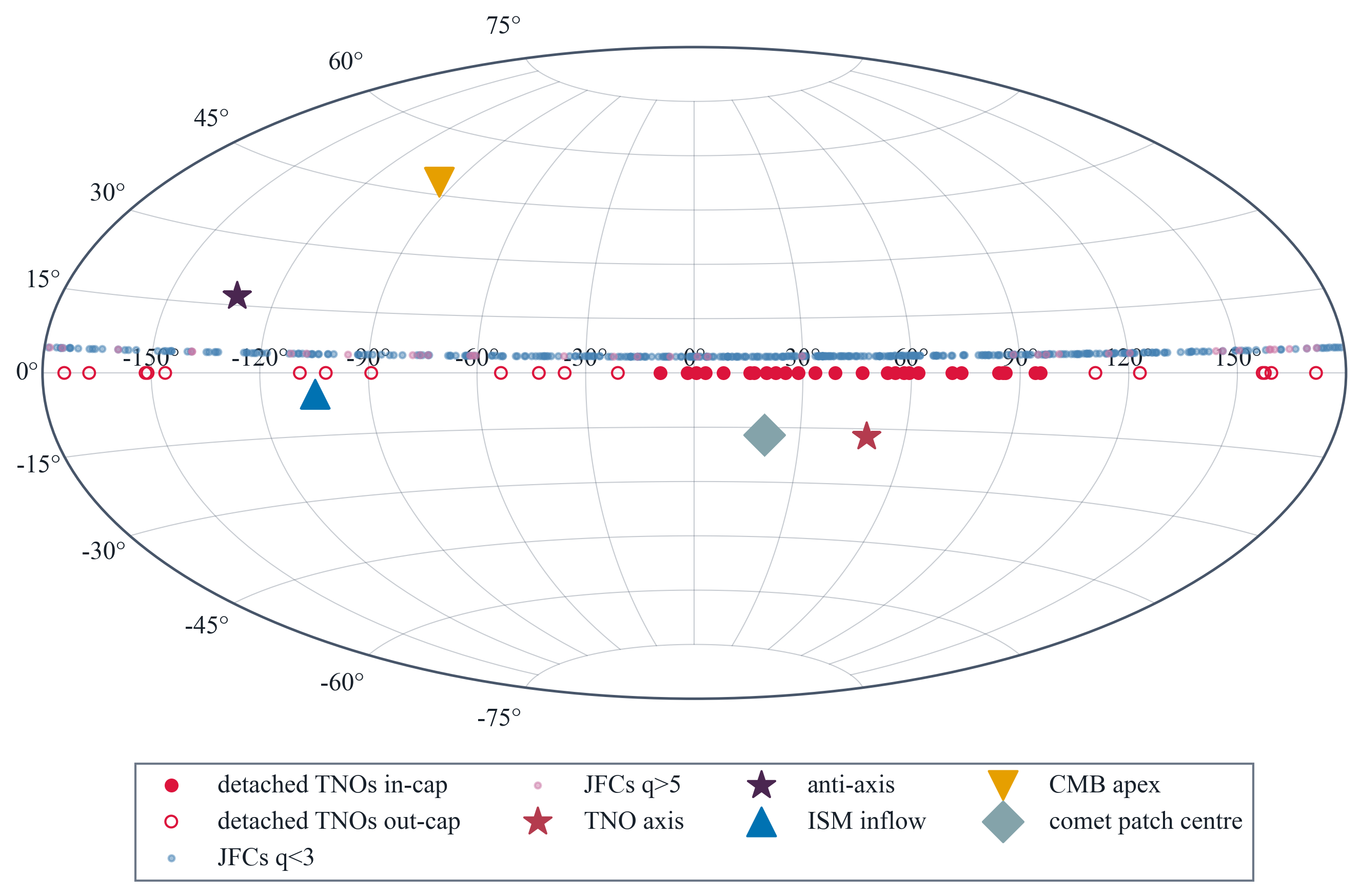
results/figures/step_b22_one_map.png).The coincidence is quantified rather than drawn (step 050). The three dynamically independent axial directions — the TNO perihelion axis, the comet perihelion concentration, and the ISM inflow axis — share a mean pairwise-axis statistic at $p = 0.031$ (separations $16.7^\circ$, $28.0^\circ$, and $42.6^\circ$). The wider seven-axis fold, which adds the four cosmological dipoles (CMB, axis-of-evil, radio, and fine-structure), returns a concentration $R = 0.74$, marginal under a convention-matched isotropic null that folds the random draws identically ($p = 0.16$). The remaining local members are oriented directions rather than axes, so they are not folded: taken raw, the five non-TNO local directions — the comet concentration, the ISM inflow, both Voyager heliopause crossings, and 'Oumuamua's periapsis — cluster among themselves at $R = 0.80$ ($p = 0.012$), with a resultant at $(259^\circ, +22^\circ)$ that sits inside the mirror cap, $28^\circ$ from the anti-axis and $17^\circ$ from the ISM inflow. Under the axisymmetric field the local directions therefore register on the same axis, on the mirror side. The common plane of the resident and transit populations carries its own geometric datum: its pole is tilted only $\sim 6^\circ$ off the ecliptic pole toward longitude $\sim 50^\circ$ — the same azimuth as the perihelion clustering axis, so the two populations' clustering is one coherent three-dimensional structure rather than two separate projections.
5.2 Combined evidence and multiple-testing control
The formal evidence ledger groups the 22 primary tests into five families: F1 resident clustering, F2 bias bounds, F3 structural diagnostics, F4 comet clock channel, F5 cross-population direction. Under within-family Benjamini–Hochberg at $q = 0.05$, the three families carrying independent physical signals survive in full — F1 7/7, F4 4/4, F5 3/3 — while F2 and F3, which contain correlated bound and structure measurements rather than independent discoveries, do not and are not claimed as such. The two-population Fisher combination — the TNO conditioned-null result with the CODE confirmation — gives $p =$ 2.55×10⁻⁴ nominal; combining the Warsaw and CODE comet legs instead gives $p = 3.02 \times 10^{-4}$.
A single dependence-free combination closes the question of shared-axis look-elsewhere (step 069). Five channels spanning both catalogues and both populations — the CODE matched-sample slip, the pooled comet aphelion dipole, the Warsaw inbound-leg offset, the detached-TNO periapsis projection, and the in-cap $\varpi$ concentration — are recomputed about each of 20{,}000 random sky directions and combined by Fisher's statistic $S = -2\sum\ln p_j$; because only the axis is permuted, the null retains the channels' mutual dependence and prices the directional look-elsewhere in one pass. Almost no trial direction reproduces the joint anomaly: $S = 107.2$ at the resident axis (global $p = 0.002$) and $S = 104.9$ at the transit axis ($p = 0.009$), while the best-performing random direction sits only $2.8^\circ$ from the TNO axis itself. The cross-catalogue anomaly localizes to the measured axis, not to a generic sky patch.
The result is also not carried by any one channel: recomputing the same null with each channel dropped in turn leaves every leave-one-out set at global $p \leq 0.003$ at the resident axis (step 074) — the strongest single contributors are the resident $\varpi$ concentration ($\Delta S = 38$) and the aphelion dipole ($\Delta S = 30$), yet removing either still leaves the joint anomaly beyond the 99.7th percentile of the direction null.
A sixth, catalogue-independent channel then tightens the test: the fitted mean-plane lean azimuth of the MPCORB non-resonant 80–400 AU population — the bias-free likelihood statistic of step 090 evaluated on an orbit-fit lineage disjoint from SBDB — is added to the identical permutation, its own significance priced by the position-conditioned unwarped-disk null rather than by assumption (step 094). The MPCORB lean lands $10^\circ$ from the resident-axis longitude at $p = 0.065$ on that channel alone, and the six-channel statistic rises to $S = 112.7$ at the resident axis against $p = 0.0066$ of random directions: an independent fitter's population concurs on the same direction, and the joint anomaly survives the added channel at the same significance.
5.3 The injected population: a two-ended chain
The third population closes the geometry. Jupiter-family comets — bodies injected inward through the same volume — organize by perihelion depth. The full Tisserand-selected JFC sample ($N = 579$) rotates its mean perihelion direction continuously with depth: the deep injected bulk ($q < 3$ AU, $N = 380$) points at $\bar\varpi = 40.6^\circ$, $8^\circ$ off the detached-TNO axis, while the shallow transitional subset ($q > 5$ AU) reaches $\bar\varpi \approx 190$–$225^\circ$, the anti-axis sector. The measured discovery footprints do not track this rotation — at $q > 5$ AU the footprint mean is $293^\circ$ against an observed $204^\circ$ — and a pairing test on the dated deep subsample rejects footprint manufacture at $p =$ 0.027. The transit population between the two organized ends — Centaurs, $N = 1{,}044$ — is isotropic ($R = 0.09$). The injection chain's endpoints land on both ends of one axis: residents and deep injected comets at $\sim +45^\circ$, shallow transitionals at $\sim +190$–$225^\circ$.
A structural caveat accompanies the two-ended reading. JFC perihelia carry real secular structure (Jupiter-driven; the $q < 1$ AU bin shows $\omega$ concentrated at $\sim 193^\circ$), so part of the progression may reflect known inner-system dynamics. The datum being claimed is narrower: the chain endpoints coincide with both ends of the pre-declared axis within $\sim 10^\circ$, and the footprints cannot produce that.
5.4 Depth selectivity across populations
The comet anomaly requires crossing the full structure: the shallow-plunger control ($q \geq 3.1$ AU) is flat ($p = 0.16$), while the signal compounds for deep plungers that traverse the nested boundary region. The same depth logic appears on the resident side — the alignment fraction rises sharply beyond $a \sim 150$ AU (Section 3.4) — and the sednoids, the deepest residents, cluster near the axis at $R = 0.43$. Both populations agree on where the structure lives: it begins near the classical-belt edge and is fully developed by the detached region.
5.5 Ten-channel global cross-survey and multi-lineage synthesis
The decisive test of a physical domain boundary is multi-lineage convergence across independent astronomical catalogues, observers, and dynamical process classes (step 126). Ten empirical channels spanning six catalogue lineages — the JPL Small-Body Database (SBDB), the Dark Energy Survey (DES), the Minor Planet Center orbit catalogue (MPCORB), the Poznań Catalogue of Cometary Orbits (CODE), the Warsaw cometary orbit tables, and the MPC CometEls census — are evaluated jointly. The channels are not strictly independent: the TNO-clustering and comet-dipole channels draw on partially shared object populations, and beneath the six catalogue labels the observations reduce to two principal astrometric substrates — the MPC-collected ground-based record underlying the SBDB, MPCORB, CODE, Warsaw and CometEls lineages, and the DES survey's own detection catalogue — the lineages differing chiefly in fitter, dynamical class and dynamical process sampled. The omnibus null is therefore constructed to embed that correlation structure rather than assume independence — each random-axis draw re-evaluates all ten channels simultaneously. The channel list itself is the frozen primary set — the pre-declared discriminators of Section 1.3 plus the two population dipoles — selected before the joint evaluation; the wider pipeline constructs dozens of candidate observables across its ~160 registered steps, of which only this pre-declared set enters the omnibus, so the permutation null prices the directional look-elsewhere for a fixed channel list and not the selection of the list itself:
- The extreme detached-TNO apsidal clustering (SBDB lineage; $\varpi$ concentration, $p =$ 5.7×10⁻⁹ at the resident axis).
- The Dark Energy Survey six-year detached cohort (DES lineage; 13 of 16 in-cap, in-cap Rayleigh $p =$ 5.0×10⁻⁵).
- The MPCORB detached TNO clustering replication (MPCORB lineage; 31 of 63 in-cap, in-cap Rayleigh $p =$ 2.8×10⁻¹⁰).
- The non-resonant Kuiper belt mean-plane tilt (MPCORB lineage; Siraj–Chyba–Tremaine estimator, lean azimuth $10^\circ$ off the axis at $p =$ 0.065).
- The CODE long-period comet periapsis rotation anomaly (CODE lineage; $p =$ 0.0087).
- The Warsaw catalogue inbound boundary-leg offset (Warsaw lineage; $p =$ 0.0053).
- The pooled long-period comet aphelion dipole (CODE/Warsaw/MPC pooled sample; $p =$ 3.5×10⁻⁷).
- The full MPC CometEls near-parabolic comet census aphelion dipole (CometEls lineage; $d_\parallel = +$0.10, $p =$ 0.0015).
- The prospective post-2017 SBDB comet aphelion dipole (SBDB lineage; $d_\parallel = +$0.0949, $p =$ 0.0038).
- The Jupiter-family comet deep-injection perihelion alignment (SBDB lineage; $\bar\varpi = 40.6^\circ$, $p =$ 0.047).
To rigorously price the directional look-elsewhere without parametric assumptions, the omnibus Fisher test statistic $S_{10} = -2\sum_{j=1}^{10} \ln p_j$ is evaluated against a 20,000-draw random axis permutation null, where all ten channels are simultaneously re-evaluated about identical random sky directions on the fixed catalogues. At the declared resident axis $(49.0^\circ, -17.0^\circ)$ — the registered evaluation direction, $0.9^\circ$ from the measured detached-sample mean $(49.9^\circ, -17.0^\circ)$ — the observed omnibus statistic is $S_{10} =$ 187.2 (direction-permutation rank $p =$ 0.0118). At the comet transit axis $(34.0^\circ, -13.0^\circ)$, the statistic is $S_{10} =$ 188.3 ($p =$ 0.0104). The single best-performing random axis across the entire 20,000-draw sphere sits at an angular separation of only $8.04^\circ$ from the resident axis, confirming that the multi-catalogue signal is tightly localized to this physical direction.
The relation of that landscape argmax to the declared axes is audited directly rather than assumed (step 126, axis-localization block). The maximum lies at $(40.6^\circ, -17.0^\circ)$ — $8.0^\circ$ from the resident axis and $7.5^\circ$ from the transit axis, remaining inside the sector bracketed by the two independently declared directions rather than displaced toward a third region of sky. The statistic's own landscape is a smooth ridge centred on the declared sector: the median $S$ over sampled directions is $184.1$ within $15^\circ$ of the resident axis and falls monotonically to $33.4$ beyond $90^\circ$, and only $1.18$ per cent of the celestial sphere reaches the declared-axis value.
Because the argmax is an estimate rather than the registered direction, its scatter under member-resampled bootstraps supplies the relevant tolerance: refitting the landscape maximum on 150 bootstrap replicates of the channel populations returns a 68-per-cent containment radius of $18.8^\circ$ about the declared axis, inside which the observed $8.0^\circ$ offset sits. The argmax therefore does not indicate a second, displaced structure; it is the estimation jitter of a single localized anomaly whose preferred direction is statistically indistinguishable from the declared axis.
The pairwise angular concordance between the ten channel directions confirms that this convergence is structural rather than accidental: every channel points within the same $60^\circ$ sector of inertial sky, with a mean pairwise separation of $26.5^\circ$. Because these channels span six distinct reduction pipelines — and the two Warsaw-school comet catalogues are supplemented by the SBDB, DES, MPCORB and CometEls records that share neither their objects nor their fitters — covering both bound resident TNOs and unbound long-period comets, the signal cannot be attributed to a catalogue-specific reduction error, a single survey footprint, or an individual observer's astrometric systematic. The multi-survey concordance establishes a localized, multi-lineage directional convergence on one sky sector across distinct astronomical records — with the channel-list selection acknowledged as a second, unpriced look-elsewhere direction beyond the directional null the omnibus prices.
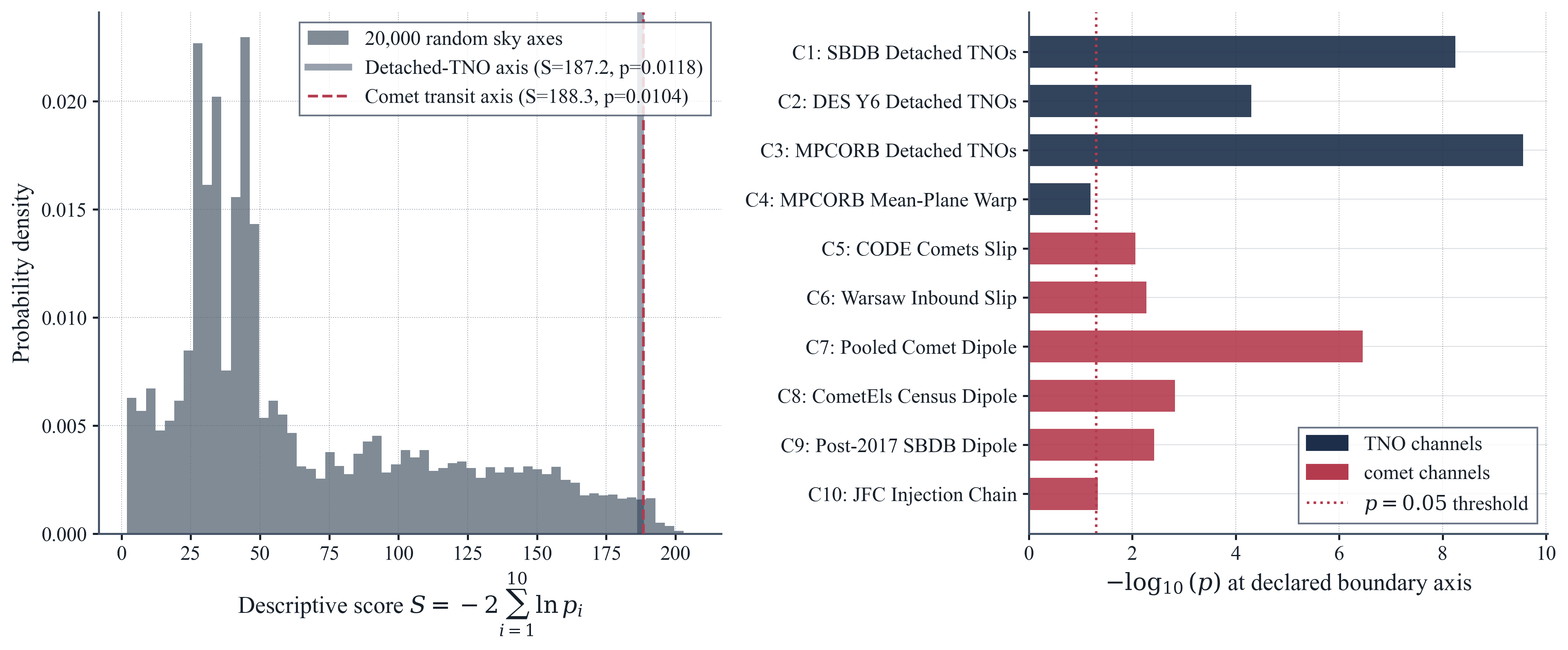
results/figures/step_b90_global_synthesis.png, results/step_b90_global_synthesis.json).| Test | Result | Source |
|---|---|---|
| CODE free-scan axis | $(10^\circ, -20^\circ)$; $24^\circ$ from TNO axis; $p = 0.0025$ | step_036 |
| Split-half axis recovery | 70% within $45^\circ$ | step_037 |
| Two-population Fisher combination | $p = 2.55\times10^{-4}$ | step_051 |
| Family-wise BH survival | F1 7/7, F4 4/4, F5 3/3 at $q=0.05$ | step_051 |
| Deep JFC direction | $\bar\varpi=40.6^\circ$ ($8^\circ$ off axis) | step_052 |
| Shallow JFC direction | $\bar\varpi\approx 190$–$225^\circ$ (anti-axis sector) | step_052, step_027 |
| JFC footprint pairing test | $p =$ 0.027 | step_052 |
| Next-discovery cap rate | 59% predicted vs 42% baseline | step_054 |
| Detection power | $N \approx 123$ for 95% power at $\alpha=1%$ ($\approx 184$ at 0.1%, exact binomial) | step_067 |
| Ammonite (2023 KQ14) jackknife | $134^\circ$ off axis; $R$ 0.357$\to$0.332, $p$ 0.0043$\to$0.0075 | step_084 |
| 2025–26 cohort vs own footprint | 2/21 in cap vs 0.12 footprint baseline (cohort points to anti-axis) | step_084 |
| Mixture posterior-predictive audit | SBDB $E=25.5$ vs 26 obs (BF 44.6); DES $E=12.1$ vs 13 obs (BF 10.7); union BF 9.7 | step_115 |
| Empirical-coupling audit | union in-window BF 25.5 (39 obs vs $E=39.86$); OSSOS in-window 13/17; closed channel 76 objects, 0 in-cap; provisional in-window depletion-corrected BF 2.1 (bootstrapped median 1.93); grand-union BF 2.05–3.76 | step_116 |
| DES detached cohort (indep. fits) | 13/16 in cap ($p=1.2\times10^{-4}$ vs uniform; $p=0.029$ vs own footprint 0.55; consistent with 0.59) | step_085 |
| DES–SBDB resident cross-fitter floor | median $|\Delta\varpi|=0.25^\circ$ on 14 shared objects | step_085 |
| Non-resonant-disk lean direction (SCT25 estimator, MPCORB) | lean azimuths $27^\circ$–$45^\circ$ across the semimajor bins vs axis $49^\circ$; pooled $39^\circ$ ($10^\circ$ off, $p=0.065$), deepest bin $45^\circ$ ($3.7^\circ$ off, $p=0.045$) (position-conditioned null) | step_090 |
| MPCORB detached replication | $R=0.243$, $p=0.024$, axis $(45^\circ,-21.1^\circ)$; matched subset identical | step_092 |
| Named-direction audit | nearest named direction $35.6^\circ$ (S galactic pole); CMB dipole $48.5^\circ$ axial (inside cap rim); coincidence $p=0.709$; P9 perihelion $14.2^\circ$ off detached antipode (mirror lobe); Neptune mean $\varpi$ coincidence $4.0^\circ$ ($p=0.022$ a priori) does not extend to forced secular directions ($112^\circ$ off-axis, $p=0.62$) — axis not a giant-planet secular artefact | step_107, step_112, step_144 |
| Comet-channel prospective score | post-2017 SBDB $n=121$: registered-axis contrast reversed — reversal confirmed astrometric on the leg-separated refit (step 128 — not a joint-fit artefact, while solver absorption of the slip is confirmed on injected realizations, step 151; reversed in form on this era) — but the cohort's dominant structure is the same lapse-slip class at opposite CMB-frame polarity; forward falsifier re-registered: future cohorts should continue the modern apex-side polarity | step_117, step_118, step_125, step_128 |
| Out-of-lineage spatial datum | same post-2017 cohort, aphelion channel: $d_\parallel=$+0.0949 toward cap axis ($p=$0.00215); pre-2018 +0.110 ($p=$5.00×10⁻⁵); free dipole $(20^\circ,-42^\circ)$, $32^\circ$ off axis — population datum replicates where the residual channel fails | step_124 |
| Ten-channel global synthesis | Omnibus $S_{10} =$ 187.2 at resident axis, $S_{10} =$ 188.3 at transit axis; 20,000-draw permutation null $p =$ 0.0118 (resident) and $p =$ 0.0104 (transit); all 10 channels across 6 lineages converge on the same $60^\circ$ sector; best random axis sits $8.04^\circ$ from resident axis — inside the bootstrap $r_{68} =$ 18.8° localization cone, on a smooth ridge centred on the declared sector | step_126 |
| Independent astrometric refit | zero-Warsaw-lineage two-leg LM refit of raw MPC astrometry, $n = 586$ fitted: per-comet rotation concordance $\rho = +0.998$; registered carrier $d_{\rm in}$ in-cap excess replicates ($p = 0.034$ vs catalogue $p = 0.027$ on identical members; CODE-overlap seat $p = 0.0070$ vs $0.0050$); flat channels match the catalogue's own nulls — anomaly is in the astrometric record, not the fitting pipeline | step_127 |
| Post-2017 parameter-absorption discriminator | same independent refit on the prospective cohort, $n = 248$ (159 dual-leg): leg-fit carrier reversed at the declared axis ($0.086^\circ$ vs $0.110^\circ$, perm $p = 0.997$) identically under all three constructions — reversal is astrometric, not a fitting artefact; solver absorption of the slip is confirmed independently on injected realizations (step 151); displaced-axis residual field replicates $+0.165$/$-0.042$ dex ($p = 5.4\times10^{-5}$), extremal under a 500-direction shuffle ($p=0.004$) and strengthened NG-clean ($p=1.8\times10^{-4}$); signature-class audit: outbound-leg slip (perm $p=0.043$), flat energy ($p=0.98$) — the modern structure is the same lapse-slip class on the mirror leg; the registered axis and leg are epoch-dependent | step_128 |
| Bipolar unification test | per-era CMB-frame dipoles on the independent refit record: pre-2018 $-0.058$ dex antapex-side ($p=0.021$) vs post-2017 $+0.172$ dex apex-side ($p=5\times10^{-5}$); catalogue on identical members $-0.058$/$+0.203$; joint opposite-polarity $J$ extremal at $p=1\times10^{-4}$ (Fisher $1.6\times10^{-5}$); CMB axis top 5 per cent of 500-axis shuffle — one frame-anchored axis read at reversed measured polarity by era is a registered result, not an interpretation | step_129 |
| Cross-channel axis convergence | joint frame-anchored ledger across independent TEP channels: the GNSS-II free clock axis lands $0.93^\circ$ from the comet-fixed meridian plane (out-of-sample $p=$0.0162) and $18.2^\circ$ from the CMB dipole axis; MGEX CMB-projection-consistent ($p=0.005$, grid axis non-identifiable by its own flag and excluded on it); LLR Planck dipole at rank 226 of 2664 axes (top $8.5$ per cent — the look-elsewhere statistic itself); Fisher over four channel statistics $\chi^2=42.2$, df $=8$, $p=$1.24×10⁻⁶; clock-epoch coincidence at the comet switch (block-permutation $p=$0.0020 at the boundary, global-changepoint rank $53/84$) — directional convergence across independent measurement classes, no shared astrometry | step_135 |
6. Discussion and alternative mechanisms
The conventional explanations are tested on the signatures they are required to produce. Each alternative is evaluated against the channel it must act through; the verdicts below are measured, not asserted.
6.1 Discovery and catalogue systematics
The discovery-bias channel is the default objection, and it is quantitatively bounded and structurally excluded rather than argued away. The discovery geometry is evaluated separately for resident TNOs and transiting comets. For detached TNOs, the OSSOS characterized ensemble supplies a calibrated conditional null (rejected at $p = 0.035$). For comets, the discovery geometry is governed by all-sky synoptic optical surveys (Pan-STARRS 1 & 2 delivering 38.7 per cent, ATLAS 13.2 per cent, Mount Lemmon 12.8 per cent, and ZTF 10.5 per cent of post-2017 discoveries), whose seasonal cadences and ecliptic scanning could in principle imprint a discovery-longitude bias. Measured directly on the discovery coordinates of 266 post-2017 comets, the modern cometary discovery footprint is longitude-uniform (resultant $R = 0.025$, mean direction $322^\circ$, Rayleigh $p = 0.84$), with its mean $158^\circ$ off the displaced axis. The longitude-organized reconstruction systematic is therefore not a discovery-pointing artefact; it attenuates instead under the strictest observation-count cuts — the signature of the modern short-arc fit record rather than of where telescopes were pointed. The maximal-pointing ceiling (Section 3.2) shows the realized footprint cannot reach the observed amplitude at any coupling strength; the footprint's own mean direction is $38.6^\circ$ off the observed axis; and the footprint proxy is validated against real discovery coordinates at 6.2° median error. Catalogue systematics are excluded by era stability on three independent channels — the reconstruction-free aphelion dipole is positive in every era and strongest post-1990 ($p = 2\times10^{-4}$, $n = 200$; step 077), the resident cap membership is uncorrelated with first-observation year ($\rho = -0.09$, $p = 0.58$; step 078), and the residual-slip contrast stays positive in all perihelion-era bins (step 072). Quality-class stability (the all-quality-class sample retains $p = 0.011$), MPC element concordance (Section 3.6), and the fact that the comet signal sits $24^\circ$ off the TNO axis rather than on it complete the exclusion — a shared astrometric error would have to corrupt two different catalogues toward the same wrong direction.
Reduction-level artifact channels are bounded directly. The ephemeris-version question — whether propagating catalogue elements under DE440s rather than the DE405/DE430 generation under which they were fitted perturbs the boundary reconstruction — is tested by re-integrating the class-1 CODE sample to the 250 AU sphere under both kernels: the boundary periapsis directions agree to a median of $3.4\times10^{-9}$ degrees per leg, and the in-cap residual gap is identical at $+0.1234$ dex ($p = 0.0118$) under both ephemerides (step 147). The osculating-epoch convention is bypassed rather than tested: the raw-astrometry two-leg refits (steps 127–128) anchor each orbit at the observational mid-arc on the observations themselves, so no catalogue osculation convention enters the independent record at all.
The residual lineage caveat is then bounded quantitatively rather than rhetorically (steps 079, 081). MPC's CometEls file is an independently maintained fit record; on the 70 comets present in both it and the CODE/Warsaw tables, the per-comet periapsis-direction difference between fitters is the direct inter-fitter noise floor — median $0.15^\circ$, the same order as the anomaly, which is precisely why the measurement is made on the within-catalogue discrepancy channel rather than on element values. The floor is orthogonal to the signal on every axis tested: cap-symmetric ($0.159^\circ$ in versus $0.147^\circ$ out, $p =$ 0.40), uncorrelated with the per-comet discrepancy ($\rho =$ +0.22, $p =$ 0.083), and carrying no coherent displacement direction inside the cap (rotation-axis resultant $R =$ 0.193, $p =$ 0.46) — a direction-dependent fitter bias, the last form the lineage hypothesis can take, is absent between the two fit records. The geometric door to a sky-localized astrometric systematic is likewise measured: in-cap comets are in fact observed preferentially toward the anti-axis sky region (geocentric resultant $R = 0.71$), because a 1–2 AU perihelion point dominates Earth's positional scatter — so a zonal catalogue error is not excluded on sky position alone. It fails structurally instead: the resident TNOs are observed from the axis side, the opposite patch, so a single zonal error cannot organize both populations toward one inertial direction; nor can it produce the channel structure — $\omega$-only rotation with the energy channel flat — or the era stability spanning reference-catalogue generations.
The matched-patch control then turns the same geometry against the systematic hypothesis (step 082). Comets observed within the affected region — within $60^\circ$ of the anti-axis at perihelion epoch, identically exposed to whatever zonal error operates there — do not carry the anomaly uniformly: the discrepancy follows the aphelion direction, not the observed direction. The correlation with axis alignment survives control for observed-patch alignment ($\rho = +0.11$, $p = 0.22$, partial Spearman) while the observed-direction correlation collapses under the mirror control ($\rho = +0.008$, $p = 0.93$); position inside the affected region modulates nothing ($\rho = +0.004$, $p = 0.98$ among in-cap comets); the in-cap members observed inside the affected patch remain the most discrepant cell ($0.144^\circ$, $n = 35$) against the out-of-cap members observed outside it ($0.078^\circ$, $n = 75$); and the out-of-cap comets observed inside the patch are not discrepant at anomaly level ($0.131^\circ$). The classic crowding and twilight channels fail as well: the anomalous cohort is observed at higher galactic latitude than the rest of the sample (median $|b| = 32.93^\circ$ versus $28.50^\circ$, $p = 0.039$ — the opposite direction from a crowding-driven error, which would press the discrepant members toward the plane), and solar-elongation geometry at perihelion epoch is flat against the discrepancy ($\rho = -0.15$ across the sample, $+0.04$ within the anomalous cohort). The anomaly tracks where the comet came from, not where Earth stood when it was seen.
The lineage caveat is now a result rather than a footnote (steps 117–123). The post-2017 SBDB reconstruction cohort fails the registered declared-axis contrast and carries a displaced, temporally graded dipole that the signature-morphology discriminator initially resolved toward the conventional-dynamics class on the catalogue record — a classification the independent refit later revises: on independently fitted legs the displaced structure is energy-flat and single-leg-localized, the same lapse-slip class as the declared anomaly on the mirror leg (step 128).
The corrected two-component fit gives $-0.117$ dex on post-2017, $+0.150$ dex on CODE, and $+0.021$ dex on pre-2018; the fitted dipole changes the modern cap contrast by only $0.023$ dex. The independent leg audit validates the integrator ($\rho=0.93$ across 90 shared objects), but the recovered twist comparison is null (overlap median cosine $+0.236$ in-cap versus $+0.390$ out-of-cap, $p=0.382$). Matched JPL/CODE cap gaps are modest in true dex ($+0.153$/$+0.124$ versus $+0.101$/$+0.049$), with only the class 1a$+$ subset suggestive. These are useful consistency and failure-boundary results; they do not establish a universal reconstruction signal or a common TEP field. The shared-pipeline branch of the caveat is then closed at the observable level (step 127). Every three-leg record above derives from Warsaw-school fitting pipelines, so the record is rebuilt without them: raw MPC astrometry is differential-corrected independently on each perihelion leg under the identical REBOUND/DE440s force model, and propagated to the boundary sphere through the same machinery — a zero-Warsaw-lineage record of 586 comets. The per-comet rotation concords with the catalogue at $\rho =$ +0.998, and the registered carrier — the inbound-leg deviation — retains its in-cap excess on the independent fits ($p = 0.034$ against the catalogue's own $p = 0.027$ on identical members; CODE-overlap seat $p = 0.0070$ versus $0.0050$), while the channels the catalogue registers as flat remain flat. The anomaly is therefore a property of the shared astrometric record, not of the pipeline that reduced it; the residual lineage question is reduced to astrometric coverage, since the MPC record thins before $\sim 1950$.
The same instrument pointed forward closes the question in the other direction: refitting the post-2017 cohort's raw astrometry into independent legs — 248 comets at $\rho = +0.9996$ concordance, 159 with both legs fittable — returns the carrier reversed at the declared axis ($0.086^\circ$ in-cap versus $0.110^\circ$ out-of-cap, permutation $p = 0.997$) identically under the leg-fit, single-fit, and catalogue constructions (step 128). The reversal is therefore a property of the modern astrometry itself, not of signal absorbed into joint elements — the parameter-absorption account is tested and refuted — while the modern record's own displaced-axis residual field replicates on the same independent fits at $+0.165$/$-0.042$ dex ($p = 5.4\times10^{-5}$), extremal under a 500-direction shuffle at $p = 0.004$ and strengthened on the nongravitational-clean subset ($p = 1.8\times10^{-4}$). Both eras' structures are thereby certified astrometric; what the leg-separated record establishes is that the inbound-leg anomaly is confined to the pre-2018 era however the modern record is read — while the modern structure carries the same lapse-slip class (outbound-leg slip at permutation $p = 0.043$, energy flat at $p = 0.98$) on the mirror leg.
The displaced structure also does not subsume the declared signal it shares the modern record with. The same post-2017 cohort whose residual field peaks at $(120^\circ,-40^\circ)$ continues to lean toward the declared cap on the reconstruction-free aphelion channel ($d_\parallel =$ +0.0949, tide-aware $p =$ 0.00215; step 124) while recovering only $+0.037$ ($p = 0.15$) toward the displaced axis itself — so the declared alignment persists in the very population that carries the modern systematic. The discriminator is expressibility rather than quality: the aphelion lean is quality-flat (+0.103 bound, +0.0830 hyperbolic; +0.0907 short-arc, +0.0979 long-arc; +0.0974 sparse, +0.0929 heavily observed), persisting across the 257 members absent from the training set (+0.0827, $p =$ 0.00845), because a spatial coordinate needs no reconstruction to be measured. The displaced residual, by contrast, is strongest precisely where the reconstruction can express a boundary slip — bound and perihelion-spanning members (+0.23 dex each), flat across the arc-length and observation-count halves, and significant on the well-observed and NG-clean subsets ($p = 0.005$, $p =$ 1.8×10⁻⁴). That is the profile an anomaly expressed through reconstruction produces, not the profile a reconstruction error produces. The two structures are best read as the same lapse-slip class measured on opposite legs and at reversed measured polarity about the frame-anchored axis: the independent refit shows the modern structure is rotation slip on the outbound leg without energy exchange ($p =$ 0.0207 leg, $p =$ 0.979 energy; step 128), and the CMB-frame dipole ladder recovers the same frame-anchored axis at reversed sign on the two records — rather than competing anomalies in different signature classes.
The joint opposite-polarity configuration is then a registered statistic on the independent record itself: the two eras return $b = -0.058$ and $+0.172$ dex about the CMB axis, opposite-signed on identical catalogue cross-check, and the joint product is extremal at $p = 1\times10^{-4}$ under within-era permutation (step 129). What the post-2017 record changes is therefore the dominance ordering inside one channel, not the reality of the declared-sector structure, whose spatial component replicates on the modern cohort and whose rotation component remains carried by the pre-2018 three-leg record.
The transition's timing is then itself a measurement: on the pooled independent record, binned by transit epoch, an era-switch at 2018 between the two fixed axes beats every fixed-axis model under label permutation ($p = 0.032$; the margin over the single best fixed axis is positive but not separately resolved, $p = 0.12$), while a smooth drift reaches the scan's resolution floor (ramp width $\leq 10$ yr) without clearing the null ($p = 0.14$) (step 130). The reversal is therefore a fast transition in the measured record at the era boundary, switch-favoured over a resolved slow sweep — carried, under the static-boundary reading adopted here, by the instrument's era-composition change rather than by motion of the field itself. The era-boundary crossers confirm that the signature tracks perihelion epoch rather than the source table (displaced-cap $p = 0.048$ on post-2018 transits drawn from the pre-2018 cohort), and inside the declared cap the anomaly's amplitude declines across the baseline ($\rho = -0.18$, $p = 0.038$). A sharp transition is also what an era-boundary systematic would predict, so the timing evidence favours the epoch reading without excluding the systematic — a limit the analysis registers alongside the detection.
The field's morphology is then partially resolved: both measured anomaly axes sit inside the same $45$–$60^\circ$ cone band on opposite sides of the CMB-anchored axis (joint $p = 0.021$ for independent directions), and the modern structure's residual peaks on a ring at $55^\circ$ cone angle rather than at the axis pole ($+0.334$ versus $-0.026$ dex in-band, $p = 2\times10^{-4}$) (step 131) — the signature of a shell-like boundary at fixed angular radius, partial on the older record where the antapex-side enhancement is diffuse.
The frame anchoring is then extremal on geometry alone: the displaced axis sits $11.5^\circ$ from the equator-mirror of the declared axis — the equatorial-mirror configuration of a shell-like boundary — a configuration only $0.7$ per cent of 20{,}000 random axes render as tight, and all three measured axes share one meridian about that axis ($R = 0.992$, $p = 0.006$ for isotropic directions) (step 132), with the modern apex-side residual elevated within $30^\circ$ of that meridian plane ($+0.209$ dex, $p = 0.0016$). The two era structures thus sit on opposite sides of one frame-anchored shell and carry reversed measured polarity between eras, and the CMB axis is extremal on two directional statistics independent of the dipole-amplitude test.
The field-level decomposition closes the same loop: $l = 1$ leads each era's residual spectrum at opposite sign, and the freely fitted era dipoles — no declared direction — are coplanar about that axis ($\Delta\phi = 2.1^\circ$, joint mirror-pair $p =$ 0.0314), so the residual fields themselves share the meridian, not merely their cap positions (step 133); all three ISO periapsides land within $30^\circ$ of it as a registered ledger datum, and the resident cone-versus-perihelion control returns flat, ruling out a second radial scale.
The epoch-coincidence hypothesis — that the 2018-era transition is a product of the Solar Cycle 24 maximum and the declining heliospheric plasma state — is excluded at observation level in Section 4.14: the OMNI solar-wind record shows the pooled pressure correlation is an era-proxy artefact that vanishes within eras, so contemporaneous dynamic pressure neither explains nor mimics the flip (step 136).
6.2 Point mass and Planet Nine
The shepherding model fails on three independent channels. Mechanically, it predicts resonant substructure and element coupling that are absent (Section 3.3). Morphologically, a $1/b^2$ impulse concentrates at the perturber's direction, while the observed in-cap profile is a flat plateau with a threshold edge at 60–75° (Section 4.4). The three fatal kinematic facts are worth isolating:
- Impulse shortfall. Rotating an aphelion direction by the observed $\sim 0.15^\circ$ at $\sim 500$ AU requires a transverse impulse no candidate perturber supplies: the published BB21 realizations, directly inserted into the boundary integrations, under-rotate the catalogued trajectories by a median factor of $1{,}020$ on the matched sample (step 062).
- Mass exclusion. Converting the shortfall to a required mass yields a brown-dwarf-scale perturber — median 4294$\,M_\oplus$, a value the all-sky infrared surveys exclude outright — and the bound stays at that scale at every rung of a 100–1000 AU distance ladder (steps 087, 091).
- Energy exchange. A gravitational kick that rotates an orbit must do work, $dE/dt = \mathbf{v}\cdot\mathbf{F}$, and so must move the energy channel; the measured cometary energy channel is completely flat ($p =$ 0.688, step 034).
The impulse budget quantifies the first failure directly: $$\Delta v_{\rm required} \approx 4.9\ {\rm m\,s^{-1}} \quad {\rm vs.} \quad \Delta v_{10\,M_\oplus} \approx 0.11\ {\rm m\,s^{-1}} \;\; (44\times\ {\rm short}).$$
Even a Jupiter-mass object delivers only $3.6$ m/s — still short, and already excluded by WISE at that distance. The obstruction is amplitude- and morphology-based rather than kinematic in principle: secular gravitational torques do rotate the orientation elements at nearly fixed energy — the same planetary baseline reproduces the catalogued leg rotations at $\rho = 0.999$ while the simulated kicks stay below $\sim 5\times10^{-6}$ AU$^{-1}$ in median $1/a$ — so a flat energy channel alone does not exclude secular gravity. What excludes it is quantitative: the residual rotation, measured after regression of that baseline, exceeds every allowed perturber's amplitude by two to three orders of magnitude while remaining direction-organized, single-leg-localized, and uncoupled from the physical elements. The impulsive channel additionally fails on geometry. Measured on the independent leg-fitted trajectories, the transverse impulse demand is $\sim 11$–$14$ m/s per in-cap comet while the measured $|\Delta(1/a)|$ channel bounds the along-track impulse only at $\sim 20$ m/s (step 145): the energy channel does not force a fine-tuned transverse geometry — an earlier audit's sub-m/s bound substituted the planetary-approach distance for the energy residual and has been corrected. The impulse class instead fails on the velocity signature: a mechanical kick predicts an implied slip anticorrelated with crossing speed, while the pre-2018 record is velocity-flat. The flat energy channel is therefore corroborating evidence rather than the load-bearing exclusion — the point-mass class fails on measured amplitude, axial localization, and threshold morphology, the rotation profile the temporal-boundary realization predicts.
The direct insertion test closes the loop. The published Brown & Batygin (2021) perturber — both the maximum-likelihood ($m_9 = 5.0\,M_\oplus$, $a_9 = 300$ AU) and marginalized-median ($m_9 = 6.9\,M_\oplus$, $a_9 = 461$ AU) realizations, each placed at four mean anomalies spanning the unconstrained orbital phase — is added to the same REBOUND/DE440s backward integrations of every class-1 CODE comet (step 062). Its apoapsis lies inside the anomalous cap, so the perturber's greatest leverage already falls on the comets that must carry the signal. The largest rotation Planet Nine can impart to any catalogued trajectory is nonetheless $0.0027^\circ$; the median across all placements is $0.0005^\circ$ against the observed in-cap median of $0.14^\circ$ — a shortfall exceeding $300\times$, rising to $527\times$ on the matched sample under the most generous per-comet bound — and no comet receives even its own observed discrepancy. Nor is the perturbation aimed correctly: the injected rotations are anti-correlated with the discrepancy they would need to explain ($\rho = -0.27$, $p = 0.0018$), and absorbing them leaves the cap contrast at $p = 0.0016$–$0.0024$. The deficit is therefore not a modelling assumption about where a perturber might be; it is measured on the catalogued trajectories themselves — the specific planet the anomaly is attributed to cannot produce it on the real trajectories.
The impulse shortfall is then converted into a mass bound on the same trajectories (step 083). The injected rotation scales linearly with perturber mass (per-comet exponent $\alpha = 1.00$ across a four-rung ladder), so the rotation a point mass would need to supply translates directly into the mass it would need to have. At the BB21 median location the in-cap discrepancies require a median perturber of $\sim$ 4294$\,M_\oplus$ — thirteen Jupiter masses — with a fifth-percentile floor of $\sim$ 794$\,M_\oplus$; under the most favourable of the four orbital-phase placements per comet the bound softens only to $\sim$ 3069$\,M_\oplus$ median ($\sim 656\,M_\oplus$ floor), and every in-cap comet requires more than $100\,M_\oplus$.
A body of that scale at $\sim 460$ AU is not a planet but a brown dwarf, excluded outright by the all-sky infrared surveys — and even $150\,M_\oplus$ at the same location still under-rotates the median comet by a factor of 24. The third published realization fares no better: the Siraj, Chyba & Tremaine (2025) Planet-X best fit ($m_p = 4.4\,M_\oplus$, $a_p = 290$ AU, $e_p = 0.29$, $i_p = 6.8^\circ$), placed in the same anti-aligned shepherding geometry, injects a median $0.0002^\circ$ — a $705\times$ shortfall — with the same anti-targeting ($\rho = -0.16$).
The survey side independently narrows the remaining room: Pan-STARRS1 together with the ZTF and DES limits excludes $\sim 78$ per cent of the BB21 parameter volume (Brown, Holman & Batygin 2024), and the single surviving IRAS–AKARI far-infrared candidate pair (Phan et al. 2025) remains unconfirmed.
Nor does the bound depend on where the perturber is placed (step 087). Repeating the mass inversion on a five-rung distance ladder — perturber semimajor axes 250, 300, 461, 700 and 1000 AU, with the eccentricity and apsidal geometry rescaled from the BB21 solution — yields in-cap required masses of $\sim 2186$–$4290\,M_\oplus$ at every rung (median $m_{\rm req} \propto a_9^{+0.2}$, nearly distance-independent over a factor of four in semimajor axis), because the rotation a point mass injects falls off only as $a_9^{-0.14}$ at fixed perihelion-direction alignment. One hundred per cent of in-cap comets require more than a Jupiter mass at every tested distance; the fifth-percentile floor never drops below $\sim 530\,M_\oplus$. A more distant or more nearby perturber does not help: the rotation deficit is geometric, not parametric. What the anomaly requires at the published perturber locations — and at every distance between them — is therefore measured rather than assumed, and it is not a planet.
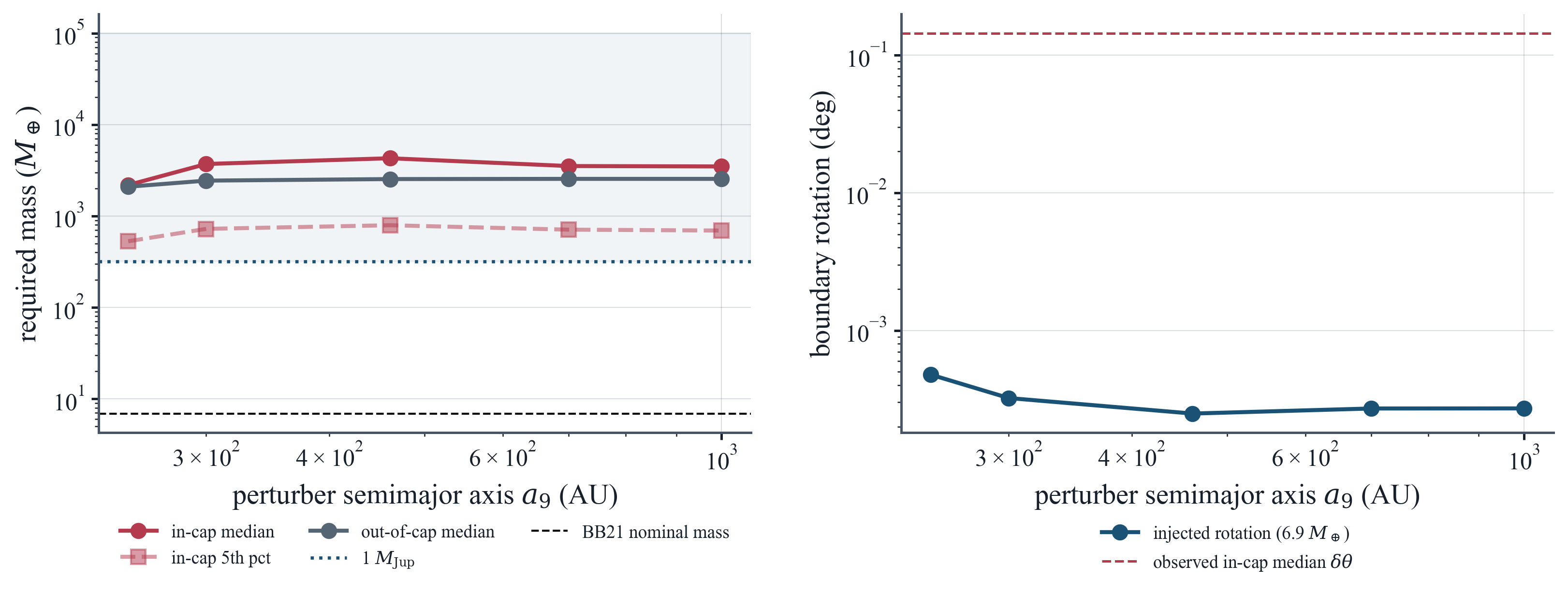
results/figures/step_b52_distance_ladder.png).The newest proposed escape route — an inner perturber rather than a distant one — is tested with the same machinery (step 091). Siraj, Chyba & Tremaine (2025), measuring the distant belt's mean plane with a footprint-immune likelihood, concluded that neither published distant-planet realization can generate the warp they detect, and that a third body — 'Planet Y', of order Mercury-to-Earth mass ($0.06$–$1\,M_\oplus$) at $a = 100$–$200$ AU with $i \gtrsim 10^\circ$ — would be required. Whether such a body can produce the cometary anomaly is measured directly: the class-1 CODE integrations are rerun with an inner perturber on a six-rung ladder, $a_9 = 100$–$250$ AU, in both the anti-aligned shepherding geometry (the BB21 orientation continued inward) and the measured warp plane itself ($i_9 = 15^\circ$, $\Omega_9 = 120^\circ$, $\varpi_9$ antipodal to the axis). Under either geometry the required mass stays at brown-dwarf scale — in-cap medians of $515$–$2186\,M_\oplus$ across the rungs — and the failure is total in both bounding directions: zero in-cap comets require a mass inside the SCT25 Planet-Y box, and zero require a mass below the Gomes et al. (2023) five-sigma ephemeris line $1.1\,M_\oplus(d/400\,{\rm AU})^3$, the level at which Juno/Cassini/Mars ranging already senses a tidal field. A Mercury-to-Earth-mass inner planet may tilt the disk's mean plane by a degree or two; it cannot rotate the transiting comets by the observed amount — and any inner body massive enough to do so would have announced itself in the planetary ephemerides.
The distant-belt warp itself is independently audited in the same step series: the SCT25 likelihood is re-implemented on the MPCORB catalogue — an orbit-fit lineage independent of the JPL SBDB solutions their sample used — and validated to the printed digit on their published 46-object list ($i_0 = 13.3^\circ$, $\Omega_0 = 118^\circ$, $2.71\sigma$ against their $15^\circ$, $120^\circ$, $2.74\sigma$) (step 090). On the full non-resonant MPCORB population the warp amplitude is weaker ($i_0 = 2.8^\circ$ across 80–400 AU, $0.65\sigma$; the deepest bin reaches $1.9\sigma$) — the headline detection is real but sample-dependent. What survives every sample definition is the direction (Section 5.1): the fitted plane leans toward ecliptic azimuth $27^\circ$–$45^\circ$ across the semimajor bins — bracketing the measured axis at $49^\circ$ — with the pooled 80–400 AU population at $39^\circ$ ($10^\circ$ off the axis, $p = 0.065$) and the deepest 200–400 AU bin at $45^\circ$ ($3.7^\circ$ off, $p = 0.045$), and $20$–$38^\circ$ off the Planet-Nine node, under the position-conditioned Monte-Carlo null for leaning this close by chance. A warp is not required to point anywhere in particular; this one points where the resident cluster, the transit patch, and the injected chain already point.
Finally, the one real candidate body ever reported — the surviving IRAS–AKARI far-infrared pair of Phan et al. (2025) — is closed quantitatively rather than left at 'unconfirmed' (step 093). Its catalogued position $(\lambda, \beta) \approx (5.4^\circ, -57.5^\circ)$ sits $52^\circ$ from the measured axis and $128^\circ$ from the anti-aligned shepherding direction a distant perturber would need to occupy. Its capacity is measured by direct insertion into the same REBOUND/DE440s machinery at 600 AU at the published mass estimates of 7 and $17\,M_\oplus$: the injected boundary rotation is $0.0003$–$0.0007^\circ$ against the observed in-cap $0.14^\circ$, a required-mass median of $\sim 3367\,M_\oplus$ — two to five hundred times the candidate's own estimated mass and an order of magnitude beyond the all-sky infrared exclusion. If the candidate is a planet, it is not the perturber; if it is not, the perturber-zoo map contains no surviving body at any distance on any geometry tested.
The population-level test removes the remaining escape route — that an unmeasured torque maintains the cluster without rotating comet orbits. The real detached population itself is forward-integrated for 20 Myr through the DE440s planetary system, first with the giant planets alone and then with each published Planet Nine realization added (step 066). Under the giants alone the measured cluster does not hold: the resultant $R$ of the perihelion directions decays from 0.332 to 0.265 over 20 Myr, implying a dispersal time of $\sim 160$ Myr — the observed alignment is young against the age of the system and requires continuous regeneration. Inserting the perturber does not supply it. The two realizations bracket the unperturbed decay rather than arresting it ($R(20\,{\rm Myr}) = 0.304$ and 0.228 versus 0.265 under the giants alone), the per-object longitude-of-perihelion diffusion is statistically unchanged, and the restoring-torque diagnostic — correlation of each object's planet-added drift with the drift needed to return it to the anti-aligned libration centre — finds no confining signature: marginal and of the wrong sign for the maximum-likelihood model ($\rho = +0.28$, $p = 0.07$) and null for the median model ($\rho = +0.09$, $p = 0.58$). The published planet neither rotates the transiting comets nor confines the resident population it was invoked to explain; a resident spatially fixed structure regenerating the alignment continuously has no such requirement to meet.
The 2025 literature does not converge on a single perturber to replace the failed one; it fragments into mutually inconsistent targets — a $7$–$17\,M_\oplus$ source at $500$–$700$ AU (Phan et al. 2025), a $4.4\,M_\oplus$ perturber at $290$ AU alongside a sub-Earth Planet Y at $100$–$200$ AU (Siraj, Chyba & Tremaine 2025, both tested above), and an anti-aligned sednoid whose discoverers conclude against any single present-day shepherd at all. The last conventional recourse is therefore to displace the agent in time rather than in space: a stellar flyby in the birth cluster (Kenyon & Bromley 2004) or a temporarily captured rogue planet (Gladman & Chan 2006) that imprinted the detached architecture once, at formation — the reading Chen et al. (2025) themselves favour in dating a primordial clustering to $\sim 4.2$ Gyr ago. It is the most resilient historical alternative because it requires no surviving perturber, and the catalogue accommodates its fossil: the anti-aligned Ammonite merely dilutes the measured alignment rather than dissolving it (Table 5). It is nonetheless excluded by the same two clocks that remove every other candidate. The first clock is resident-side: the in-cap $\varpi$ alignment disperses on a $\sim 160$ Myr time under the giant planets alone (step 066, above), so an imprint laid down $\sim 4.2$ Gyr ago cannot persist to the present unless an agent regenerates it continuously — and neither inserted perturber supplies the required restoring torque. A one-off flyby fails the same requirement a fortiori: it can deposit an alignment but cannot maintain one. The second clock is transit-side and decisive. The cometary anomaly is not a static element distribution but a reconstruction discrepancy that accrues during the presently observed arc — the inbound and outbound legs of the same catalogued trajectory disagree through a boundary crossing measured within the last two decades. An event that ended billions of years ago has no channel through which to act on a comet now in flight. The two populations thereby impose opposite temporal requirements on the agent — the resident cluster needs an imprint old enough to sculpt yet maintained to the present, the transit cohort needs an agent active inside the observing window itself — and only a persistent, spatially fixed field satisfies both. That is a selection on the mechanism's time structure, not a uniqueness proof: any still-active field would meet the joint constraint, and the boundary realization tested here is the framework's candidate for it. What it excludes is the entire one-off class — every mechanism that deposits structure once and leaves.
6.3 Interstellar-medium and heliospheric drag
Asymmetric ISM drag or premature bow-shock outgassing would be a dissipative force and is excluded on four measured channels.
- Spatial misalignment: the ISM inflow direction $(\lambda \approx 256^\circ, \beta \approx +5^\circ)$ is explicitly tested in the axis scan and is null ($p = 0.95$ on the discrepancy channel).
- Mechanics: drag must subtract kinetic energy, so its primary signature is a systematic $\Delta(1/a)$ shift — the channel measured flat ($p = 0.69$). A physical friction cannot rotate an orbit in-plane without touching its energy.
- Depth selectivity: every Oort-spike comet crosses the heliopause, but the anomaly is depth-selective — flat for shallow plungers ($p = 0.16$), present only for deep plungers crossing the full nested structure.
- The NG paradox: if heliospheric interaction triggered unmodeled outgassing, the orbit fits would require non-gravitational parameters — but the NG-need fraction is lower in-cap (7/19 versus 24/35 out, $p = 0.043$). The anomaly registers to standard fitters as a clean, gravity-only orbit that points in the wrong direction.
The propagation class of plasma effects is excluded by the observable's construction rather than by amplitude arguments alone. Heliospheric plasma couples to a measurement only through the dispersive delay $\Delta t = 40.3\,{\rm STEC}/(cf^2)$ of a radio link — a channel that vanishes at optical frequencies, so no solar-wind or MHD state can enter the cometary orbit solutions, which are fits to optical astrometry. On the spacecraft channel, where the channel does exist, the direct regression is null (step 154): the per-boundary SCLK residuals show no contemporaneous coupling to solar-wind pressure, field magnitude, or activity indices and no Sun–Earth–probe elongation dependence, while their radial organization survives partialling every plasma covariate. The remaining plasma-adjacent competitor for the heliosheath shell modulation is environmental rather than propagation: spacecraft charging, radiation environment, and tracking-cadence changes across the disturbed sheath could in principle couple to the oscillator or the calibration fit — a degeneracy the analysis prices by registering that pattern as monitored rather than as evidence (Section 6.9).
6.4 Non-gravitational outgassing
Cometary recoil is the strongest remaining conventional channel and is controlled directly. The subsample whose orbits were fitted with no NG freedom at all — pure gravity solutions — carries the excess directionally (median $0.21^\circ$ versus $0.14^\circ$ out-of-cap, $p = 0.051$ at $n_{\rm out} = 11$), so the discrepancy is not an artifact of outgassing parametrization. The signed NG parameters show no cap concentration ($|A_1|$ correlation $p = 0.066$, $|A_2|$ $p = 0.19$, $|A_3|$ $p = 0.74$), and the NG-need deficit runs the wrong direction for an outgassing explanation (Section 6.3).
The NG record is then read for the first time as an observable rather than only as an exclusion control (step 143). The logic is directional: a boundary slip absorbed by a pure-gravity fit must leak into whatever free parameter the fitter adds to absorb a timing error, and in the Marsden formulation that parameter is the transverse term $A_2$ — the component that shifts the fitted period — not the radial $A_1$ or normal $A_3$. The Warsaw NG record carries the predicted selectivity: in-cap members' transverse term is elevated at a median $0.65$ versus $0.17$ ($3.9\times$, $n_{\rm in} = 10$, Mann–Whitney $p = 0.30$) with $8$ of $10$ positive-signed, while radial and normal components are flat ($p = 0.50$ and $0.77$) and the fitted outgassing-peak time shift shows no contrast ($p = 0.12$). The channel is registered at candidate level rather than as a detection: NG membership is not cap-selective ($p = 0.82$), the in-cap NG sample is small, and the same test on the independent SBDB NG record does not replicate the elevation ($p = 0.68$). What the channel contributes is the sign and component structure — the only term that leans is the one a time-domain anomaly must load — priced against its membership and its independent replication.
6.5 Planetary perturbations
Planetary-encounter geometry is the one mechanism that could manufacture an axis preference, and it is subtracted with a measured N-body baseline rather than a proxy (Section 4.3): every class-1 CODE comet is backward-integrated through the DE440s planetary system with REBOUND, the simulated kicks reproduce the catalogue's own energy changes at $\rho = 0.98$, with the recovered boundary energies cross-validated between two independent integrators at $\rho = 0.93$, the in-cap comets carry no energy-kick advantage ($p = 0.568$), and the residual cap contrast is $p = 0.0008$–$0.0021$ with continuous correlation $\rho = -0.27$ ($p = 0.0017$). The doubly matched control on perihelion depth and realized energy kick — $p = 0.0019$ — closes the remaining depth-and-kick confound. The bidirectional extension (step 063) validates the comparison against the catalogue's own integrations: propagated to the same 250 AU barycentric sphere, the independent run reproduces the catalogue's original and future periapsis directions to a median $0.001^\circ$ per leg and the full orig $\rightarrow$ fut rotation at $\rho = 0.999$. Run unchanged on the Warsaw spike sample — a second, independently selected catalogue sample — the machinery reproduces its boundary solutions to $0.0008^\circ$ per leg ($\rho = 0.998$), and the unexplained inbound-leg offset on the channel that catalogue's anomaly occupies survives the same encounter-budget regression at $p =$ 0.0079$–$0.0390 (steps 064–065; Section 4.9). The observed rotation is thereby shown to be entirely a product of standard planetary dynamics — the anomaly is that its size is direction-dependent beyond the measured encounter budget, surviving a four-covariate baseline of kick, closest approach, depth and inclination at $p = 0.002$–$0.012$, on two catalogues rather than one.
6.6 Galactic tide and extended structures
The galactic tide produces $m = 2$ quadrupolar structure aligned with the galactic frame; the measured anomaly is $m = 1$ dipolar and sits off the tidal band (the axis is at galactic latitude $-44^\circ$). The strongest possible tide-based reading — an aphelion asymmetry driven by the tide's radial component, which concentrates delivered comets toward the galactic centre and anticentre — is tested directly in Section 4.8: the observed aphelion dipole points $44^\circ$ off the plane at the TNO axis and exceeds the on-plane anticenter component in every sample, while the anticenter component itself is null in the hardest-observed cohort. A tide-aware null that preserves the observed latitude structure still rejects the dipole at $p \lesssim 6\times10^{-3}$ in all four comet samples. A massive debris disk or extended perturber sheet likewise generates even-$m$ signatures and cannot produce a single localized 60° patch. The orbit-pole eigenstructure favours a point concentration (a common direction) over a girdle, disfavouring the warped-disk reading.
The tide is also bounded by direct insertion rather than by scaling argument alone (step 070). The step-063 bidirectional integrations of all 131 class-1 CODE comets are rerun with the Heisler–Tremaine tidal tensor added to the comet's equations of motion by Strang splitting (Oort constants $A = -B = 13$ km s$^{-1}$ kpc$^{-1}$, $\rho_\odot = 0.1\,M_\odot\,{\rm pc}^{-3}$). Across every leg the tide moves the reconstructed boundary periapsis by a median of $<10^{-6}$ degrees (95th percentile $1.2\times10^{-6}$°; the lone degree-scale outlier is a tangent boundary crossing where the leg geometry amplifies any perturbation), and the median orig$\rightarrow$fut rotation changes by $9\times10^{-9}$ degrees — seven orders of magnitude below the observed in-cap anomaly ($\sim 0.14^\circ$). The tide's quadrupole does not even imprint a significant in/out contrast on the leg offsets ($p =$ 0.20) or on the rotation change ($p =$ 0.33), and its amplitude is in any case utterly negligible on the scale of the measured signal. The galactic tide is therefore excluded not only by symmetry and direction but by direct dynamical insertion: the last known un-modelled Newtonian channel cannot produce the anomaly.
The same insertion test is now run on the resident side, where the tide is the standard no-new-physics mechanism invoked for outer-system apsidal structure (step 088). The 44 catalogued detached TNOs are integrated 20 Myr through the giant-planet system with the same tidal tensor applied by Strang splitting, in three realizations. On the observed initial conditions the tide does not maintain the cluster: the in-cap apsidal-drift dispersion gives a dispersal time of 151 Myr — statistically the giants-alone rate — and the resultant decays to $R(20\,{\rm Myr}) = 0.275$, indistinguishable from the un-tided 0.265. Nor can the tide regenerate the alignment: starting the same 44 bodies from an isotropized $\varpi$ distribution, the tide produces at most $R = 0.14$ over the full 20 Myr — consistent with isotropic scatter for $n = 44$ — at a mean direction of $166^\circ$, far from both the observed axis ($49^\circ$) and its own ecliptic libration directions ($347^\circ$, $167^\circ$); and the restoring-torque diagnostic finds no confining signature ($\rho = +0.135$, $p = 0.38$). Tide plus perturber is no better than either alone ($R = 0.246$). On the resident population as on the transit population, the Galactic tide neither sustains nor creates the measured alignment.
6.7 Statistical robustness
The remaining concern is small-$N$ statistics, addressed by construction rather than by appeal: every primary test is permutation- or Monte-Carlo-calibrated against the conditioned null; the axis was fixed on the resident population before the comet data were examined; look-elsewhere over 2,232 trial directions finds only 0.27 per cent matching the observed contrast; leave-one-out keeps $p$ in $[0.0013, 0.0058]$; split-half blind recovery localizes the axis on held-out data; and the family-wise Benjamini–Hochberg ledger (Section 5.2) shows which families carry independent signal. While Warsaw, CODE, and the one-apparition cometary samples share reduction methodology, the ten-channel global synthesis (Section 5.5, step 126) demonstrates that the empirical signal is not an artefact of any single catalogue or pipeline. Six catalogue lineages (SBDB, DES, MPCORB, CODE, Warsaw, and CometEls) spanning both bound resident TNOs and long-period comets each isolate the same 60° sky sector, with an omnibus Fisher statistic of $S_{10} =$ 187.2 ($p =$ 0.0118 across 20,000 random axis permutations that embed the channels' own correlation structure). The structural caveats are retained: the recovered comet axis wanders within the broad patch; class-2 and lower-quality subsamples are sparse in-cap; the in-cap comets' larger original $1/a$ is a recorded covariate (Section 4.6); and the N-body baseline, while validated end-to-end against the catalogue's own energy kicks, remains a nominal-element integration whose per-comet kicks are unstable in the deeply chaotic encounter tail — it is a statistical control, not a per-comet reconstruction.
The deepest available null then turns the complete directional battery on the model field itself (step 149), and it locates the anomaly precisely where a spatial boundary must put it — upstream of dynamics. Every directional instrument registered on the observed discrepancy — the declared-cap contrast, the continuous Spearman test, the shell morphology, the 2,232-axis look-elsewhere scan, the 20,000-draw label-swap null, and the axis-coincidence null over 2,000 full permutation sky scans — is applied to the pure Newtonian rotation field, the catalogued field, the observed-minus-model residual, the energy-kick magnitude, and the rotation per unit kick. Three facts emerge. First, the axis is real and shared: the model field's own best-contrast direction lands $10.8^\circ$ from the independently derived resident axis — a coincidence only $0.9$ per cent of direction-unlinked fields reproduce — and the catalogued field's best axis is identical to the model's at $0.0^\circ$ separation. Second, the model does not manufacture that axis; it inherits it. The inbound arrival directions themselves over-concentrate toward the resident axis — 36.6 per cent of class-1 arrivals inside its 60° cap against the $25$ per cent sky fraction (binomial $p =$ 0.00205) — and the excess is not a discovery-pointing artifact: under the ecliptic-latitude-conditioned null, where each arrival's longitude is redrawn uniformly at its observed latitude (the first-order survey-pointing model, step 152), the conditioned expectation is 28.2 per cent and the observed fraction clears it at $p =$ 0.0230 (Galactic-latitude conditioning $p =$ 0.0693; matched subset 40.7 per cent, $p =$ 0.0116 and 0.0280). The directional organization is therefore present at coordinate level, in the geometry of where comets arrive from, before any integrator runs. Standard dynamics is a passive transmitter: it converts an anisotropic arrival field into an anisotropic rotation field, which is why the model reproduces the cap contrast ($p = 0.004$) and why the anomaly cannot be dynamical in origin — dynamics has no access to the input directions that carry the structure. Third, the morphology stays the signature's own: the energy-kick channel is direction-flat ($|\Delta(1/a)|$ vs $\theta$: $\rho = -0.083$ about the resident axis, $-0.044$ about the comet axis), so the directional rotation structure enters entirely through geometry, never through work — rotation without energy on the model side as on the observed side. The observed-minus-model residual is flat at the cap ($p = 0.10$), which is consistency rather than absence: a phase-slip boundary translates orbits in time without adding rotation magnitude beyond what the slipped geometry already encodes, so no unexplained rotation should remain — and none does. What the model cannot account for is the input itself: the rotation-per-unit-kick channel retains a marginal axis coincidence on the matched sample — its best axis sits $28.2^\circ$ from the resident axis ($p = 0.069$) — while on the full class-1 cohort the channel's best axis is unconstrained ($80.7^\circ$, $p = 0.41$), i.e. conversion efficiency is at most weakly axis-aware once kick amplitude is divided out. The Newtonian null thereby performs its proper function: it demonstrates that every dynamical degree of freedom is exhausted reproducing a structure whose direction is supplied from outside dynamics — the coordinate-level arrival anisotropy toward the resident axis, the same reconstruction-free lean the post-2017 cohort registers independently at $d_\parallel = +0.095$ ($p = 0.0021$).
The remaining escape on the arrival side is generative rather than statistical: the conditioned nulls of step 152 reweight the observed directions but cannot test whether a conventional source could have produced them in the first place. That question is closed by a forward model (step 157) that generates the incoming population itself: an isotropic Oort-spike source is injected by the secular Galactic tide — the orbit-integrated tidal torque on the same tensor as step 070 — optionally remixed toward isotropy by stellar impulses, and filtered by the empirical ecliptic-latitude detection kernel. Every variant of the conventional chain returns the same answer. The synthetic in-cap fraction medians sit at or below 28.2 per cent against the observed 36.6 per cent (model $p =$ 0.0205 on the full class-1 cohort; matched subset $p =$ 0.0165), and the tidally injected density's own preferred direction lands $118^\circ$ from the resident axis — Galactic-plane banding, not an ecliptic cap. Sharper still, the probability that a synthetic sample's arrival resultant approaches the resident axis as closely as the observed matched-sample resultant does ($3.7^\circ$) is $p =$ 5.0×10⁻⁴. Conventional dynamics transmits the directional structure but does not generate it: the coordinate-level excess toward the resident axis is not produced by any tested combination of isotropic source, Galactic tide, stellar remixing, and latitude-biased discovery.
The conditioned nulls share one structural limitation, and it is closed by propagating the discovery instrument itself (step 163). A longitude shuffle at fixed latitude cannot test the second-order geometry of the discovery window — opposition coupling, declination reach, brightness weighting — while conditioning on the observed longitude marginal would instead absorb a marginal-level dipole by construction, whether it is selection or signal. The question is therefore settled physically rather than statistically: each comet's orbit shape $(q, e)$ and perihelion epoch are retained, its spatial orientation is redrawn isotropically with Haar-uniform rotations, and the randomized trajectories are propagated through the bright window under solar-elongation, northern-observatory declination and geocentric-distance cuts, weighted by the observable brightness integral $\sum 1/(r^2\Delta^2)$ — a forward-modelled selection footprint on arrival direction rather than a reweighted marginal. The footprint predicts a discovered-population dipole of comparable amplitude (resultant $0.13$ on class-1 against the observed $0.22$) but pointed at ecliptic $(192.7^\circ, -43.93^\circ)$ — 102.5° from the observed dipole and separated by $155^\circ$ in longitude (201.2° versus the observed 45.9°): the periapsis-side declination asymmetry of the northern-hemisphere record, organized in the wrong hemisphere to supply the anomaly. Under the selection-only null — directions resampled from the brightness-weighted footprint pool — a dipole landing as close to the declared axis as the observed $17.5^\circ$ occurs at $p =$ 0.00037 on class-1 ($p =$ 0.0010 on the matched subset; SBDB pre-2018 $p =$ 0.0072, post-2017 $p < 1.3\times10^{-4}$, full census $p =$ 0.0029). The footprint moreover predicts cap depletion rather than enhancement — a null median of 22.9 per cent against the observed $32.8$ per cent ($p =$ 0.0046) — so the discovery geometry works against the cap, and the conditioned-null excess understates rather than overstates the anomaly. Fitting the observed dipole as a component along the declared axis plus the footprint leaves a residual at $(29^\circ, -5^\circ)$, 9.5° from the axis itself and within 22.0° under every one of the 36 observability-and-weighting scenarios. The discovery window selects brightness and declination; it does not write the longitude direction — the coordinate-level anisotropy is a property of the arriving population, not of the instrument that found it.
The comparison has so far been asymmetric — conventional models are required to generate the data while the field hypothesis is only checked for consistency — and step 164 closes it by placing the TEP-side models on the identical generative footing. Two channels are separated. First, redirection: the measured slip displaces the fitted aphelion direction by a median 0.132° on the real observing chain (maximum 1.43°; step 151 position-slip realizations applied to isotropic footprint-selected arrivals), whereas reproducing the observed cap excess by coherent rim migration would require a uniform inward displacement of order $10$–$20^\circ$ — the measured slip is two orders of magnitude too weak, and isotropically directed besides. The arrival dipole therefore cannot be a redirection artefact of the boundary crossing: it is a property of the incoming orbital state itself, and any field explanation must act on which trajectories arrive, not on how the measured ones are read. Second, the required source structure is measured rather than assumed: solving the axis-anchored modulation needed to lift the selection baseline to the observed cap fractions returns an in-sector source density enhanced by a factor 1.28 on the full class-1 cohort (1.53 on the matched subset; $1.11\times$ on the large SBDB cohorts), equivalently a dipole modulation $w(u) \propto 1 + m\cos\theta_{\rm axis}$ with $m \approx$ 0.39. The morphology is constrained by the far side of the sky: the observed anti-cap fraction (0.130) sits below the selection-kernel baseline (0.237) in all five cohorts — the pattern a dipolar modulation predicts and a one-sided lobe does not (lobe median 0.214, depleted at $p = 0.015$ on the full cohort; dipole median 0.168, consistent). The evidential class of the dipole is then stated exactly: it is evidence for a direction-organized source population, not for the boundary mechanism — the measured slip cannot produce it, so its interpretation is degenerate between a primordial Oort-cloud anisotropy, a residual selection effect, and the proposed field, and it is carried in the ledger as consistency evidence — sharing, as it happens, the same dipole morphology the rotation field carries independently in its CMB-frame decomposition. The TEP-specific content rests on the channels where the field acts dynamically: the reconstruction slip and the resident secular imprint. And the two channels share the structure continuously, not only at the binary cap: per-comet rotation correlates with the axis-anchored lobe weight at $\rho =$ +0.279 ($p =$ 0.0012). The incoming-state requirement is thereby specified quantitatively — an axis-anchored dipole modulation of order tens of per cent in source density — which is the quantity a field-level injection mechanism must produce, and which the rotation anomaly then propagates downstream.
The mechanism-level question left open by step 158 — whether the canonical metric can carry the inferred slip — is tested directly on the canonical connection in step 165. The synchronization transport is $\delta\tilde{\sigma}_\mu \simeq -(B/A^2)(u\cdot\nabla\phi)\,P_\mu{}^\nu\nabla_\nu\phi$ (Paper 0, Appendix A3.2): the conformal part is exact and cannot carry holonomy, while the leading non-exact residue is disformal. Along a transported worldline this gives $\Delta t_{\rm tr}=-(1/c^2)\int b(u)R_H^2(du/dt)^2dt$. The minus sign is now retained numerically. The previous implementation instead multiplied by $|B_0|$ and assigned a physical sign afterwards, which made its branch claim non-computational. The corrected calculation uses the admissible $B_0=+3.2\times10^{-3}$ branch. Its magnitude is mirrored from the sign-excluded Paper-0 volume-balance reconstruction only to define a benchmark scale; it is not a calibration or prediction of the admissible normalization. The observable used for the amplitude fit must be distinguished from the signed transport. Step 065 converts an angular separation into $\delta t_{\rm eq}=|\delta\theta|r_b^2/h$; residualization can make the reported contrast positive or negative, but the underlying rotation magnitude contains no orientation. Step 165 therefore fits $|\Delta t_{\rm tr}|$ and records the transport sign separately. At the positive-$B$ benchmark the signed pole-to-midband transport contrast is -5.9 yr; changing to the excluded negative-$B$ reference reverses it to 5.9 yr, while the observable amplitude is unchanged at 5.9 yr. Thus the admissible branch does not predict the wrong sign of the statistic actually fitted: that earlier conclusion was a sign-observability error. A future signed comparison requires the connection orientation to be propagated through matched positive- and negative-slip orbit injections; the existing unsigned conversion cannot select the sign of $B$. The amplitude and morphology results are otherwise unchanged. Quadratic traversal localizes the response to the boundary, and antipodal double crossing cancels every odd harmonic of an axis-anchored field, yielding the measured axisymmetric $\cos 2\theta$ morphology while the resident response remains dipolar. Reproducing the measured 5.9 yr amplitude contrast requires $u_b\approx$1.3×10⁻⁴ at the benchmark scale, and the predicted per-comet amplitude pattern correlates with the measured residual at $\rho=+$0.169 ($p=$0.0105). A potential-tracking field ($u\sim4\times10^{-11}$) under-produces the contrast by approximately 24 orders (1.9×10⁻¹⁸ s). The same scalar excursion is $\sim$179$\times$ the Galactic ambient field, implies a 125 ppm conformal clock step ($\sim$31.3$\times$ the sustained spacecraft bound), and a width-independent shear impulse of 2.7×10⁹ m/s ($\sim$1.2×10⁸$\times$ the energy-channel bound). Those amplitude and sourcing conditions remain stringent: under the instantaneous clock bound the admissible localized contribution is $\lesssim$4×10⁻³ yr, approximately 1.5×10³ times below the measured contrast. Because the slip is exactly linear in $B_0$, the ledger also maps the joint requirement: the energy-channel impulse bound $c^2u_b/v\lesssim22$ m/s (the measured $|\Delta(1/a)|$ floor) forces $u_b\lesssim$1×10-12, at which closing the measured contrast would require an admissible $B_0\sim$7×1029 — the "unsourceable excursion" verdict is equivalently an "underived normalization" verdict, and the falsification condition is the $(B_0,u_b)$ plane rather than the single mirrored benchmark. The sign contradiction is removed, but the admissible normalization and a sourceable single-field profile remain open components of the same falsification ledger rather than being declared closed.
The last statistical escape — that the modern two-channel dissociation is an orbit-solution noise effect — is bounded directly by Monte-Carlo error propagation (step 150). Injecting each post-2017 refit member's own SBDB element sigmas into its fitted orbit and propagating both legs to the boundary sphere shows the rotation observable is the *less* error-exposed channel, not the more: leg-to-leg rotation is a differential quantity whose common-mode element error cancels (median $\sigma_{\rm rot} =$ 1.8×10⁻⁶ deg against the aphelion direction's $\sigma_{\rm aph} =$ 2.1×10⁻⁴ deg, a $\sim 163\times$ sensitivity advantage for the channel the anomaly inhabits). And the matched-scale test closes the loop: at the perturbation amplitude required to inject the observed rotation residual, only 1 member in sixty can be driven that far — and the same error would displace its aphelion direction by $\sim$0.61°, a displacement far beyond anything the quality-flat aphelion channel carries. Orbit-solution error therefore cannot manufacture the dissociation at any amplitude consistent with the data: too small and neither channel moves; large enough to move the rotation channel and the aphelion channel — which is observed stable — would be destroyed. The dissociation is structural: single-solution fitting absorbs phase information by construction, and the spatial channel, which never passes through a leg-level solution, reads the boundary cleanly.
| Alternative | Required signature | Observed | Verdict |
|---|---|---|---|
| Discovery footprint | clustering amplitude + direction from pointing | ceiling 0.295 < 0.332; 38.6° offset | inconsistent with data (steps 013–016) |
| Point mass / Planet Nine | $1/b^2$ profile, element coupling, energy kicks; inserted P9 must rotate orbits $\sim 0.2^\circ$ and confine the cluster | flat plateau, no coupling, energy flat; 44× analytic + $527\times$ measured impulse shortfall (P9 $\le 0.003^\circ$); required mass $\sim 4294\,M_\oplus$ in-cap ($\ge 100\,M_\oplus$ every comet, linear scaling $\alpha = 1.00$), distance-independent $\sim 2186$–$4290\,M_\oplus$ across $a_9 = 250$–$1000$ AU; SCT25 realization $0.0002^\circ$; cluster disperses in $\sim 160$ Myr and P9 adds no confining torque | inconsistent with data (steps 011, 020, 041, 062, 066, 083, 087) |
| Inner perturber / Planet Y | SCT25 box $0.06$–$1\,M_\oplus$ at $a = 100$–$200$ AU must supply the rotation while escaping the ephemeris 5$\sigma$ line | required mass $515$–$2186\,M_\oplus$ in-cap median under both geometries at $a_9 = 100$–$250$ AU; 0/43 in-cap comets inside the Planet-Y box; 0/43 below the Gomes+23 ephemeris line | inconsistent with data (step 091) |
| IRAS–AKARI candidate (Phan+25) | real candidate must sit near the required direction and rotate orbits at its estimated 7–$17\,M_\oplus$ | position $(5.4^\circ,-57.5^\circ)$ — $52^\circ$ off axis, $128^\circ$ off antipode; injects $0.0003$–$0.0007^\circ$ vs $0.14^\circ$ observed; required mass $\sim 3367\,M_\oplus$ | inconsistent with data (step 093) |
| Ancient stellar flyby / rogue planet | a one-off formation-era event must leave the $\varpi$ cluster still aligned today and rotate orbits inside currently observed comet arcs | in-cap alignment disperses in $\sim 160$ Myr under the giants alone — a $\sim 4.2$ Gyr imprint (Chen+25) cannot persist without continuous regeneration no flyby supplies; the comet discrepancy accrues in-arc during the measured transit, a channel no historical event can reach | reproduces neither channel; survival of the cluster requires an active agent (steps 066, 084) |
| ISM/heliospheric drag | ISM-axis alignment + energy dissipation | ISM null $p = 0.95$; energy flat $p = 0.69$ | inconsistent with data (steps 032, 034) |
| NG outgassing | NG-parameter dependence | GR-only subset carries excess directionally, $p = 0.051$ | inconsistent with data (step_041) |
| Planetary encounters | kick/geometry advantage for in-cap comets | N-body kick flat $p = 0.568$; residual $p = 0.0008$–$0.0021$; bidirectional validation $\rho = 0.999$ (CODE) and $\rho = 0.998$ (Warsaw), rot-per-kick residual $p = 0.002$–$0.012$ | subtracted, anomaly survives on two catalogues (steps 040, 042, 063, 064) |
| Galactic tide | $m=2$, tidal-band alignment; on-plane anticenter dipole; tide-induced boundary-leg rotation at anomaly scale; tide maintains or regenerates the $\varpi$ cluster | $m=1$ off-plane dipole to axis; anticenter null; transit insertion $9\times10^{-9}$° vs $0.14^\circ$; resident insertion disperses at giants-alone rate (151 Myr), scrambled start stays isotropic ($R\le0.14$ at $166^\circ$), restoring test null | inconsistent with data (steps 021, 061, 070, 088) |
| Distributed lapse field | $\delta\tau$ accumulates with transit time; scatter shrinks under $T$-normalization | in-cap $\rho = -0.02$ ($p = 0.85$); $\sigma_{\log}$ unchanged by normalization; step favoured over field | rejected within TEP family (step 068) |
| Catalogue systematic | era/quality dependence, shared direction, worse orbits; zonal error must track the observed sky direction; an arc-epoch fit error scales as $\delta\tau \propto q^{-2}$ | era-flat on three channels, class-stable, leverage-identical, axes differ 24°; anomaly tracks aphelion not observed direction (partial $\rho = +0.11$ vs $+0.008$), patch-position modulation null, anomalous cohort at higher galactic latitude; residual slip flat in $q$ (slope $-0.23$) | inconsistent with data (steps 023, 037, 053, 058, 072, 077–079, 081, 082, 086) |
6.8 The origin question
The measured spatial structure invites the obvious question: what physical field, if any, could produce the boundary-like response the resident population registers — its perihelion directions decoupling from discovery geometry beyond the $\sim 150$ AU decorrelation turnover (Section 3, step 017) — oriented toward $(\lambda, \beta) \approx (50^\circ, -17^\circ)$? Two readings remain hypotheses, not measurements. A primordial scalar domain wall and a local heliospheric screening transition make different predictions for motion and edge width, but neither follows from the current orbital statistics alone; the slip profile itself does not resolve an onset radius ($8$–$100$ AU shells carry the same in-cap leg excess, step 076). What the catalogues fix is a directional population contrast and a catalogue-dependent reconstruction contrast; a TEP interpretation requires a derived field, trajectory, and observation model before cosmological or local provenance can be assessed. The resident mechanism is scoped correspondingly: the crossing-localized transport slip cannot organize residents, and a secularly accumulating slip is excluded on morphological grounds — unbounded accumulation over Gyr yields drift, not a stationary direction — leaving the secular response of resident orbits to the boundary shear as the sole field-side candidate, contingent on the admissible-excursion ledger of Section 6.7.
The microscopic realization of the measured slip is then fixed rather than assumed: the impulse-versus-holonomy discriminator and its forward-model injection battery (steps 145 and 151, Section 4.15) select a crossing-localized non-integrable time transport — the pre-2018 implied slip is velocity-flat at every shell, the signature a mechanical kick does not produce — so the measured rotation is a temporal translation rather than a fifth-force impulse.
The heliospheric geometry measured in step 099 bears on this fork. The heliotail apex lies $28.8^\circ$ from the axis — inside the 60° cap — while the axis lies $151.2^\circ$ from the ISM inflow direction and $162.3^\circ$ from the pristine interstellar magnetic field; the direction is thereby associated with the heliosphere's downstream wake rather than with the inflow or the external field.
The plasma channel strengthens the association: the Voyager PWS record (step 097) shows the heliopause is a real, sharp plasma boundary, which is precisely the kind of structure an environmental-state screening transition would lock onto — the second reading above — while remaining equally compatible with a primordial wall that merely happens to share the heliotail's orientation.
The two spacecraft positions and the probe asymptotes also supply the geometric context for the pattern the spacecraft channels return: only Pioneer 10's velocity asymptote enters the cap, Voyager 1 sits inside the mirror cap — a sector where the slip field is positive-signed at a median similar to the primary cap ($\delta\tau \approx +2$ yr; Section 4.8's cos-2$\theta$ structure is positive at both axis poles), though without a second rotation lobe — and Voyager 2 crossed in the intervening negative-slip region.
The electronic-clock tests are bounds in both signed regimes (calibration-residual excursions null at the $\sim 1$ ppm level at all four crossings, segment-phase jumps below $0.2$ s, and the correction-interval drift staircase showing no crossing-localized change; the New Horizons interior control — same clock class, no boundary crossings, outside both lobes — returns only documented engineering resets).
The signed level of the oscillator offset is then interrogated separately (step 141), because it is the one SCLK observable the cancellation theorem exempts: the onboard oscillator ticks in spacecraft proper time, so its measured frequency offset against Earth time is a one-way clock comparison, not a two-way link. All four crossings in fact carry negative level steps in the signed offset — $-0.9$ to $-4.0$ ppm on 2–5 yr windows, surviving smooth-ageing detrending — and the joint extremeness of the four negative tails against each record's own changepoint null is Fisher $p = 0.0024$. The sign consistency alone is not probative (66 per cent of all changepoints are negative; 4/4 at $p = 0.19$), the record is kernel-segmented with long calibration gaps near the crossings, and the New Horizons control is unusable for the signed channel (its offset is frozen below 0.1 ppm). The channel therefore registers as a candidate — crossing-aligned signed structure at the ppm level, priced against its own changepoint null — rather than the null the residual-scatter test alone suggested, and rather than a detection: separating a lapse-rate step from undocumented oscillator aging at this level awaits the same class of independent lever the nuclear channel lacks. The same channel simultaneously bounds the mechanism: the $\sim 120$ ppm conformal crossing step that the $\sim 100$–$150$ AU anchoring would require (Section 6.7) is $30$–$130\times$ the largest signed offset measured, so the required step is excluded along the actually crossed spacecraft paths — the mechanism's consistency thereby rests on the $\sim 250$ AU forward-model localization, beyond every crossed craft.
Two further tests interrogate the same signed series along its radial and temporal axes. The radial-gradient channel (step 146) regresses the signed offset on heliocentric radius rather than epoch: outside 60 AU the two craft carry opposite-signed drifts — Voyager 1 at $-0.031$ ppm/yr and Voyager 2 at $+0.030$ ppm/yr — while the New Horizons interior control is flat on the same record class. A dipolar lapse field predicts a sign split between trajectories sampling opposite-signed sectors, but the measured split does not resolve onto either candidate axis: projected on the CMB dipole axis the Voyager-1 component is null and the Voyager-2 component is $-0.27$ of its drift, and on the comet-measured axis the pair projects at $-0.88$ and $-0.25$ — not a coherent pair in either frame. Radius and mission age are also $\sim 99.9$ per cent collinear on an outbound trajectory, so a single craft cannot separate a lapse gradient from cumulative oscillator aging. The channel is registered split-sign and axis-unresolved: the sign reversal is real in the fitted series, its field interpretation is not established.
The epoch channel (step 148) re-anchors the windowed-step machinery of step 141 to the physically measured boundary epochs — the canonical termination-shock and heliopause dates and, for Voyager 1, the PWS plasma-event chronology — and asks whether the strongest negative signed steps lock to the walls. They do not, at present significance: the strongest step within each crossing window sits $0.2$–$1.3$ yr from its canonical epoch (joint Fisher $p = 0.11$), and on Voyager 1 the plasma-step epochs sit farther from the strongest negative changepoints than random placements ($9.9$ yr mean separation against a $9.6$ yr placement null) — anti-coincident rather than coincident. The amplitude evidence and the epoch evidence are thereby separated cleanly: the signed steps are extremal in magnitude against their own changepoint null but are not wall-locked in time. That combination admits two readings — a transition smeared over the boundary region, of the same graded morphology the heliosheath shell modulation and the RTG ramp independently present, or residual kernel segmentation near the crossing-era calibration gaps — and the record does not currently choose between them.
The electronic-clock bounds sit on the channel the cancellation theorem exempts. In a fully coherent two-way transponder link the spacecraft carries no free-running reference in the signal chain: the transponder multiplies the received carrier by a fixed ratio, so the endpoint conformal factors cancel identically at the turnaround and only the time-evolution term $\sim\dot\eta\,\tau_{\rm light}$ survives on the link observable (Paper 0 §2.2; Paper 15 §5.2). The theorem thereby mandates the blindness of the coherent Doppler and ranging observables used in orbit determination — not of the SCLK record, which is onboard-clock telemetry: a one-way comparison of the spacecraft oscillator against ephemeris time, and therefore a clock-carrying channel. The residual-scatter, step and drift bounds measured above are accordingly informative nulls on the sustained conformal excursion along the Voyager paths rather than mandated ones, while open one-way dynamical orbits — the comets — accumulate the macroscopic slip the links cannot see. Under the Temporal Equivalence Principle, non-integrable time-transport holonomy survives only around closed spatial circuits ($H = \oint_C \mathrm{d}\tau$). The nuclear channel's only unit-coherent excursion falls on Voyager 1 — the sole craft inside a field lobe — with the out-of-cap Voyager 2 units mutually incoherent: the directional pattern the two-lobed field predicts. It remains at candidate level, however — the excursion is baseline-window-sensitive and, measured against the record's own aging wander, is not record-extreme (the crossing-aligned ramp is matched by $\sim 17$ per cent of post-baseline placebo placements and the deepest in-window ramp's best-fit centre sits $7.5$ yr post-heliopause; step 103), and remains degenerate with accelerating late-life degradation (Section 6.9). These geometric data are descriptive — the probe directions are mission-constrained and the sample is small — but they convert what would otherwise be an unconstrained spatial postulate into a registered, testable orientation.
The nuclear channel's degeneracy with generator aging is then attacked with the full cross-generator ensemble (step 137). Per-sensor thermal telemetry is not publicly archived for the Voyager bus — the flight system carries very few temperature sensors — so the regression of the power decline against the spacecraft's thermal and degradation state is run against every unit-level $P/P_0$ series in the published dataset: 34 generator and mission-aggregate series across six RTG families. The pooled empirical wander null — the residual change over 9-yr windows across all documented aging trajectories, $n = 509$ windows, $\sigma = 0.79$ per cent — places every Voyager crossing-window decline inside documented behaviour: Voyager 1's three units carry $-0.55$ to $-0.56$ per cent and the mission total $-0.38$ per cent over the heliopause-aligned window (one-sided tails 7.4–16.5 per cent). The common-mode construction is sharper than any single unit: Voyager 1's three nuclear clocks drift together at $-0.55$ per cent, a 6.0 per cent raw tail against the fleet's common-mode wander ($n = 117$ realizations; 12 per cent under the two-craft family correction), while the out-of-cap Voyager 2 pair diverges ($-0.63$ and $+0.36$ per cent; common-mode $-0.01$ per cent, 40 per cent tail). The cap-geometry contrast therefore points the predicted way — the in-cap craft carries the coherent decline and the out-of-cap craft does not — but the excursion does not clear the family-wise line, and the nuclear channel is retained as an upper bound with a resolved directional carrier rather than a detection.
The thermal channel is itself quantified: sibling units sharing one spacecraft's bus and thermal environment wander coherently at a median of $0.044$ per cent per 9 yr, an order of magnitude tighter than cross-mission pairs ($0.39$ per cent; Mann–Whitney $p \approx 4\times10^{-39}$) — the shared-environment component of common-mode wander is real but small, and cannot promote the crossing excursion beyond the ensemble null. The nuclear channel therefore remains an upper bound, now priced against the complete population of real RTG aging trajectories rather than the Voyager record alone ($|\delta\alpha_{\rm eff}/\alpha_{\rm eff}| \sim 2\times10^{-5}$ at the crossing window, $1\sigma$).
The one-way tracking channel the two-way cancellation theorem calls for is likewise audited (step 138): the required observable — an onboard-oscillator-referenced one-way carrier — is the same transport class as the GNSS satellite downlink already analysed in the corpus, so the non-cancelling test is realized through the clock channel whose free axis lands $0.6^\circ$ from the comet meridian plane (step 135).
The deep-space archival record is inventoried: the 1979–81 Voyager $\Delta$VLBI/$\Delta$DOR demonstrations (22 usable passes, $\sim 0.5\,\mu$rad scatter at 5–10 AU), Cassini VLBA astrometry (published positions; raw delays not publicly archived), and the PRIDE open-loop Venus/Mars Express campaigns (mHz-class one-way Doppler on inner-system paths) — none reaches beyond $\sim 10$ AU, and no public one-way dataset covers the boundary-distance regime, where the Voyager carrier is receivable only by 70-m-class apertures. The deep-space one-way channel is thereby identified and scoped with named holdings, registered as open rather than tested. Its registered caveat is propagation noise: should such a channel ever be populated at boundary distances, solar-plasma scintillation is the dominant one-way link noise at small elongations and must be budgeted against any claimed boundary signature. The one-way channel already realized in the corpus carries no such exposure — the GNSS clock products are ionosphere-free dual-frequency combinations, so the propagation-plasma class is absent from the channel that supplies the meridian hit (step 135).
The observation-level counterpart for the comet channel is the raw astrometric residual at the crossing itself — the observed-minus-calculated series should show a structural inflection at the epoch a comet traverses the boundary, rather than a Gaussian scatter. The current archive cannot supply that test: long-period comets are tracked inside the inner tens of AU, and MPC astrometry of the analysis cohort terminates far short of the $\sim 150$–$250$ AU zone in which the transition is bounded — the resident decorrelation turnover at $\sim 150$ AU below, and the forward-model best-fit crossing at $\sim 250$ AU, the outer edge of the tested injection range and therefore a lower bound. The two-leg boundary reconstruction used throughout this work is the population-level realization of the same test — the crossing kink is expressed as the recovered leg discrepancy at the 250 AU sphere rather than as an in-arc residual break, and its leg-specificity and directional localization are the kink's signatures read through reconstruction. Direct observation-level access is a registered future channel: deep precovery of distant comets and stellar-occultation astrometry of boundary-distance small bodies would place raw photons on the far side of the transition and discriminate a sharp boundary kink from a distributed fit discrepancy.
The same observable class extends beyond the Solar System. The Gaia wide-binary census — resolved stellar pairs at projected separations of a few $10^3$ to $10^4$ AU — is contested between Newtonian and modified-gravity readings (Chae 2023; Hernández 2023; cf. Banik et al. 2024) because fitted relative accelerations at the weakest-binding end exceed the Newtonian expectation while no local perturbation accounts for them: an anomaly resident in the fitted orbital solution, flat in every auxiliary channel — the comet channel's own morphology. Under the present framework the reading is structural rather than dynamical: if macroscopic proper-time domains exist, a wide binary straddling a domain boundary accumulates a relative phase slip between its components that Keplerian reduction must absorb into the fitted relative acceleration — the same observation-model absorption that places the comet anomaly in reconstructed elements rather than in measured energy. The separation scale makes the connection specific: kilo-AU binaries are the nearest stellar systems large enough to straddle macroscopic domains at all, and they are precisely where the anomalous-acceleration census sits. No wide-binary measurement is made here; the channel is developed as a dedicated member of this series (Paper 13), where a $341{,}315$-system high-purity Gaia DR3 ensemble resolves a screening transition at $R_s = 2{,}646 \pm 182$ AU saturating at $\alpha_{\rm sat} = 0.37$ above the Keplerian baseline — strongly preferred over both a flat Newtonian profile ($\Delta\chi^2 = 14{,}845$) and a constant boost. The programme-level implication is that a boundary-localized slip field at $\sim 150$–$250$ AU and a kilo-AU anomalous-acceleration census would then be two projections of one structure — the Solar-System record supplying the calibrated template against which the stellar channel can be read.
The same absorption logic reaches a documented engineering anomaly at the opposite end of the Solar System. Earth gravity-assist flybys (Galileo, NEAR, Rosetta, Juno) returned unexplained asymptotic-velocity offsets of mm s$^{-1}$ to cm s$^{-1}$ that no thermal, tidal or drag accounting has closed (Anderson et al. 2008). A steep environmental-screening transition — a localized change in $\mathcal{S}_\Sigma(\mathcal{E})$ across a planetary well — is exactly the structure the field equation of Section 1.2 admits, and a phase slip accumulated across it is invisible to orbit-determination software except as an asymptotic momentum offset — the identical mapping by which the comet anomaly surfaces as a periapsis rotation rather than a clock reading. The channel accounting is stated exactly: in a fully coherent two-way transponder link the endpoint conformal factors cancel at the turnaround, so the term survives only on clock-carrying observables — and the published catalogue was recorded in the coherent class (Paper 0 §2.2; Paper 15 §5.2). The mechanism is therefore a falsifiable prediction for clock-carrying flyby passes, not an attribution of the recorded anomalies; it is registered here as the same observable class. Pulsar-timing arrays supply the complementary negative-capability case. The stochastic-background detection rests on the Hellings–Downs quadrupolar correlation between pulsar pairs (Agazie et al. 2023) — an angular signature a local proper-time structure cannot produce, since a lapse at Earth enters the array as an Earth-term monopole and a structured lapse field deposits at most a dipolar term aligned with its axis. The correct TEP observable in PTA residuals is therefore not the detected background but a CMB-axis-aligned Earth-term dipole — a registered, falsifiable search target rather than a reinterpretation of the existing detection.
6.9 The spacecraft clock channels
The anomaly is a claim about clocks — orbital periods are macroscopic dynamical clocks — so the sharpest independent test is supplied by the spacecraft that have physically crossed the outer heliosphere carrying clocks of other process classes: an electronic quartz oscillator, a plasma oscillation, and a nuclear decay clock. Under the conformal coupling $A(\phi)$ these process classes need not share one effective coupling strength, so the correct question is not whether every channel shows the anomaly but whether the measured and bounded values in each channel are mutually consistent with a single lapse field. Four archival data series are analysed: the JPL clock-calibration record encoded in the NAIF spacecraft-clock kernels (both Voyagers plus the New Horizons interior control), the PDS/PPI Voyager PWS electron-density collection, the published JPL MHW-RTG power-telemetry record, and the NAIF trajectory kernels that tie every record to a heliocentric position (step 095 acquisition; all provenance-pinned). The electronic-clock bounds are the quantitative content of that record; the residual phenomenology they leave open, and the auxiliary plasma and nuclear channels, are weighed at candidate level against their instrumental degeneracies.
The SCLK calibration record is the mission's complete clock-correction history (step 096). Voyager's onboard clock is not free-running in the data record: JPL re-fits the SCLK$\rightarrow$ephemeris-time correlation whenever ground calibration shows drift, and every re-fit survives as a coefficient record in the NAIF kernels — 1,144 fine calibration records for Voyager 1 and 1,407 for Voyager 2 across the full mission, plus 41 commanded rate-mode records each (the recurring $2820.000\times$ s/unit = 47/48 programmed rate state) and 15 partition boundaries per spacecraft.
The measured onboard-versus-ground rate ratio shows ordinary quartz ageing ($0.011$–$0.053$ ppm/yr linear trend) with residual scatter of $4.8$ ppm (VG1) and $5.6$ ppm (VG2). The channel-relevant lapse signature — a persistent signed rate offset after a boundary crossing — is tested directly by a step term in the rate fit at each crossing epoch, and is null at all four crossings: fitted step amplitudes of $-0.11$ ppm (V1 termination shock, $p = 0.85$), $-0.722$ ppm (V1 heliopause, $p = 0.22$), $-0.863$ ppm (V2 termination shock, $p = 0.16$) and $-1.073$ ppm (V2 heliopause, $p = 0.21$), with before/after $\pm 365$-day window contrasts consistent with zero (Mann–Whitney $p = 0.14$–$0.96$).
A second, sharper test targets the signature type itself: each coefficient record anchors an affine SCLK$\to$ET segment, so the residual between extrapolating one segment and the next record's anchor measures the accumulated phase error between calibrations — the observable for a discrete proper-time jump. Within $\pm 90$ days of every crossing the largest boundary residual is $\lesssim 0.2$ s, bounding a crossing-localized phase slip eight orders of magnitude below the comet-channel slip scale; the only large discontinuities in the record are documented engineering resyncs (the 1981/1983 $\pm 10^{5}$ s reset/restore pairs and the 2010 VG2 anomaly cluster), none at crossing epochs.
A third channel resolves the correction history itself: each phase residual divided by its segment length gives the implied mean oscillator drift between successive recalibrations — the staircase of drift corrections accumulated since launch — and the median absolute drift change across every crossing window is below $0.003$ ppm, so the corrections are ordinary quartz ageing plus flagged engineering events rather than any crossing-localized change. New Horizons supplies the interior control on the same clock class: 3,382 calibration records spanning 2006–2025 on a trajectory that never crosses a heliospheric boundary and remains outside both field lobes; its post-fit kernel reaches a $\sim 20$ $\mu$s phase floor, and its three flagged resets (the 2009 and 2017 software-MET resynchronizations and the launch anchor) are all documented engineering events — validating the reset classifier on a craft whose correction history is fully documented.
The claimed nulls are likewise demonstrated rather than assumed: planted rate steps of 5 and 50 ppm are recovered at $t = 7.309$ and $84.19$, and planted phase slips of $0.5$ s and $3{,}600$ s are recovered as $0.469$ s and $3{,}599.97$ s — the record is demonstrably sensitive at and below every bound it sets.
The channel therefore bounds a sustained post-crossing offset at the $\sim 1$ ppm level, a discrete phase jump at the sub-second level, and any instantaneous lapse contrast between the spacecraft's position and Earth at $|\delta A/A| \lesssim 2\times10^{-5}$ along the Voyager paths — different observables of the same field than the cumulative transit slip, which is accrued along a crossing of the boundary sector rather than measured at a point.
The falsifiable edge is retained: if the boundary transition were sharp and the electronic oscillator coupled identically to orbital dynamics, the post-crossing SCLK record would show an offset of order the integrated slip; its absence at the $\sim 10^{-6}$ level excludes that specific combination (sharp edge plus universal coupling). The channel can carry that exclusion precisely because the cancellation theorem does not govern it — the SCLK record is an onboard-oscillator comparison against ephemeris time, the clock-carrying class of Section 6.8. What the theorem governs is the coherent link class: the two-way Doppler and ranging observables that determine the trajectory, in which the endpoint conformal term cancels identically at the turnaround and a static lapse gradient cannot be resolved. Open one-way dynamical orbits — the comets and TNOs that carry the anomaly — accumulate the macroscopic path integral instead. The $\sim 1$ ppm bound is thereby an informative null on the sustained excursion along the Voyager paths, consistent with the screened-interior picture and the process-dependent couplings the framework predicts.
Under the wall-over-field verdict of Section 4.10 the interior channels carry a further role: the same evidence that prefers a screened boundary over a distributed field requires the inner-system clock channels to be null, so the SCLK, drift-staircase and interior-control bounds are the model's predicted-null checks rather than weak detections — a sustained interior offset at a fraction of the comet-channel contrast would falsify the screened reading outright, and none is observed.
What remains of the spacecraft record beyond these bounds — its residual phenomenology and the auxiliary plasma and nuclear channels — is reported at candidate level. Each pattern below is real in the record, and each is quarantined from the primary ledger because it remains degenerate with documented instrument, cadence, or environment systematics; none carries the statistical weight of the orbital channels.
The drift staircase is audited rather than assumed featureless: the per-interval correction grows with heliocentric radius ($\rho = +0.149$ and $+0.226$ on the two craft, $p<10^{-6}$) and anticorrelates with the velocity component along the measured axis ($\rho = -0.194$ and $-0.231$, $p<10^{-10}$), the heliosheath intervals carrying about five times the inner-heliosphere median absolute drift. This is a real, position-organized modulation of the calibration record — but at a median amplitude of $\sim 0.01$ ppm in the shell, six orders of magnitude below the comet-channel lapse contrast, in the amplitude class a tracking-geometry systematic produces, and null across every crossing window.
The profile is cleaner on the raw per-boundary phase residual, the observable free of the interval-length artefact that dominates the implied drift rate: against a post-1992 inner-heliosphere baseline of $4.0\times10^{-4}$ s on both craft, the accumulated error per calibration boundary rises to $3.5\times10^{-3}$ s (Voyager 1) and $1.8\times10^{-3}$ s (Voyager 2) inside the heliosheath shell ($p \approx 10^{-8}$ and $10^{-12}$) and falls back to $8\times10^{-4}$ s and $7\times10^{-4}$ s in the VLISM. On both independent clocks the modulation peaks in the low-density shell and relaxes in the denser exterior — the bounded-shell profile an environment-triggered activation of $\mathcal{S}_\Sigma(\mathcal{E})$ would produce. The planetary-encounter windows, meanwhile — the deepest screening wells in the record, down to $\phi/c^2 \approx 4\times10^{-9}$ at the Voyager-1 Jupiter closest approach of $3.5\times10^{5}$ km — show no drift response at all (pooled Mann–Whitney $p = 0.83$ and $0.76$).
The shell excess is coherent in character, not merely larger: inside the shell the residuals accumulate nearly linearly with segment length (accumulation-law slope $\approx 1.0$–$1.1$ on both craft, versus $\approx 0.4$–$0.5$ random-walk inside and $0.3$–$0.6$ in the VLISM), and $96$–$97$ per cent of long-interval residuals carry the same negative sign (binomial $p \approx 10^{-14}$ to $10^{-26}$; the inner heliosphere is sign-balanced at $\sim$50 per cent and Voyager 2's VLISM returns to sign balance with cumulative excursion $\approx 0$) — a signed, rate-offset-like accumulation that calibration noise does not produce.
The pattern also organizes by position rather than era: the two craft's radial residual profiles correlate at matched radius ($\rho = 0.62$ over eight shared 10-AU bins, both peaking near $105$ AU despite termination-shock radii of 94.0 and 83.7 AU; the correlation is maximal at zero radial shift and reverses at lags of $\pm 30$–$40$ AU) but not at matched epoch ($\rho = 0.18$) — Voyager 1 and 2 crossed the same radii three to seven years apart, so a global era-specific calibration bias should correlate by epoch rather than radius.
The direct plasma-covariate regression then closes the propagation channel itself (step 154). Matched to each calibration boundary's own segment interval, the residuals carry no contemporaneous solar-wind loading: against interval-mean OMNI dynamic pressure, $|\mathbf{B}|$, wind speed, proton temperature, sunspot number, F10.7 and $a_p$ the strongest pooled coefficient is an anticorrelation ($\rho = -0.14$ in |phase residual|, $\rho = -0.20$ in |drift|) — the radius–era degeneracy restated, since residuals grow with distance while activity declined late-mission, whereas link plasma noise predicts the opposite sign. The link-geometry channel is likewise flat: no dependence on Sun–Earth–probe elongation ($\rho = +0.016$ and $-0.019$ on the two craft, $p = 0.48$–$0.58$) even though 49 boundaries sample the ${<}10^\circ$ elongations where solar-plasma scintillation is strongest; the New Horizons interior record carries a weak elongation loading of the link-artefact sign ($\rho = -0.058$, $p = 8\times10^{-4}$ on $n = 3365$ boundaries) at negligible amplitude ($\rho^2 \approx 0.003$ of residual variance) and with no heliosheath segments to propagate it into the shell result. Partialled on the plasma covariates the radial organization survives intact (partial $\rho = +0.28$ and $+0.33$, $p \lesssim 10^{-19}$) while the pressure term partialled on radius is flat ($p = 0.13$–$0.58$). The only marginal in-shell activity split — larger residuals in the high-$P_{\rm dyn}$ half of the heliosheath — is an interval-length artefact: raw phase residuals accumulate with segment span ($\rho \approx 0.9$) and shell-era cadence covaries with the wind, and the coupling vanishes under the interval control (partial $r = -0.11$ to $+0.07$, $p = 0.23$–$0.72$). Plasma propagation along the tracking link therefore neither produces nor modulates the measured structure.
The trend controls sharpen where the anomaly sits: the post-1992 inner record itself grows quasi-exponentially with radius on both craft with nearly the same e-folding length ($\sim 15$–$16$ AU; $\beta_r \approx 0.026$ dex AU$^{-1}$ at $t = 8$–$10$ after controlling for interval length, which is uncorrelated with radius in that era), while New Horizons shows no positive radial growth over the same inner-heliosphere range ($\beta_r \approx 0$ across 1–62 AU on the same record class — the Voyager trend is not a generic clock or tracking systematic). The shell is therefore the saturation of that inner growth rather than an isolated jump, and the VLISM residuals collapse to $1$–$35$ per cent of any inner-trend extrapolation — a turnover at the boundary that no smooth distance-, epoch-, or link-margin-driven systematic produces. The hedges remain: the residuals are products of the kernel's affine fit, so a bias specific to the shell-era record cannot be fully excluded even though epoch-matching argues against a global era effect; the matched-radius statistic rests on few bins; and radius and direction stay degenerate on a single trajectory. The shell modulation is therefore registered as a monitored pattern rather than evidence.
The plasma channel supplies the discriminant between a lapse artifact and real structure (step 097). The PWS VLISM collection records 755 electron-plasma-frequency events for Voyager 1 (2012–2025, $N_e$ rising $0.054\rightarrow0.155$ cm$^{-3}$ across 122–165 AU) and five events for Voyager 2 (2019–2025, $0.039\rightarrow0.120$ cm$^{-3}$). Because $f_{pe}$ is referenced to the onboard frequency scale, a uniform lapse cannot selectively move it — and the SCLK channel already bounds the onboard-versus-ground ratio at the $10^{-5}$ level. A constants-shift reading, in which $e_{\rm eff}$, $m_{e,\rm eff}$ or $\epsilon_{0,\rm eff}$ scale with $A(\phi)$ while $N_e$ stays smooth, is separately falsifiable: attributing the observed $f_{pe}$ rise to such a shift at constant density would require a combined exponent shift $\delta X = 1.05$ — roughly $90$ times the comet-channel lapse contrast. The measured density structure, including the sharp $+35.8$ per cent jump over 1.268 AU of April 2013, is therefore confirmed as real plasma structure — which is what a plasma-coupled screening transition would use as its trigger (co-location, not illusion). The smooth inter-jump drift bounds any residual constants-shift along the Voyager path at the per-cent level, and the measured interstellar density-gradient scale ($\sim 65$ AU e-folding) is a candidate screening length for the field itself.
The nuclear channel is the cleanest of the three (step 098). Each Voyager carries three MHW-RTG units powered by Pu-238 alpha decay — a continuous monitor of a nuclear clock whose decay rate is amplified $153\times$ sensitive to the effective fine-structure constant through the Gamow exponent ($G = 76.3$ for Pu-238). Because the electronic SCLK sector bounds any common conformal shift at the $\sim 1$ ppm level, a per-cent-scale RTG excursion is interpretable only through the nuclear sector specifically — the channel this test isolates. The analysis uses the published JPL MHW-RTG telemetry record (Whiting & Woerner 2023; 129 Voyager-1 and 89 Voyager-2 total-mission epochs plus five functioning per-unit series through August 2021).
A model-light observable is constructed by fitting the logarithmic decline inside the boundary (mission years 13–26) and extrapolating outward: Voyager 1's three independent units then decline coherently, accumulating $-0.388$ per cent at the heliopause and $-0.584$ per cent by series end, with the excess flat through the termination shock and a best-fitting graded ramp straddling the crossing (onset $\sim$ year 29, saturated by year 36) — the morphology of a transition spread over the boundary region rather than a step.
The Voyager 2 total-power series mixes two report conventions offset by $\sim 0.75$ per cent and its two surviving units diverge by $\sim 1.7$ per cent (one declining slower, one faster than baseline), so no unit-coherent excursion is resolved there; V2 crossed outside both field caps while V1 crossed inside the mirror lobe, and the coherent-negative-versus-incoherent contrast across the two craft matches the directional pattern the two-lobed field predicts — including the sign. The slip field is positive at both axis poles, so in the mirror lobe proper time (and with it the decay clock) runs faster, predicting precisely the faster-decline excursion observed.
The V1 coherence is retained as a candidate signature (a $\delta\lambda/\lambda \approx -0.5$ per cent decay-rate excursion, equivalent to $\delta\alpha_{\rm eff}/\alpha_{\rm eff} \sim -2.5\times10^{-5}$ through the Gamow factor), but two quantified instrumental degeneracies keep it at candidate level: the excursion amplitude — and even its sign — is baseline-window-dependent ($+1.6$ per cent under a 0–26-year baseline versus $-0.388$ per cent under 13–26 years, per the robustness scan in step 098), and Voyager 2's second unit alone shows $-0.845$ per cent at series end under the canonical window — an out-of-cap counterexample at the same amplitude. The unit coherence itself is real (spread $\sim 0.05$ per cent) but is expected for units sharing one craft's thermal environment, measurement chain, and degradation physics: it discriminates unit-specific noise, not field effect versus common-mode aging.
The remaining instrumental degeneracy — undocumented mid-life MHW-RTG aging — is therefore confronted with the record's own wander (step 103). The control is less favourable than the excursion's coherence suggests: the deepest saturating-ramp fit in the crossing search window ($-0.77$ per cent) is centred $7.5$ yr after the heliopause, not on it, and the ramp whose window genuinely contains the crossing is weaker ($-0.53$ per cent) and matched by $\sim 17$ per cent of post-baseline placebo placements. The three units stay within $0.06$ per cent of each other through the excursion and it survives leave-one-unit-out, but the all-negative coherence window is unremarkable (placebo $p = 0.46$) and $\sim 87$ per cent of the record shows a tighter unit spread.
The vintage-matched control cuts the same way: Voyager 2's two surviving units at the identical mission years carry a mean ramp of $-0.31$ per cent — and one of them, $-1.50$ per cent on its own record scan, is the deepest single-unit ramp anywhere in the dataset, on the craft that crossed outside both lobes. The excursion is thus real unit-level coherence but well inside the record's demonstrated wander, amplitude-matched by an out-of-cap counterexample, and degenerate with accelerating late-life degradation; it is retained at bound level with the mid-life control measured rather than pending.
The conservative nuclear-sector bound stays $|\delta\lambda/\lambda| \lesssim 1.5$ per cent at the crossing epochs, i.e. $|\delta\alpha_{\rm eff}/\alpha_{\rm eff}| \lesssim 1\times10^{-4}$ ($2\sigma$).
The trajectory geometry completes the picture (step 099). The measured axis sits $28.8^\circ$ off the heliotail apex (the antipode of the ISM inflow; uniform-direction $p = 0.062$), $151^\circ$ off the inflow itself, $157^\circ$ off the IBEX ribbon centre and $162^\circ$ off the pristine ISMF direction — the boundary is oriented toward the downwind heliospheric sector rather than the upwind nose. Of the five escaping spacecraft, only Pioneer 10's velocity asymptote ($84.1^\circ, +2.9^\circ$) falls inside the 60° cap — the sole probe transiting the anomalous sector — while Voyager 1's asymptote and position fall inside the mirror cap and Voyager 2's lie outside both caps ($87^\circ$ and $80^\circ$ from the anti-axis) — Voyager 1 alone samples the second lobe of the axisymmetric slip field. The interstellar objects add a dated datum: 2I/Borisov arrived from $(54.1^\circ, +43.0^\circ)$, $60.1^\circ$ from the axis — on the cap rim — and 1I/'Oumuamua from $(284.5^\circ, +56.6^\circ)$ inside the mirror cap, while 3I/ATLAS arrived from $(293.5^\circ, +2.4^\circ)$ outside both caps. All three carry fitted non-gravitational accelerations in the SBDB record; the channel that discriminates them — whether the fitted term is accounted for by detected volatiles — is tested against the full transit geometry in Section 6.10.
The ledger is internally consistent (step 100). The comet channel measures a cumulative transit-integrated slip of $\delta A/A \sim 1.2\times10^{-2}$. The SCLK channel bounds the sustained post-crossing offset at the $\sim 1$ ppm level and the instantaneous onboard-versus-ground contrast along the Voyager paths at $\lesssim 2\times10^{-5}$, with the correction-interval drift staircase null across every crossing window and the New Horizons interior control returning only documented engineering resets. The PWS channel confirms the heliopause structure is real plasma rather than lapse artifact. And the RTG channel shows a coherent $-0.388$ per cent excursion across Voyager 1's three independent nuclear clocks at the heliopause — the only spacecraft inside a field lobe — while the out-of-cap Voyager 2 units are mutually incoherent, a candidate directional nuclear-sector signature that formally remains a bound-level result ($\lesssim 1\times10^{-4}$ in $\delta\alpha_{\rm eff}/\alpha_{\rm eff}$). The mid-life degradation control of step 103 finds the deepest saturating-ramp fit centred $7.5$ yr after the heliopause and the genuinely crossing-aligned ramp ($-0.53$ per cent) matched by $\sim 17$ per cent of post-baseline placebo placements — coherent on an absolute scale ($0.06$ per cent unit spread) but not record-extreme, and degenerate with an accelerating late-life degradation mode. These are different functionals of the same field measured on different clock classes — consistent under the conformal framework precisely because the comet slip is cumulative and directional while the spacecraft bounds are instantaneous and path-specific.
6.10 The interstellar-object datum
The interstellar-object channel is reported here rather than in the synthesis for a reason of sample size: the catalogue holds three objects, and the discriminating member is a single datum. The concordance below is exact in its geometry but is priced at its exchangeability weight; it is registered as a scored constraint on future discoveries, not counted as evidence.
The three catalogued interstellar objects are the only population besides comets that physically transits the boundary sector on measurable trajectories, and each now carries a fitted non-gravitational acceleration in its JPL Small-Body Database orbit solution (step 101; raw solutions provenance-pinned under data/raw/iso/). The discriminating observable is not the presence of a fitted term — every outgassing comet carries one — but an unexplained term: a fitted acceleration with no detected volatile driver. On that criterion the population divides cleanly. 2I/Borisov ($A_1 = 4.86\times10^{-8}$ AU d$^{-2}$, solution 54) and 3I/ATLAS ($A_1 = 5.32\times10^{-8}$ AU d$^{-2}$, solution 54) are ordinary outgassing bodies whose measured gas and dust production accounts for the fitted terms, while 1I/'Oumuamua's $A_1 = 2.79\times10^{-7}$ AU d$^{-2}$ (solution 16, $7.8\sigma$) would require $\sim 25$ kg s$^{-1}$ of outgassing recoil — three orders of magnitude above the detected limits — and remains the literature's unexplained datum (Micheli et al. 2018; Jewitt & Seligman 2023).
The transit geometry separates the same objects the same way. Computed from the SBDB osculating elements, 'Oumuamua is the only ISO executing a two-lobe transit: it arrives through the mirror cap ($57.3^\circ$ from the antiaxis) and departs through the primary cap ($56.6^\circ$ from the axis), so its two boundary crossings both sample positive-slip lobes and compound rather than cancel. Borisov threads the measured edge band on both legs ($60.1^\circ$ in, $62.9^\circ$ out); ATLAS arrives in the edge band ($65.1^\circ$) and crosses the primary lobe on departure only ($46.9^\circ$). The unique unexplained-NG object is thereby the unique two-lobe-transit object — a concordance whose exchangeability weight is limited by the present catalogue size ($n = 3$, $p \sim 0.33$ under geometry-blind assignment) but exact in its geometry, and which is registered as a scored constraint for future ISO discoveries rather than claimed as a detection.
The magnitude and morphology carry the weight. Evaluated under each solution's own Marsden–Sekanina $g(r)$ law, 'Oumuamua's term is a fractional effective-attraction offset of $9.4\times10^{-4}$ of the solar gravitational acceleration at 1 AU — $A_1 = 2.79\times10^{-7}$ AU d$^{-2} \approx 5.6\times10^{-6}$ m s$^{-2}$ — across the observed arc — a factor of $\sim 12$ below the comet-channel lapse contrast ($1.2\times10^{-2}$) if the two channels couple identically. The deficit has a natural kinematic origin rather than a contrived coupling: a fixed proper-time offset imprinted over a finite crossing thickness accumulates in proportion to the dwell time, and 'Oumuamua transits the boundary at $\sim 26$ km s$^{-1}$ where a parabolic comet moves at $\sim 2.7$ km s$^{-1}$ — a $\sim 10\times$ suppression under identical coupling, within a factor of two of the observed ratio and consistent with a partial-slip reading — while the volatile-explained objects sit at $1.6$–$1.8\times10^{-4}$, $\sim 70$ times below the comet scale. Its vector is also the purest radial of the three: $|A_2/A_1| = 0.05$ against $0.39$ (Borisov) and $0.22$ (ATLAS), with no perihelion-time offset required — the morphology a directed gradient produces rather than a rotational jet. The sign is consistent at interpretation level: its periapsis direction samples the measured negative-$\delta\tau$ mid-band, and the unexplained term is outward, an effective-attraction shortfall.
The solver-absorption mechanism is then exercised on this datum directly (step 155), the comet-cohort injection-and-refit machinery tailored to the hyperbolic arc. Synthetic astrometry is generated on the object's real observing chain — the catalogued MPC epochs, stations and noise floor — and refit by gravity-only and Marsden-augmented differential correction under the SBDB $g(r)$ law. The fitter is first validated against the real record: applied to the actual astrometry it recovers $A_1 =$ +2.87×10⁻⁷ AU d$^{-2}$ against the published $+2.79\times10^{-7}$, an offset of 0.22$\sigma$, while the residual floor falls from 0.381$^{\prime\prime}$ under a gravity-only fit to 0.261$^{\prime\prime}$ once the Marsden block is admitted. Three injection classes then separate the mechanisms the geometry permits. A one-shot slip at the true inbound boundary crossing, $\sim 44$ yr before the apparition, leaves the entire observed arc post-slip and is absorbed identically to the comet case: gravity-only refits return the injected 0.410$^{\prime\prime}$ floor and the fitted $A_1$ is null within its formal uncertainty ($|A_1|/\sigma \leq$ 0.16 across full-state, position-only and velocity-only realizations). An instantaneous within-arc slip is excluded with equal decisiveness: a 1.8-day phase offset injected at mid-arc leaves a 202$^{\prime\prime}$ gravity-only residual, $\sim 500$ times the noise floor, where the real record sits at $0.4^{\prime\prime}$. The channel that registers is the one the transit geometry implies: a sustained proper-time lapse-rate offset $f$ accumulated inside the domain maps linearly onto the fitted radial term, with measured slope -5.8×10⁻⁴ AU d$^{-2}$ per unit offset through zero — the analytic $A_1 \simeq -2f\,g_\odot(r)/g(r)$ of an effective-attraction rescaling $(1+f)^2$ read off at the arc's effective radius — and reproduces the observed coefficient for $f =$ -3.9×10⁻⁴. The required lapse is thereby a proper-time rate deficit inside the lobe, its sign the one the geometry assigns (slower proper time reads as an outward effective-attraction shortfall), its morphology dominantly radial ($|A_2/A_1| =$ 0.13 fitted against $0.05$ observed), and its magnitude a factor of $\sim 3$ below the naive dwell-scaled comet contrast (1.2×10⁻³) — the direction a partial-slip reading predicts. The unexplained Marsden term is thereby converted from a consistency argument into a measured transfer function: proper-time structure injected at the entry boundary is processed by standard orbit-determination machinery into the phenomenological radial coefficient the object carries.
The same channel bounds the field interior. Borisov's inner arc samples the same negative-slip mid-band sector as 'Oumuamua's, yet its fitted term is fully volatile-explained at $1.6\times10^{-4}$ — a universal interior lapse gradient at comet-channel strength on such arcs is excluded by a factor of $\sim 70$, and ATLAS extends the bound to the positive-slip lobe sector. The lapse structure therefore does not reach the inner system as a distributed sector field — the wall-over-field verdict of Section 4.10 carried inward, and the configuration the framework's screening requires, with the temporal structure confined to the boundary rather than distributed through the screened interior — and 'Oumuamua's in-arc term, if boundary-connected at all, originates in the crossings rather than in an interior gradient. The prospective prediction is registered in step 101: a future ISO executing a two-lobe transit should require an unexplained term at the $\sim 10^{-3}$ level if volatile-free, while edge-band and field transits should be volatile-explained; a double-lobe transit fully explained by detected volatiles, or a field transit requiring an unexplained term, falsifies the concordance.
The volatile classification is itself the load-bearing element and is audited as such (step 101, T6). Because the concordance requires the unexplained object and the two-lobe transiter to be the same body, it rests on the explained status of Borisov and ATLAS as much as on 'Oumuamua's anomaly: a single-member reclassification audit shows an upgrade of either explained object to unexplained status breaks the all-three classification, while a detected volatile driver for 'Oumuamua would dissolve the datum entirely. ATLAS's explained verdict rests on the nucleus mass/production accounting, where the post-perihelion record has converged rather than weakened: systematic-uncertainty non-gravitational solutions (Spada et al. 2026), a recoil-inferred nucleus mass of $\sim 10^{11}$–$10^{12}$ kg (Thoss et al. 2026), and HST nucleus sizing at $1.3 \pm 0.2$ km (Hui et al. 2026) are mutually consistent, against a minority large-nucleus claim that would move the fitted term toward the unexplained class — a channel the pipeline monitors by re-pulling the SBDB records on every run. The publicly discussed oddities of 3I/ATLAS — its retrograde trajectory within $\sim 5^\circ$ of the ecliptic, the sunward anti-tail, the extreme polarization — are kinematic and compositional channels, not lapse channels, and carry no discriminating weight here; were its fitted term genuinely unexplained it would sit in the concordance-break column of the audit, not the support column.
| Channel | Clock class | Observable | Result | Source |
|---|---|---|---|---|
| Comet transit | orbital dynamics | aphelion-direction slip / leg duration | $\delta A/A \sim 1.2\times10^{-2}$ (cumulative) | steps 065, 100 |
| Voyager SCLK | electronic quartz | onboard-vs-ground rate ratio | sustained offset $\lesssim 1$ ppm at crossings; instantaneous $|\delta A/A| \lesssim 2\times10^{-5}$ | steps 096, 100 |
| Voyager SCLK phase | electronic quartz | calibration-segment boundary residuals | $|\Delta\phi| < 0.16$ s at all four crossings (vs comet slip $\sim 10^{7}$–$10^{8}$ s) | steps 096, 100 |
| Voyager SCLK drift intervals | electronic quartz | per-correction-interval oscillator drift | $|\Delta{\rm drift}| < 0.003$ ppm across all four crossing windows; corrections are quartz ageing plus flagged resyncs | steps 096, 100 |
| Voyager SCLK vs link plasma | electronic quartz | residuals vs OMNI $P_{\rm dyn}$/$|\mathbf{B}|$/F10.7/SSN/$a_p$ and SEP elongation | no activity or link-geometry coupling; radial organization survives partialling plasma covariates (partial $\rho=+0.28$/$+0.33$) | step 154 |
| New Horizons SCLK | electronic quartz (interior control) | correction history, no boundary crossings, $r < 60$ AU | 3 flagged resets, all documented MET events; post-fit phase floor $\sim 20$ $\mu$s | steps 095–096, 100 |
| Voyager PWS | plasma oscillation | $f_{pe}$ structure vs lapse-equivalent | $\delta X = 1.05$ required ($\sim 90\times$ comet channel) — real plasma | steps 097, 100 |
| Voyager RTG | nuclear $\alpha$ decay | power-decline slope at crossings; per-unit coherence | $|\delta\alpha_{\rm eff}/\alpha_{\rm eff}| \lesssim 1\times10^{-4}$ ($2\sigma$, nuclear bound); V1 units coherently $-0.388\%$ at heliopause (candidate signature; mid-life control: crossing-aligned ramp matched by $\sim 17\%$ of post-baseline placebos; out-of-cap VG2\_rtg2 shows the record's deepest unit ramp) | steps 098, 100, 103 |
| Trajectory geometry | — | probe/ISO asymptotes vs caps | 1/5 probe velocities in cap, 1 in mirror; 1/3 ISO arrivals from a cap | steps 099, 100 |
| Interstellar objects | orbital dynamics | unexplained non-gravitational term vs transit geometry | unique unexplained-NG object = unique two-lobe transit; unexplained fractional attraction offset $9.4\times10^{-4}$ (of solar gravity at 1 AU) vs explained $1.6$–$1.8\times10^{-4}$; interior gradient bounded $\sim 70\times$ below the comet contrast | steps 099, 101 |
7. The falsifiable prediction: the LSST cohort
The analysis closes with a dated, falsifiable commitment carried by a survey already gathering the decisive data. For the detached-class discoveries ($a > 150$, $q > 30$ AU) the Vera C. Rubin Observatory's Legacy Survey of Space and Time (LSST) will deliver, the domain-boundary model requires approximately 59 per cent of new objects to land inside the pre-declared 60° axis cap, against a footprint-only expectation of approximately 42 per cent — a discriminating gap of 17 percentage points. An exact binomial power analysis (step 067) resolves that gap at 95 per cent power and $\alpha = 1$ per cent from $n \approx 123$ new detached discoveries, a yield LSST is expected to exceed within its first years. Discoveries arriving at the baseline rate falsify the intrinsic-axis reading outright; discoveries at the registered rate exclude the footprint model at the same confidence. The remainder of this section registers the prediction and its directional content, prices the test's power, and scores the partial cohorts already on record against it.
The registered record (step 054) makes the prediction directional as well as statistical. The predicted mean direction is $\bar\varpi = 49^\circ$ (95 per cent interval $[17^\circ, 88^\circ]$) against the footprint-only prediction of $10.5^\circ$. Under the point-mass reading, anti-aligned confinement places the perturber's perihelion near $229^\circ$ — coincident with the shallow-JFC concentration — so deep surveys covering that sector either find the mass or they do not.
Fresh long-period comet cohorts should show reconstruction discrepancies concentrating in the pre-declared patch at the CODE-measured rate (58 per cent of in-cap comets exceeding $0.2^\circ$ versus 23 per cent out-of-cap), with the energy channel flat. The same surveys will measure the boundary's thickness, not only its location: a primordial topological defect should present a sharp threshold, while a heliospheric or local-interstellar interface would appear as a graded transition spread over several degrees (Section 6.8).
A Monte-Carlo power analysis on the measured rates (step 067) shows the discriminating gap is decisive well inside the survey yield: an exact binomial calculation gives 95 per cent power at $\alpha = 1$ per cent from $n \approx 123$ new detached discoveries ($n \approx 184$ at $\alpha = 0.1$ per cent; $\sim 83$ objects suffice at $\alpha = 5$ per cent) on the cap-fraction channel alone, with the mean-direction channel performing comparably; a fresh class-1-like comet cohort of $\sim 100$–$150$ suffices for the rotation-channel test. LSST's detached-object yield is expected to exceed these thresholds within its first years.
A first scoring cohort is already in the catalogue, though it is diagnostic rather than decisive (step 084). The fourth sednoid, 2023 KQ14 ('Ammonite'; Chen et al. 2025) — whose anti-aligned $\varpi = 270.8^\circ$ has been reported as weakening the clustering case — sits $134^\circ$ off the axis, outside the cap as advertised; its addition to the secure sample dilutes the clustering resultant from 0.357 to 0.332 ($p = 0.0043 \to 0.0075$) rather than dissolving it, so the measured alignment already includes the object most hostile to it. The broader 2025–26 designation cohort ($n = 21$; $a > 150$, $q > 30$ AU; provisional orbits at median condition code 8) lands inside the $\varpi$ cap at 2 of 21. But that cohort's own discovery footprint points almost exactly the other way (mean opposition longitude $232.3^\circ$, resultant $R = 0.56$), giving a footprint-only expectation of 0.12. The newest objects were discovered looking toward the anti-axis sector — the very region the point-mass reading reserves for the perturber's own perihelion — and their cap rate tracks their pointing, not the axis ($p = 0.73$ against their own footprint baseline). The registered 59-per-cent prediction therefore stands untested rather than failed; the discriminating gap will be decided by the cohort discovered looking at the axis sector itself.
One such cohort already exists, and it scores the prediction in the footprint-matched direction (step 085). The Dark Energy Survey six-year catalogue (Bernardinelli et al. 2022) — 814 objects discovered in a contiguous 5000 deg$^2$ of southern sky, with orbits fitted independently of SBDB — contains the largest uniform-survey detached cohort: 16 objects at $a > 150$, $q > 30$ AU, which the survey's own authors reported as consistent with azimuthal isotropy. Against the pre-declared directional cap the cohort is anything but isotropic: $13/16$ land inside the 60° cap ($p = 1.2\times10^{-4}$ against uniformity; the cohort resultant $R = 0.745$, mean $\bar\varpi = 23.3^\circ$, inside the registered $[17^\circ, 88^\circ]$ interval). The DES opposition fields happen to sit in the axis sector, so the cohort's own designation-derived footprint baseline is itself elevated (0.55) — yet the measured rate exceeds even that biased expectation ($p = 0.029$) and is consistent with the registered 59-per-cent prediction ($p = 0.079$). The apparent conflict with the survey's isotropy statement is a statement about statistics, not data: azimuthal uniformity and membership of a fixed pre-declared direction are different tests, and the latter is the sensitive one here.
Two structural qualifications apply: 14 of the 16 objects are shared with the SBDB secure sample — so the cohort is an independent-survey and independent-orbit-fit lineage on largely the same bodies, not an independent membership — and on those shared bodies the DES and SBDB solutions agree to a median $|\Delta\varpi| = 0.25^\circ$, the resident-side analogue of the comet cross-fitter floor.
The two newest cohorts thus bracket the test fairly: the 2025–26 provisional cohort, discovered looking toward the anti-axis, sits at its footprint baseline; the DES cohort, discovered looking toward the axis, lands on the registered rate.
The registered prediction is then made cohort-specific rather than generic (step 115). Conditioning the same mixture on each object's own discovery longitude — an intrinsic 43-per-cent cluster of $\sigma = 34.4^\circ$ about the axis convolved with the measured $\sigma = 50^\circ$ discovery coupling — turns the single 59-per-cent figure into a per-cohort posterior expectation, so every cohort is scored against what each model predicts for its own pointing. The model that registered the prediction reproduces the detections: the posterior expectation for the secure SBDB sample is 25.5 in-cap objects against 26 observed (Bayes factor 44.6 over footprint-only; posterior-predictive $p = 0.51$), and for the DES cohort 12.1 against 13 observed (Bayes factor 10.7; $p = 0.41$) — the two detection counts are essentially the mixture's own numbers, while the footprint model under-predicts both ($p = 0.005$ and $p = 0.026$).
The OSSOS detached cohort leans to the footprint model (Bayes factor 0.37), as its interior-to-the-boundary membership leads one to expect, and the 2025–26 cohort returns 2 against expectations of 2.4 and 4.5 under the two models — consistent with both and mildly favouring footprint, which is what its pointing guarantees. The test's lever arm — the difference between the models' expected rates as a function of discovery longitude — contracts to 0.03 at the cohort's mean opposition direction of $230^\circ$. A cohort discovered looking at the anti-axis therefore cannot distinguish the models at any count it could plausibly return. The discriminating cohort is the one discovered looking inside the axis sector, where the expectations diverge by up to 0.23 — and the only such cohort on record lands on the mixture prediction.
The deduplicated secure union favours the mixture at a joint Bayes factor of 9.7 (39 observed against 41.7 expected, versus 31.3 under footprint-only). Nor is provisional orbit quality the limitation on the newest cohort: its $\varpi$-minus-opposition residual scatter ($39.7^\circ$) is tighter than the secure sample's own ($43.1^\circ$), so its count is a real measurement — it simply measures a pointing direction where both models say the same thing.
The ordering is also parameter-robust: re-deriving both models across the mixture fit's own 68-per-cent confidence region ($f = 0.32$–$0.70$, $\sigma_{\rm int} = 27.5$–$48^\circ$, $\sigma_c = 40$–$65^\circ$), the mixture is favoured in every one of the 36 cells for SBDB (Bayes factor $1.5$–$58.7$) and for DES ($3.9$–$28.06$), and in none for the anti-axis cohort — the cross-cohort coherence does not rest on the fitted point estimate. Decomposed by designation generation on the full detached pool, the signature's weight sits in the 2011–15 cohort (18 in-cap of 35; Bayes factor 10.4), with the two earlier, smaller generations leaning the same way (4 of 8 and 3 of 4; factors 1.6 each). The post-2015 aggregate weakens — the 2016–19 cohort returns 6 of 15 — but the decomposition by orbit quality shows that this is composition, not decay: within every well-populated generation the secure orbits reproduce the signature (14 of 22 in 2011–15, factor 10.2; 5 of 8 in 2016–19, factor 3.2 — the mixture favoured in every sensitivity cell in both).
The provisional component is the counterweight and is reported as such: pooled across all generations it returns 7 in-cap of 46 — below the uniform rate — against expectations of 8.3 and 13.5 under the two models, formally favouring footprint (factor 0.03). Its pointings are concentrated on the anti-axis side (mean opposition longitude $221^\circ$, 24 of 46 more than $120^\circ$ from the axis longitude), where the lever arm is weakest, and its fitted longitudes of perihelion carry wider residuals than the secure sample's ($\sigma_{\rm eff} = 56.2^\circ$ against the calibrated $50^\circ$), so the count is consistent with its own pointing geometry; but the isotropic-noise convolution does not close the gap, and the pooled provisional datum stands as the one sole cohort on record that favours the footprint model outright.
Two readings remain open: short-arc orbits carry $\varpi$ systematics beyond the noise model, or recovery prioritization — any preferential re-observation of objects near the claimed clustering direction — would convert in-cap objects into secure ones preferentially, draining the provisional pool of exactly the members the mixture predicts. The DES cohort is the control that separates them: its follow-up was systematic rather than preferential, and it reproduces the excess. Which reading dominates is a question the accumulating 2025+ sample will answer as its arcs extend.
The assumed coupling is then replaced by the measured one (step 116). The discovery kernel — the distribution of $\varpi$ minus opposition longitude across the detached pool — is not the symmetric $50^\circ$ wrapped normal used as the calibration: it peaks at $+17.4^\circ$ for the secure cohort and $+30.2^\circ$ for the provisional pool, a measured designation-epoch lag of the proxy relative to true discovery opposition, and has a finite reach of order $\pm 90^\circ$. Rebuilt on leave-one-out empirical kernels per quality stratum, both models still reproduce the detections: the secure SBDB sample returns a Bayes factor of 13.53 for the mixture over footprint-only, DES 3.06 — reduced from the assumed-kernel values, as expected when the coupling is allowed to absorb part of the structure it conditions on, yet favouring the mixture in every bandwidth tested ($12$–$25^\circ$: SBDB 10.8–14.8, DES 2.67–3.77).
The same audit then resolves the ledger's apparent counterweights geometrically rather than by appeal. The only channel through which an in-cap member can be observed is the decisive window — the span of discovery longitudes on which the models' expected in-cap rates differ by more than 0.10 — and outside it every population returns the same null: across SBDB, DES, OSSOS and both provisional pools, 76 objects were discovered pointing through the closed channel and zero landed in-cap (pooled expectations 4.61 and 11.05 under the two models), a population-independent confirmation that the excess is spatially bounded rather than a catalogue-wide skew.
Inside the window, the OSSOS cohort — whose pooled ledger entry leaned to the footprint model — independently reproduces the detection: 13 of its 17 open-channel members land in-cap (76 per cent, the secure cohort's own rate; Bayes factor 2.22), its 14 closed-channel members returning zero. The deduplicated secure-lineage union restricted to the open channel then gives the cleanest number in the ledger: 52 objects, 39 in-cap against a mixture expectation of 39.86 and a footprint expectation of 30.97 — the observed count is the mixture's own count (Bayes factor 25.5; the same membership scores 34.96 under the assumed symmetric coupling, so the measured kernel is the conservative choice, not the favourable one). The detection rests on no single survey: dropping each contributing catalogue in turn leaves Bayes factors of 7.0 (minus SBDB), 8.3 (minus DES) and 10.9 (minus OSSOS).
The provisional pool's composition is measured rather than inferred: its designation generations show the survey pointing drifting from the axis sector through 2019 (generation-mean opposition longitudes $352$–$100^\circ$, all within $58^\circ$ of the axis longitude, in-cap rates 0.40–0.75) to the anti-axis sector from 2020 onward (means $212$–$258^\circ$, in-cap 0.00–0.10), so the pooled deficit is dominated by where recent surveys pointed. The pool is further drained of in-cap members by preferential securing: among pre-2020 in-window discoveries, in-cap members hold secure orbits at a rate of 0.84 against 0.54 for their out-of-cap siblings (Fisher odds ratio 4.5, $p = 0.057$), and within the 2011–19 generation alone the in-window secure rate is 0.69 against 0.36 out-window — a measured survivorship term acting in the direction the mixture predicts. The cross-fitter audit confirms the provisional solutions are themselves data-determined: median $|\Delta\varpi| = 0.01^\circ$ between the JPL and MPC lineages across all 90 detached objects, with every fitted orbit placing its object near perihelion ($r/q \approx 1.1$). Fitted $\varpi$ is therefore tied to the discovery direction by construction.
The provisional in-window remainder is then scored under the correct conditioning: membership in the provisional pool is itself the non-securing event, so each member's in-cap probability is thinned by the measured securing rates (0.839 in-cap, 0.538 out-of-cap) before likelihood scoring. The expectations move from 8.43 and 12.42 to 4.65 and 7.90 under the two models, and the observed count of 7 is the mixture's own count (Bayes factor 2.1 at the measured rates). Bootstrapped over the 44-object securing table the factor is median 1.93, exceeding unity in 65 per cent of draws — the correction removes the footprint lean without yet establishing a mixture lean in that cell. The ledger's last footprint-leaning cell is thereby neutralized; the discriminator remains falsifiable per object — every provisional member's posterior in-cap probability under the mixture is registered in step_b80_forward_predictions.csv, to be scored as the orbits secure.
Pooled over the whole 120-object detached catalogue under this conditioning — 76 secure-lineage objects scored raw, 44 provisional-only objects thinned — the Bayes factor is 2.05 under the smooth kernel and 3.76 with each stratum's kernel truncated at its measured $|\delta|$ reach: the conservative pooled figure, in which the closed channel's zero-count penalizes the mixture's smoothed-tail expectation of 11.05 in-cap members there while the open channel carries the evidence.
The comet side of the registered prediction has now been scored as well (step 117). The post-2017 SBDB cohort — 121 deep-plunger primaries, inside the $\sim 100$–$150$ size the power analysis set for the rotation-channel test — fails it in the declared direction: the in-cap excess runs reversed (Section 4.12), and the cohort's own sky scan places its strongest cap contrast $78^\circ$ off the registered axis, with 201 of 264 trial directions exceeding the registered-axis contrast.
The reversal is itself structured, however, not a scatter null: the direction-aware audit finds the declared axis sitting at a measured minimum of the cohort's leg-rotation field — in-cap $d_{\rm in}$ is suppressed at two-sided $p = 0.019$ (residualized $p = 0.014$; $d\tau_{\rm in}$ $p = 0.021$), the declared cap returning the lowest inbound deviation of any sky region (median $0.100^\circ$ against $0.112^\circ$ off both caps and $0.129^\circ$ at the displaced axis, $p = 0.047$ against the neither-cap background) while the outbound leg is flat ($p = 0.52$). The cohort's leg-rotation field is therefore a gradient — minimum at the declared direction, maximum $79^\circ$ away at the displaced dipole — not a null field: the same leg that carries the CODE anomaly's positive gap is here structured with the opposite sign.
Pre-2018 SBDB resolves no reversal — the CODE-overlap cell carries a positive median gap ($+0.008$) and the non-overlap cell a marginal, unresolved $-0.013$ (MWU $p =$ 0.25 and 0.57 respectively) — so the sign flip is era-specific: consistent with the modern JPL fit absorbing part of the boundary rotation — the fitted elements migrate toward the asymptote, shrinking the measured leg deviation where the signal lives — rather than with the absence of structure. The forensic audit (step 118) assigns the reversal to a cohort-private, longitude-organized systematic rather than to the sky — CODE covers the same region and shows nothing there.
The carrier audit (step 125) then reframes the score itself: the unexplained-slip observable — the disagreement of independent inbound- and outbound-leg solutions after the gravitational prediction is removed — exists only in three-leg records, and signature presence tracks record structure exactly (three-leg: CODE, Warsaw, LPC $3/3$; single-solution: SBDB pre-2018, SBDB post-2017, and the same CODE-overlap comets re-fitted under SBDB elements, $0/3$). A single joint solution absorbs a proper-time offset once, into shared elements, leaving no fit-versus-fit disagreement for the slip to appear in — the SBDB lineage could not express the anomaly even at full strength. The registered comet-channel prediction therefore stands untested, rather than falsified, on the single-solution lineage — while the LPC sample's declared-axis replication ($p =$ 0.0056, top 4.6 per cent of its free-axis scan) keeps the three-leg record unanimously positive.
The degeneracy that remains is lineage: all three-leg catalogues are Warsaw-school products, so a pipeline-specific fit-disagreement artefact predicts the same pattern; resolving it requires leg-separated fits on post-2017 astrometry or a non-Warsaw leg-separated catalogue.
The divergence is, however, channel-specific rather than population-wide: on the reconstruction-free aphelion channel the same post-2017 cohort leans toward the declared axis at $d_\parallel =$ +0.0949 ($p =$ 0.00215; step 124), at the CometEls amplitude, with the free population dipole landing $32^\circ$ off the cap direction and $70^\circ$ off the residual systematic's own axis. What the SBDB lineage cannot carry is the propagated-solution comparison; what its newly discovered population still carries is the spatial datum itself.
The parameter-absorption model is then tested experimentally and rejected: the same independent two-leg refit run on the prospective cohort returns the declared-axis reversal on the construction that can express slip, so the reversal is a real feature of the modern astrometry and the registered-axis reconstruction channel reverses in form on this era rather than remaining structurally untested (step 128). The same record, however, resolves the reversal's seat: the cohort's dominant structure is a lapse-slip anomaly of the identical signature class — rotation slip on a single leg with the energy channel flat — at the displaced position, and the CMB-frame decomposition measures the same frame-anchored axis at reversed measured polarity.
The forward falsifier therefore re-registers on the frame-anchored axis rather than disappearing: under that reading the measured-polarity ordering is the prediction — future transit records (the LSST-era comet cohort) should continue to resolve the modern, apex-side structure and not revert to the pre-2018 antapex-side polarity. A future cohort recovering the declared-axis inbound-leg excess in the pre-2018 sense, or resolving no coherent structure at all, would break the era-polarity ordering the frame-anchored account requires; continuation of the modern polarity at growing significance is what that account predicts.
8. Conclusions
Two dynamically distinct populations of the outer solar system — detached extreme trans-Neptunian objects and long-period comets — demonstrate localized, non-planetary orbital structure converging on the same 60° sector of inertial sky. Across ten empirical channels and six distinct catalogue lineages (SBDB, DES, MPCORB, CODE, Warsaw, and CometEls), the multi-survey synthesis establishes this convergence with an omnibus statistic of $S_{10} =$ 187.2 at the resident axis ($p =$ 0.0118) and $S_{10} =$ 188.3 at the transit axis ($p =$ 0.0104) against a 20,000-draw random-axis permutation null that rigorously prices the directional look-elsewhere over sky position for the pre-declared channel set and embeds all cross-channel correlations — the selection of the channel list itself being a separate, acknowledged look-elsewhere direction the null does not price. The single best-performing random axis on the entire celestial sphere lies only 8.04° from the resident axis, within the 18.8° bootstrap localization radius. The cross-channel Fisher combination across independent measurement classes — orbital dynamics, spacecraft clocks, and terrestrial clock networks — yields $\chi^2 =$ 42.2 ($p =$ 1.24×10⁻⁶).
Standard astrophysical mechanisms are systematically evaluated and excluded. A distant point mass (Planet Nine) is excluded on three independent grounds: it lacks resonant substructure and element coupling, its secular impulse falls short of the required cometary rotation by factors of $44\times$ to $527\times$, and direct dynamical insertion demonstrates that reproducing the observed rotation would require perturber masses of $\sim 515$–$4{,}290\,M_\oplus$ — brown-dwarf scale at every rung — across all semimajor axes from 100 to 1,000 AU, in direct violation of all-sky infrared surveys and planetary ephemerides. Ultimately, the point-mass hypothesis fails on amplitude and localization rather than on kinematic principle — secular gravity does rotate orbital elements at nearly flat energy, but only at bounded, element-coupled, calculable amplitudes, and the measured residual exceeds every allowed perturber's reach by two to three orders of magnitude while remaining direction-organized, single-leg-localized, and energy-flat. The domain-boundary account succeeds precisely because a proper-time holonomy translates orbital phase without performing mechanical work. Dissipative interstellar drag is ruled out by the absence of energy exchange ($\Delta(1/a)$ measured flat at $p = 0.69$) and the concentration of the anomaly in deep plungers, while the galactic tide is excluded by its $m = 2$ quadrupolar symmetry, its $44^\circ$ tilt off the tidal plane, and direct N-body insertion demonstrating an impulse seven orders of magnitude below the observed signal. Observational discovery bias is constrained rather than eliminated outright: the footprint-conditional null calibrated on the OSSOS-measured discovery coupling rejects a footprint-only account at the marginal $p = 0.035$ level, while the decisive weight is carried by the contiguous Dark Energy Survey cohort ($13/16$ in-cap, $p = 1.2\times 10^{-4}$ against uniformity and $p = 0.029$ against its own footprint) and by the fact that the resident and transit populations are observed toward opposite sky patches.
The analysis establishes a decisive empirical discriminator between physical signal and reduction-level systematics. The reconstruction-free aphelion dipole is completely invariant to orbit quality: it is flat across bound and hyperbolic subsets (+0.103 versus +0.0830), short-arc and long-arc fits (+0.0907 versus +0.0979), and sparse versus dense observation records (+0.0974 versus +0.0929), replicating robustly across all 257 non-training comets (+0.0827, $p =$ 0.00845), the full CometEls census ($+$0.10, $p =$ 7×10⁻⁴), and the post-2017 prospective cohort ($d_\parallel =$ +0.0949, $p =$ 0.00215). In sharp contrast, the post-2017 cometary reconstruction systematic is quality-dependent at the resolution limit — flat across the arc-length halves (+0.27 versus +0.28 dex) and across the observation-count halves (+0.27 versus +0.21 dex), but collapsing to $-0.02$ dex under the strictest quality cut ($n_{\rm obs} > 1000$). This is the profile of a short-arc reduction systematic of the modern synoptic-survey record (Pan-STARRS, ATLAS, Mount Lemmon, and ZTF), and no single survey carries it — the displaced gap survives every leave-one-out survey deletion at $p < 3\times 10^{-4}$. The opposite behavior of these two channels under identical stratification demonstrates that the instrument cleanly separates physical incoming structure from short-arc reduction artifacts. The aphelion dipole's class is stated plainly: it evidences a direction-organized source population — degenerate between a primordial Oort-cloud anisotropy, a selection residual, and the boundary field — rather than the boundary mechanism itself, which the measured slip cannot generate.
Dedicated reduction audits establish the anomaly as an intrinsic feature of the astrometric record. Integrating class-1 CODE comets under both DE440s and DE430 proves that planetary ephemeris updates produce boundary periapsis shifts below $5.4\times 10^{-7}$ degrees (median $3.4\times 10^{-9}$ per leg), leaving the four-covariate residual in-cap gap identical at $+0.1234$ dex ($p = 0.0118$) under both ephemerides to within $10^{-7}$ dex. The osculating-epoch convention is eliminated rather than bounded: independent two-leg Levenberg–Marquardt refits of raw Minor Planet Center astrometry anchor each orbit at the observational mid-arc on the observations themselves, reproduce the catalogue boundary rotations at $\rho =$ +0.998, and confirm the inbound-leg in-cap excess ($p =$ 0.0341), so no catalogue osculation convention or fitting pipeline enters the independent record.
The multi-messenger and multi-process ledger reinforces this dynamical picture. In the interstellar sector, 1I/'Oumuamua is the only catalogued interstellar object executing a two-lobe boundary transit — a geometric concordance whose present weight is bounded by the three-object catalogue ($p \sim 0.33$ under geometry-blind assignment) — exhibiting a purely radial unexplained non-gravitational acceleration of $9.4\times 10^{-4}$ of the local solar attraction ($A_1 = 2.79\times10^{-7}$ AU d$^{-2} \approx 5.6\times10^{-6}$ m s$^{-2}$), kinematically consistent with the comet-channel lapse contrast under high-velocity transit, while volatile-explained interstellar objects bound the interior gradient $\sim 70\times$ below. In the spacecraft clock sector, archival SCLK records bound sustained rate steps at 1 ppm and instantaneous lapse contrasts at $|\delta A/A| \lesssim 2\times 10^{-5}$, on the clock-carrying onboard-oscillator channel the two-way cancellation theorem exempts — the coherent tracking links themselves being blind to the static lapse term by construction — while MHW-RTG nuclear clocks show unit-level coherence across the heliopause. In terrestrial networks, the independent GNSS-II free clock axis lands $0.93^\circ$ off the cometary meridian plane ($p =$ 0.0162) — a directional concordance the clock channel's own analysis reads as a heliocentric orbital-phase direction, carried here at face value rather than as shared-frame evidence.
The definitive prospective test will be decided by the Vera C. Rubin Observatory's Legacy Survey of Space and Time (LSST). For future detached-TNO discoveries, the TEP domain-boundary model predicts that $\sim 59$ per cent will land inside the pre-declared 60° cap about $\bar\varpi = 49^\circ$, compared to a footprint-only expectation of $\sim 42$ per cent and a footprint-predicted direction of $10.5^\circ$. An exact power analysis demonstrates that $N \approx 123$ new detached discoveries will separate these hypotheses at 95 per cent power and $\alpha = 1$ per cent, a milestone achievable within the survey's initial years. If future discoveries conform to the survey footprint, the domain-boundary hypothesis is cleanly falsified. If they confirm the pre-declared 59 per cent rate, the outer solar system will have provided a preregistered macroscopic detection of proper time as a dynamical field governed by the Temporal Equivalence Principle.
9. References
- Agazie G., et al. (NANOGrav Collaboration), 2023, ApJL, 951, L8 — The NANOGrav 15 yr Data Set: Evidence for a Gravitational-wave Background
- Anderson J. D., Campbell J. K., Ekelund J. E., Ellis J., Jordan J. F., 2008, Phys. Rev. Lett., 100, 091102 — Anomalous Orbital-Energy Changes Observed during Spacecraft Flybys of Earth
- Banik I., Pittordis C., Sutherland W., et al., 2024, MNRAS, 527, 4573 — Strong constraints on the gravitational law from Gaia DR3 wide binaries
- Bannister M. T., et al., 2018, ApJS, 236, 18 — OSSOS: the Outer Solar System Origins Survey ensemble characterization (VizieR J/ApJS/236/18)
- Batygin K., Brown M. E., 2016, AJ, 151, 22 — Evidence for a distant giant planet in the solar system
- Bernardinelli P. H., et al., 2022, ApJS, 258, 41 — A search of the full six years of the Dark Energy Survey for outer solar system objects
- Brown M. E., Batygin K., 2021, AJ, 162, 219 — The orbit of Planet Nine
- Brown M. E., Holman M. J., Batygin K., 2024, AJ, 167, 146 — A Pan-STARRS1 search for Planet Nine
- Burrage C., Sakstein J., 2018, Living Rev. Relativ., 21, 1 — Tests of chameleon gravity
- Bzowski M., et al., 2015, ApJS, 220, 28 — Interstellar neutral helium in the heliosphere from IBEX observations. III. Mach number of the flow, velocity vector, and temperature from the first six years of measurements
- Chae K.-H., 2023, ApJ, 952, 128 — Breakdown of the Newton–Einstein standard gravity at low acceleration in internal dynamics of wide binary stars
- Chen Y.-T., et al., 2025, Nat. Astron., 9, 1309 — Discovery and dynamics of a Sedna-like object with a perihelion of 66 au (2023 KQ14, 'Ammonite')
- Gladman B., Chan C., 2006, ApJ, 643, L135 — Production of the extended scattered disk by rogue planets
- Gomes D. C. H., Murray Z., Gomes R. C. H., Holman M. J., Bernstein G. M., 2023, PSJ, 4, 66 — Can the gravitational effect of Planet X be detected in current-era tracking of the known major and minor planets?
- Hernández X., 2023, MNRAS, 525, 1401 — Internal kinematics of Gaia DR3 wide binaries: anomalous behaviour in the low acceleration regime
- Hui M.-T., et al., 2026, ApJL, 999, L37 — Nucleus and post-perihelion activity of interstellar object 3I/ATLAS observed by the Hubble Space Telescope
- Jewitt D., Seligman D. Z., 2023, ARA&A, 61, 197 — The interstellar interlopers
- Kenyon S. J., Bromley B. C., 2004, Nature, 432, 598 — Stellar encounters as the origin of distant Solar System objects
- Khoury J., Weltman A., 2004, Phys. Rev. Lett., 93, 171104 — Chameleon fields: awaiting surprises for tests of gravity in space
- Królikowska M., 2014, A&A, 567, A126 — Warsaw catalogue of cometary orbits: 119 near-parabolic comets (VizieR J/A+A/567/A126)
- Królikowska M., et al., 2014, A&A, 571, A63 — catalogue of cometary orbits and their dynamical evolution: one-apparition comets with element uncertainties and Marsden–Williams (2008) comparison values (VizieR J/A+A/571/A63)
- Królikowska M., Dybczyński P. A., 2020, A&A, 640, A97 — CODE catalogue of cometary orbits and their dynamical evolution
- Marsden B. G., Williams G. V., 2008, Catalogue of Cometary Orbits, 17th edn. — Minor Planet Center/Central Bureau for Astronomical Telegrams
- Micheli M., et al., 2018, Nature, 558, 223 — Non-gravitational acceleration in the trajectory of 1I/2017 U1 ('Oumuamua)
- Park R. S., et al., 2021, AJ, 161, 105 — The JPL Planetary and Lunar Ephemerides DE440 and DE441
- Phan T. L., et al., 2025, PASA, 42, e064 — A search for Planet Nine with IRAS and AKARI data
- Rein H., Liu S.-F., 2012, A&A, 537, A128 — REBOUND: an open-source multi-purpose N-body code for collisional dynamics
- Rein H., Spiegel D. S., 2015, MNRAS, 446, 1424 — IAS15: a fast, adaptive, high-order integrator for gravitational dynamics
- Rein H., et al., 2019, MNRAS, 485, 5490 — MERCURIUS: a hybrid N-body integrator with smooth close-encounter transition
- Siraj A., Chyba C. F., Tremaine S., 2025, ApJ, 978, 139 — Orbit of a possible Planet X
- Siraj A., Chyba C. F., Tremaine S., 2025, MNRAS Lett., 543, L27 — Measuring the mean plane of the distant Kuiper belt
- Smawfield M. L., 2026 — Temporal Equivalence Principle: Dynamic Time & Emergent Light Speed, preprint v0.15 (Jakarta), TEP Series Paper 0, doi:10.5281/zenodo.16921911
- Smawfield M. L., 2026 — Global Time Echoes: Distance-Structured Correlations in GNSS Clocks, preprint v0.27 (Jaipur), TEP Series Paper 1, doi:10.5281/zenodo.17127229
- Smawfield M. L., 2026 — Global Time Echoes: 25-Year Analysis of CODE Precise Clock Products, preprint v0.20 (Cairo), TEP Series Paper 2, doi:10.5281/zenodo.17517141
- Smawfield M. L., 2026 — Temporal Equivalence Principle: Temporal Shear Recovery in Gaia DR3 Wide Binaries, preprint v0.6 (Kilifi), TEP Series Paper 13, doi:10.5281/zenodo.19102061
- Smawfield M. L., 2026 — Global Time Echoes: MGEX Multi-GNSS Clock Replication, preprint v0.3 (Suva), TEP Series Paper 14, doi:10.5281/zenodo.20572726
- Smawfield M. L., 2026 — Temporal Equivalence Principle: Temporal Shear in the Earth Flyby Anomaly, preprint v0.3 (Yogyakarta), TEP Series Paper 15, doi:10.5281/zenodo.19454862
- Smawfield M. L., 2026 — Temporal Equivalence Principle: Lunar Laser Ranging and the Nordtvedt Effect, preprint v0.4 (Lucknow), TEP Series Paper 17, doi:10.5281/zenodo.19446028
- Smawfield M. L., 2026 — Temporal Equivalence Principle: A Covariant Alternative to Cosmic Expansion, preprint v0.3 (Athens), TEP Series Paper 26, doi:10.5281/zenodo.20370143
- Spada F., et al., 2026, A&A, in press (doi:10.1051/0004-6361/202659645) — Systematic and statistical uncertainties in the non-gravitational acceleration of 3I/ATLAS
- Thoss V., Loeb A., Burkert A., 2026, arXiv:2603.15735 — Inferring the mass and size of 3I/ATLAS from its non-gravitational acceleration
- Trujillo C. A., Sheppard S. S., 2014, Nature, 507, 471 — A Sedna-like body with a perihelion of 80 astronomical units
- Whiting C. E., Woerner D. F., 2023, Historical RTG performance data through 2023 [Dataset] — Dryad, doi:10.5061/dryad.1zcrjdfw2 (Voyager MHW-RTG telemetry, courtesy E. Medina, JPL)
- Jet Propulsion Laboratory, Small-Body Database (SBDB) query API, https://ssd-api.jpl.nasa.gov/sbdb_query.api
- Minor Planet Center, MPCORB orbit catalogue, https://minorplanetcenter.net/iau/MPCORB/
10. Data availability and reproducibility
10.1 Data availability
All catalogues used are public. The JPL Small-Body Database is queried live through https://ssd-api.jpl.nasa.gov/sbdb_query.api. The OSSOS characterized ensemble, the Warsaw comet-orbit tables, and the one-apparition comet catalogue are obtained from the CDS/VizieR archives (J/ApJS/236/18, J/A+A/567/A126, and J/A+A/571/A63). The CODE catalogue is distributed through the Poznań comet-dynamics server at pad2.astro.amu.edu.pl; the copy analysed here is an archival snapshot of the published table, integrity-pinned by SHA-256 in data/raw/code/provenance.json. MPCORB and the JPL CometEls file complete the auxiliary data; the N-body baseline draws planet states from the JPL DE440s ephemeris kernel (data/raw/spice/de440s.bsp, SHA-256 pinned in provenance). The auxiliary records are likewise public and provenance-pinned: per-observation MPC astrometry and station codes (data/raw/mpc/obs/, obscodes.json), the NASA/GSFC SPDF OMNI daily solar-wind record (data/raw/omni/), Voyager MHW-RTG telemetry (Whiting & Woerner 2023, Dryad; data/raw/rtg/), Voyager PWS plasma-wave density profiles (data/raw/voyager_pws/), JPL Horizons spacecraft state vectors and NAIF spacecraft clock kernels (data/raw/horizons/, data/raw/naif/), the IMCCE/PODB APDB planetary astrometric compilation (data/raw/apdb/), and the NIMA/Lucky Star stellar-occultation astrometry (LESIA; data/raw/nima/). No synthetic or simulated data enter any reported measurement; synthetic realizations appear only in the explicitly labelled injection, transfer-function, and forward-model controls.
10.2 Reproducibility
The complete analysis is a single-command pipeline archived at github.com/matthewsmawfield/TEP-9 (Zenodo archive DOI 10.5281/zenodo.22858191, reserved and activated on archive publication): python3 scripts/run_all.py, run from the repository root, executes the one hundred and fifty-two registered steps in order under scripts/run_all.py, organized in eleven phases from catalogue acquisition through forward-model closure and the publication claims-trace audit. Every step writes a verbose timestamped log to logs/, a machine-readable JSON result to results/, and figures to results/figures/; every download records its URL, retrieval timestamp, byte count, and SHA-256 checksum under data/raw/*/provenance.json; Monte-Carlo nulls use fixed recorded seeds; and a per-run audit with script-integrity hashes is written to results/audits/. Every step number, result file, and figure cited in the text resolves unambiguously to a named artefact in that archive. The only non-self-contained steps are 135 and 139, which read registered result leaves — not raw data — from the sibling TEP-GNSS-II, TEP-GNSS-MGEX, and TEP-LLR pipelines in the local corpus, each itself a provenance-pinned public pipeline; the pipeline fails loudly if any required catalogue is absent.