
Abstract
The Gaia DR3 catalog of over one million wide binaries opens a precise window onto gravity in the weak-field regime ($a \lesssim 10^{-10}\,\mathrm{m\,s^{-2}}$), yet whether the observed velocity excess reflects modified gravity or unresolved systematics remains contested.
In the Temporal Equivalence Principle (TEP), a conformal scalar field modulates matter proper time as
\begin{equation} \label{eq:conformal_relation} \mathrm{d}\tau/\mathrm{d}t \approx A(\phi), \qquad A(\phi)=\exp(\beta_A\phi/M_{\rm Pl}). \end{equation}
The Cepheid-calibrated response scale is denoted $\kappa_{\rm Cep}$, while the wide-binary transition is parameterized independently by the velocity-profile saturation amplitude $\alpha_{\rm sat}$, not by a bare scalar coupling. This paper tests whether the Gaia wide-binary anomaly is better described as smooth Temporal Shear recovery in weak-field environments.
From 341,315 high-purity systems, the analysis identifies a screening transition at $R_s = 2{,}646 \pm 182$ AU (statistical; $\pm 609$ AU total), strongly preferred over both a flat Newtonian profile ($\Delta \chi^2 = 14{,}845$) and a constant boost ($\Delta \chi^2 = 3{,}583$). The transition is strongly preferred under diagonal, AR(1) and Gaussian-process covariance treatments; even the most conservative covariance-aware comparison gives $\Delta\chi^2 \ge 1{,}073$ against a flat Newtonian profile and $\Delta\chi^2 \ge 284$ against a constant boost. At large separation the profile saturates at $\alpha_{\rm sat} = 0.366 \pm 0.012$, roughly 35--40% above the Keplerian baseline. Broader smooth-transition fits preserve the same few-thousand-AU onset.
The signal also shows the environmental ordering required by TEP. With a non-circular metallicity guardrail that uses a conservative external $\beta_{\rm MLR}$ prior unless independent spectroscopic metallicities are cached, the lower-density high-$|Z|$ population transitions at smaller radius than the higher-density midplane ($R_s = 4{,}662 \pm 196$ versus $7{,}131 \pm 1{,}341$ AU), confirmed by a solar-track control ($R_s = 4{,}145 \pm 276$ versus $6{,}856 \pm 920$ AU; permutation $p < 10^{-4}$ for the full sample and $p < 10^{-3}$ for the solar track). A five-bin $|Z|$ stratification confirms the density-dependent scaling: within the chameleon completion used as a tractable benchmark (TEP does not commit to a specific microscopic mechanism), the inferred potential index $n = 1.02 \pm 0.14$ is consistent with the canonical Ratra–Peebles value $n = 1$. Scrambling tests and phase-mixed Newtonian orbital forward models fail to reproduce the observed screening preference. The wide-binary anomaly is therefore not a generic low-acceleration excess but a structured, environmentally modulated screening transition—one whose morphology, onset scale, and environmental ordering are quantitatively consistent with the conformal scalar field of TEP and are not reproduced by the Newtonian orbital-projection or MOND/EFE parameterizations tested here.
Keywords: Temporal Equivalence Principle – wide binaries – Gaia DR3 – weak-field gravity – Temporal Shear recovery – environmental transition morphology – Temporal Topology – Temporal Shear – modified gravity – MOND
1. Introduction
Gaia Data Release 3 (DR3) provided astrometry for more than a million wide binary stars, opening a direct laboratory for gravity in the extreme weak-field regime ($a \lesssim 10^{-10}$ m/s$^2$). Yet the physical interpretation of the resulting signal remains unsettled.
Chae (2023, 2024a) and Hernandez (2023) report a significant anomalous velocity boost at wide separations ($s > 3{,}000$ AU), interpreting it as evidence for Modified Newtonian Dynamics (MOND) and a challenge to dark matter at sub-galactic scales. Hernandez et al. (2024) further showed through statistical analysis that the anomaly persists in kinematically cleaner subsamples. Chae (2024b) confirmed the anomaly using normalized velocity profiles with increasingly stringent quality cuts, arguing that triple contamination alone cannot account for the observed profile shape. By contrast, Banik et al. (2024) argue that their Gaia DR3 analysis is consistent with Newtonian gravity once hierarchical triple contamination is modeled explicitly, and Pittordis et al. (2025) reach a similar conclusion using realistic triple population synthesis, attributing the apparent velocity excess to unresolved inner binaries that inflate photometric masses and bias the velocity ratio. The disagreement therefore hinges on whether the observed signal survives stringent quality cuts and whether its separation-dependent morphology can be quantitatively reproduced by triple contamination alone. Independent constraints from the vertical dynamics of the Galactic disk add further context, suggesting that the weak-field regime may harbor signals beyond the reach of standard dark-matter models.
This paper argues that the Temporal Equivalence Principle (TEP) offers a more physically specific resolution. By predicting smooth Temporal Shear recovery in weak-field environments, TEP naturally explains a partial, environmentally modulated velocity boost—one that neither pure MOND nor a purely artifactual GR interpretation accommodates as readily.
The extension from the Temporal Topology saturation scale framework (Smawfield 2025g) to wide binaries follows directly. In the conformal sector of TEP, matter couples to the metric $\tilde{g}_{\mu\nu} = A^2(\phi)\,g_{\mu\nu}$ with $A(\phi) = \exp(\beta_A\phi/M_{\text{Pl}})$, so that in the weak-field limit matter proper time is modulated as $\mathrm{d}\tau/\mathrm{d}t \approx A(\phi)$. In dense environments the source-charge sector continuously suppresses the locally observable Temporal Shear $\nabla \ln A$; in diffuse environments that suppression weakens and a residual temporal gradient emerges. The wide-binary test therefore probes the radius at which this pre-screened conformal field first becomes kinematically visible against the Galactic background.
The velocity-profile saturation amplitude $\alpha_{\text{sat}}$ and the transition scale $R_s$ function as the kinematic realizations of the abstract screening operator $\mathcal{S}_\Sigma(\mathcal{E})$ for virialized orbital phase space. Rather than a flat scalar coupling, these parameters trace the continuous un-screening of the Temporal Shear in the ultra-diffuse, weak-field environments of the galactic halo.
The claim-discipline framework for the TEP corpus, including the scope limitations of canonical precision tests, is established in TEP-EXP (Paper 9).
2. Theoretical Framework: Temporal Shear Recovery
Unlike MOND, which is organized around a universal acceleration threshold $a_0 \approx 1.2 \times 10^{-10}$ m/s$^2$ (Milgrom 1983), the Temporal Equivalence Principle (TEP) is organized around Temporal Shear recovery in weak-field environments of a conformal scalar field. In the full TEP framework (Smawfield 2025a), matter couples to a physical metric $\tilde{g}_{\mu \nu} = A^2(\phi)\,g_{\mu \nu} + B(\phi)\,\nabla_\mu\phi\,\nabla_\nu\phi$, where $A(\phi) = \exp(\beta_A\phi/M_{\text{Pl}})$ is the universal conformal factor and $B(\phi)$ encodes small disformal deformations (Smawfield 2025a). Wide binaries probe separations and velocities far from the relativistic limit, so the disformal sector is negligible and only the conformal sector matters here. In that limit matter proper time is modulated as $\mathrm{d}\tau/\mathrm{d}t \approx A(\phi)$, with $\alpha(\phi) \equiv \mathrm{d}\ln A/\mathrm{d}\phi$ the conformal coupling strength. The underlying screening transition is associated with a Temporal Topology saturation scale $\rho_T \approx 20$ g/cm$^3$ (Smawfield 2025g), which is not a binary on/off threshold but a non-linear saturation scale of the conformal-factor sector. In the language of scalar-tensor theory, the gravitational metric $g_{\mu\nu}$ corresponds to the Einstein frame and the matter metric $\tilde{g}_{\mu\nu}$ to the Jordan frame; the kinematic observables measured here—orbital velocities and projected separations—are defined in the Jordan frame, where matter propagates and clocks tick. The conformal factor $A(\phi)$ therefore enters the velocity ratio $\tilde{v}$ directly through its effect on matter-frame proper time, not merely as a post-Newtonian correction to the Einstein-frame potential. This frame distinction is what ties the kinematic enhancement to the clock-rate signature in Section 2.2.
In the weak-field limit, writing $\Theta = \ln A$, the matter-frame potential is $\Phi_{\rm eff} \simeq \Phi_N + c^2\Theta$. Matter-frame motion therefore responds to
where $\mathcal{S}_\Sigma(\mathcal{E})$ is the environmental screening factor that suppresses the locally observable Temporal Shear. For an approximately radial binary response,
The observed velocity enhancement is therefore the kinematic projection of recovered Temporal Shear, while $\alpha_{\rm sat}$ parameterizes the wide-binary channel response rather than the microscopic coupling $\beta_A$.
2.1 The Screening Radius
$R_T$ here denotes the projected separation at which the Temporal Shear suppression transitions from the screened to active-shear regime, related to but distinct from the GNSS correlation length $\lambda_T$ (which characterises the radial relaxation scale within a gravitational well) and the geometric saturation radius $R_T(M, \rho_T, \epsilon_{\rm env})$ derived in Paper 6 (which characterises the system-level boundary condition for a self-gravitating source of mass $M$). The wide-binary screening radius $R_s$ introduced below in Equation (\ref{eq:screening_radius}) is the chameleon-completion benchmark for this transition scale.
For a binary of total mass $M$, the locally active Temporal Shear $\Sigma_\mu \equiv \nabla_\mu \ln A(\phi)$ is suppressed continuously by the environmental and source state rather than gated by an on/off density threshold (Smawfield 2025a, Section 7). As the binary's internal Newtonian potential becomes shallow enough that the source-charge sector no longer fully suppresses the locally observable Temporal Shear, the residual gradient of $\ln A$ generates an additional kinematic enhancement above the Keplerian baseline. The transition is therefore characterized by a continuous recovery of the Temporal Shear, parameterized below by an effective screening radius $R_s$.
Within the Galaxy, however, the binary is not isolated. The TEP framework itself does not commit to a single microscopic screening mechanism: chameleon, Vainshtein, Galileon, DBI, and symmetron mechanisms are all treated as candidate completions of the conformal-sector screening (Smawfield 2025a, §A4, §7), with the defining ontology being the continuous suppression of the locally observable Temporal Shear $\Sigma_\mu \equiv \nabla_\mu \ln A(\phi)$ by source-charge sector, environmental state, and boundary conditions. To extract a quantitative benchmark prediction for the wide-binary transition scale the chameleon completion (Khoury & Weltman 2004; Burrage & Sakstein 2018) is adopted as one tractable realization. Within that completion the effective potential $V_{\rm eff}(\phi;\rho) = V(\phi) + [A(\phi) - 1]\,\rho$ has a density-dependent minimum that generates a large effective scalar mass in dense environments, flattening the Temporal Topology and driving $\Sigma_\mu \to 0$ continuously rather than via thin-shell matching. The surrounding halo and disk already drive $\phi$ toward this screened configuration, so the transition scale relevant to a wide binary is set not by $\rho_T$ directly but by the residual local screening floor that the binary samples. Within the chameleon completion this floor admits a closed-form parameterization that serves as a benchmark; other completions would yield qualitatively similar but quantitatively different forms.
Here $\epsilon_{\rm env} < 1$ is the pre-screening factor generated by the Galactic environment, and the formula above is the chameleon-completion expression for $R_s$; in TEP it serves as a benchmark rather than a unique prediction of the underlying theory. Two of the three ingredients—$\rho_T$ and the field equation whose solution determines $\epsilon_{\rm env}$—are already derived in earlier work. The Temporal Topology saturation scale $\rho_T \approx 20$ g/cm$^3$ is anchored by GNSS atomic-clock networks and supported by SPARC rotation-curve slopes and compact-object consistency tests (Smawfield 2025g). The chameleon-completion effective potential $V_{\rm eff}(\phi;\rho)$ whose ground state sets the local screening floor follows from the TEP two-metric action together with a chameleon self-interaction sector (Smawfield 2025a, §7). The character of the transition is further tested by comparing the canonical phenomenological TEP recovery profile to alternative transition morphologies. As shown in Section 4, a sigmoid model—which represents a sharper, more step-like transition of the kind inspired by the thin-shell approximation—is rejected at $\Delta\chi^2 = +131.5$ relative to the TEP exponential (Table 4.1). This rejection is naturally explained by the continuous Temporal Topology framework: the field gradient recovers smoothly, not via a step-function onset.
Moreover, the characteristic TEP acceleration $g_{\rm TEP} \approx 5 \times 10^{-10}$ m/s$^2$, extracted from SPARC rotation-curve fits with no reference to wide binaries (Smawfield 2025g), independently predicts the transition scale $R_s^{\rm pred} = \sqrt{GM/g_{\rm TEP}} \approx 3{,}831$ AU for the sample mean mass ($M \approx 1.24\,M_\odot$)—within a factor of 1.5 of the observed value (Section 6.2). Including the Galactic external field as an additional screening floor ($\eta=2$) tightens the prediction to $\approx 2{,}709$ AU (within 3\% under the stated external-field prescription). The wide-binary $R_s$ is therefore not a theoretically unanchored binary-sector scale: although it is fitted directly from the Gaia profile, its expected order of magnitude is independently fixed by the wider TEP cross-scale architecture.
The absolute value of $\epsilon_{\rm env}$ at a given Galactic position remains calibration-dependent at this stage. Numerically, using the sample median total mass ($M \approx 1.2\,M_\odot$), the observed onset corresponds to $\rho_{\rm eff} = 3M/(4\pi R_s^3) \approx 9.2 \times 10^{-18}$ g/cm$^3$, giving $\epsilon_{\rm env} \approx 4.6 \times 10^{-19}$ within the chameleon-completion benchmark. The height dependence of $\epsilon_{\rm env}$ is then semi-predictive within that completion: for a power-law self-interaction $V(\phi) \propto \phi^{-n}$, chameleon thin-shell matching yields the scaling $R_s \propto \rho_{\rm amb}^{1/(n+1)}$, so the ratio of screening radii at two Galactic heights depends only on the ambient density ratio and the potential index. As shown in Section 5.2, the canonical Ratra–Peebles potential ($n = 1$) combined with a standard three-component Galactic density model reproduces the observed environmental $R_s$ ratio within $\sim 1\sigma$. The TEP-native statement is qualitative—more strongly screening environmental states more strongly suppress the locally observable Temporal Shear—while the quantitative power-law index is a property of the chameleon completion, not of TEP itself. Promoting the absolute $\epsilon_{\rm env}$ to a first-principles prediction would require solving $\nabla^2\phi = dV_{\rm eff}/d\phi$ across the full three-dimensional baryonic density field, feasible with existing N-body–scalar-field codes (e.g., Llinares, Mota & Winther 2014). The large gap between $\rho_T$ and $\rho_{\rm eff}$ does not imply two unrelated saturation scales; it reflects the many orders of magnitude of pre-screening already absorbed by the Galactic halo and disk before the binary's own potential is tested.
2.2 The Velocity Enhancement Profile
Within this framework, the kinematic profile is expected to satisfy three qualitative constraints: (i) $\tilde{v} \to 1$ in the fully screened limit $s \ll R_s$; (ii) a monotonic transition near $s \sim R_s$; and (iii) saturation at a bounded enhancement $\tilde{v} \to 1 + \alpha_{\rm sat}$ for $s \gg R_s$. These follow directly from conformal-sector screening and do not depend on the detailed nonlinear field dynamics.
These qualitative features are not merely asserted; they follow from the continuous Temporal Topology of the conformal scalar field. In the TEP framework (Smawfield 2025a, §7), screening operates not via the thin-shell approximation but through the continuous spatial profile of $\ln A(\phi)$ (the Temporal Topology), governed by the non-linear superposition of conformal-factor gradients (the Temporal Shear, $\Sigma_\mu \equiv \nabla_\mu \ln A = \alpha(\phi)\,\nabla_\mu\phi$). In dense environments the source-charge sector and environmental state drive the locally observable shear toward zero, flattening the Temporal Topology. As that suppression weakens with the diluting ambient environment—rather than crossing a binary on/off density threshold—the Temporal Shear recovers continuously, producing a smooth transition from the screened to the active-shear regime. This Temporal-Topology framing is independent of the specific microscopic screening completion; the chameleon mechanism used as a benchmark in §2.1 is one of several candidate completions (chameleon, Vainshtein, Galileon, DBI, symmetron) consistent with the same continuous-suppression ontology.
The classical thin-shell formalism (Khoury & Weltman 2004; Burrage & Sakstein 2018) provides useful context. For a screened mass $M$ with screening radius $R_s$ embedded in a background of effective scalar mass $m_{\rm bg} = \sqrt{V_{\rm eff}''(\phi_{\rm bg})}$, the exterior scalar field profile obtained under thin-shell matching conditions is:
where $C$ is determined by the thin-shell matching and the $R_s/r$ prefactor arises from the thin-shell boundary. The corresponding unscreening fraction $f(s) = 1 - (R_s/s)\,e^{-m_{\rm bg}(s - R_s)}$ produces onset–rise–saturation morphology with a step-like character at $R_s$.
However, the TEP Temporal Topology framework replaces the thin-shell approximation with a continuous field profile. Without a step-function matching condition, the $R_s/s$ geometric prefactor—which encodes the thin-shell boundary—does not arise. Continuous Temporal Topology therefore requires a smooth, one-scale recovery from the screened state toward a finite asymptotic Temporal Shear. The canonical wide-binary realization of this relaxation is the pure exponential:
where $R_s$ is the characteristic scale of the Temporal Topology transition and $\alpha_{\rm sat}$ is the saturation amplitude set by the asymptotic Temporal Shear. This is adopted as the canonical fitting function throughout the analysis. Unlike the thin-shell formula, the pure exponential is the canonical one-scale realization of continuous Temporal Topology in the wide-binary sector, containing exactly the two physical quantities required by the TEP screening geometry: the recovery scale $R_s$ and the asymptotic response $\alpha_{\rm sat}$. Equation (\ref{eq:velocity_profile}) is the minimal smooth realization of the TEP onset–recovery–saturation morphology; the transition scale and environmental ordering, rather than the exact exponential shape alone, carry the physical inference. Mass and environmental variation broaden this canonical profile rather than changing its underlying onset–recovery–saturation structure, as demonstrated explicitly by the mass-convolved TEP model in Section 4.1. A literal first-principles prediction for the precise profile shape would require solving the full coupled system $\nabla^2\phi = dV_{\rm eff}/d\phi$ in the realistic potential of each binary within its Galactic environment. What the data can test at this stage is whether the morphological class of profile predicted by continuous Temporal Topology—finite onset, smooth exponential rise, bounded saturation—is preferred over the alternatives (scale-free MOND, constant boost, flat Newtonian, or the sharper step-like transition of the thin-shell sigmoid). The sensitivity of the inferred transition scale to the choice of functional form is assessed explicitly in Section 4 by fitting sigmoid and double-exponential alternatives, and the resulting spread is absorbed into the systematic uncertainty budget. As shown there, all three transition models agree on a $\sim 2{,}000$–$3{,}200$ AU onset scale, confirming that the inferred $R_s$ is a robust feature of the data rather than an artifact of any particular parametric choice. Notably, the data reject the sigmoid model ($\Delta\chi^2 = +131.5$ versus the TEP exponential), which represents a sharper, more step-like transition of the kind inspired by the thin-shell approximation. This rejection is naturally explained by the continuous Temporal Topology framework: the field gradient recovers smoothly, not via a step-function onset.
A natural question is what distinguishes TEP screening from a generic chameleon or symmetron model at the observational level, given that the qualitative profile shape (onset, rise, saturation) is common to all screening gravities. The answer lies in three features that go beyond morphology. First, TEP makes a quantitative cross-scale prediction: the same universal conformal sector and Temporal Topology saturation architecture that govern atomic and compact-object phenomenology (Smawfield 2025g) also set the Galactic screening floor. The wide-binary transition scale is therefore not theoretically isolated within the binary sector, but is anchored to independently measured TEP scales. Second, the environmental test (Section 5) probes the environmental dependence of the locally observable Temporal Shear generated by the conformal sector; in the chameleon benchmark this dependence projects primarily onto ambient baryonic density. Third, continuous Temporal Topology predicts a smoother recovery than the thin-shell approximation of standard chameleon models; in the canonical wide-binary realization adopted here, that recovery is represented by the pure exponential $\tilde{v}(s) = 1 + \alpha_{\rm sat}(1 - e^{-s/R_s})$ rather than the thin-shell form $f(s) = 1 - (R_s/s)\,e^{-m_{\rm bg}(s-R_s)}$ with its geometric $R_s/s$ prefactor. Notably, the data already favor this prediction: the sigmoid model, which serves as a sharper thin-shell-inspired benchmark, is rejected at $\Delta\chi^2 = +131.5$ relative to the TEP exponential (Table 4.1). Future observations could sharpen these distinctions: Gaia DR4 radial velocities would enable three-dimensional deprojection, testing whether the proper-time signature of TEP—in which the same Temporal Shear that produces the kinematic enhancement also rescales matter-frame clock rates as $\mathrm{d}\tau/\mathrm{d}t = A(\phi)$—produces a different velocity-anisotropy pattern than a generic screened scalar model that does not make the TEP-specific identification of the conformal gradient with dynamical proper-time geometry. Measurements of the transition radius as a function of Galactocentric radius $R_{\rm gc}$ would further discriminate among candidate completions, since the chameleon-completion benchmark adopted here predicts a screening floor set by the local baryonic density rather than the total gravitational potential (Burrage & Sakstein 2018), whereas symmetron- or Vainshtein-style completions would imply different gradient-profile dependences—a pattern that maps directly onto the underlying Temporal Shear morphology rather than onto a uniform acceleration threshold.
3. Data and Methodology
3.1 Sample Selection
This study constructs a wide-binary sample from the Gaia DR3 astrometric catalog (Gaia Collaboration et al. 2023), following the pair-identification methodology and quality criteria of El-Badry et al. (2021). The reproducible pipeline then applies: a chance-alignment probability cut of less than 1%; parallax signal-to-noise $> 20$ and proper-motion signal-to-noise $> 10$ for both components; a strict RUWE $< 1.2$ cut; and a projected-separation window of $50 < s < 50{,}000$ AU. Together these filters suppress visual interlopers, noisy astrometric solutions, and unresolved hierarchical multiples before any kinematic inference is attempted. The resulting high-purity sample contains 341,315 systems.
The RUWE cut deserves particular comment, since hierarchical triples are the principal contaminant identified by Pittordis et al. (2025). Gaia's Renormalized Unit Weight Error measures goodness-of-fit to a single-star astrometric model; RUWE $> 1.4$ is the standard flag for an unresolved companion. The pipeline adopts a stricter threshold of $1.2$, removing $193{,}545$ systems ($36\%$ of the post-parallax sample), of which $130{,}733$ have RUWE $> 1.4$ for at least one component. If the pre-filter triple fraction is $15$–$20\%$ (Pittordis et al. 2025), the number removed exceeds the expected triple count by $1.8$–$2.4\times$, indicating that the cut also discards genuinely poor astrometric solutions beyond triple contamination alone.
The residual triple fraction is bounded by RUWE detection incompleteness for long-period inner binaries ($P \gtrsim 3$–$5$ yr), which Gaia's $\sim 34$-month DR3 baseline cannot resolve. For plausible detection efficiencies of $50$–$70\%$, the residual contamination is $\sim 5$–$10\%$, and the surviving triples are preferentially the least kinematically disruptive—long inner periods, small velocity perturbations. Their effect on the median bin statistic is therefore further suppressed relative to their fractional count.
3.2 Metallicity-Dependent Mass Estimation
A central systematic—identified in the recent literature and confirmed by the present audit—is the effect of metallicity on stellar mass estimation. Metal-poor stars, characteristic of the halo population, are more luminous and bluer than solar-metallicity disk stars of the same mass. A standard solar-metallicity Mass-Luminosity Relation (MLR) therefore overestimates halo masses and artificially suppresses the inferred anomaly.
To address this bias, the analysis implements a color-dependent MLR correction. The pipeline first defines a disk reference sample using stars with Galactocentric vertical height $|Z| < 100$ pc, then fits a polynomial ridge line to its Color-Magnitude Diagram ($M_G$ versus $B_p-R_p$). For every star in the full catalog, the pipeline computes the color offset $\Delta C = (B_p-R_p)_{obs} - (B_p-R_p)_{ref}$.
The stellar masses are then calculated as:
Here $M_{solar}(M_G)$ is the baseline solar-metallicity mass from the empirical main-sequence relations of Pecaut & Mamajek (2013, updated 2022), and $\beta_{\rm MLR} \approx 1.5$ is a conservative color-mass coefficient. To avoid circularity, the pipeline calibrates $\beta_{\rm MLR}$ only from independent spectroscopic metallicities when a LAMOST or APOGEE cache is available; photometric [Fe/H] proxies derived from $\Delta C$ are retained for diagnostics but are not regressed back onto $\Delta C$. In the absence of an independent spectroscopic cache, the pipeline uses the external $\beta_{\rm MLR}=1.5\pm0.5$ prior and then stress-tests the environmental ordering with $\beta_{\rm MLR}=0$, $1$, $2$, and a quadratic correction. (This notation is kept distinct from the fundamental conformal coupling $\beta$ in $A(\phi)$.) The correction lowers the inferred masses of the bluer halo population and thereby restores a more accurate Newtonian baseline for the kinematic analysis.
3.3 Kinematic Analysis
The pipeline calculates the projected relative tangential velocity from the Gaia proper-motion difference and system distance, then compares it with the Newtonian circular velocity $v_c(s) = \sqrt{GM_{tot}/s}$. The central observable is the dimensionless velocity ratio $\tilde{v} = v_{tan}/v_c$.
The analysis takes the median of $\tilde{v}$ in logarithmic separation bins and normalizes the resulting profile by the mean of the first five bin medians, corresponding approximately to the $50$–$270$ AU screened core. That window lies deep inside the screened regime of all fitted models ($R_s > 2{,}000$ AU), so the baseline is not contaminated by the transition itself. The choice of baseline affects the apparent amplitude of the outer-bin enhancement: normalizing at $50$–$270$ AU yields $\tilde{v}_{\rm out}/\tilde{v}_{\rm in} \approx 1.37$, whereas normalizing at $\sim 500$–$1{,}200$ AU (where the transition is already underway) yields $\approx 1.24$, and normalizing at $\sim 1{,}200$–$2{,}400$ AU yields $\approx 1.16$. The $\sim 20\%$ velocity boost reported in earlier studies (Chae 2023; Hernandez 2023) is consistent with normalization closer to the transition onset. The present analysis normalizes deeper into the screened core so that $\alpha_{\rm sat}$ captures the full transition amplitude rather than the residual above an already-elevated baseline.
At the shortest separations ($s \lesssim 100$ AU), unresolved spectroscopic binaries within one or both components can inflate the photometric mass estimate—by blending the luminosity of a hidden companion—while leaving the proper-motion difference largely unaffected. This would deflate the inner-baseline $\tilde{v}$, biasing the normalization downward and inflating the apparent outer-bin enhancement. The RUWE $< 1.2$ cut removes many such systems, and averaging over five normalization bins ($50$–$270$ AU) dilutes any residual contamination; nonetheless, the effect contributes an unquantified systematic at the few-percent level on $\alpha_{\rm sat}$. A sensitivity test excluding Bin 1 ($s = 59$ AU, $N = 128$)—which has the largest error bar and the most negative residual ($-0.10$)—shifts $R_s$ by less than $2\%$ and $\alpha_{\rm sat}$ by less than $0.5\%$, confirming that the fit is not driven by the sparsest inner bin.
Because Gaia provides only sky-plane proper motions, $\tilde{v}$ is a projected quantity. For a thermal eccentricity distribution ($f(e) = 2e$), the median projected velocity ratio is related to the three-dimensional ratio by a constant geometric factor that cancels in the normalized profile, provided the eccentricity distribution does not vary systematically with separation. Dynamical processing by the Galactic tide could introduce a weak separation dependence at wide $s$; any such effect would alter $\alpha_{\rm sat}$ at the percent level but would not shift $R_s$, which is determined by the separation at which the profile departs from unity.
Bin-level uncertainties are estimated as follows. Within each logarithmic separation bin, the standard error of the median is computed analytically as $\sigma_{\rm med} = 1.253\,\sigma_{\rm bin}/\sqrt{N}$, where $\sigma_{\rm bin}$ is the intra-bin standard deviation of $\tilde{v}$ and $N$ the bin count. The 68% confidence interval is obtained by drawing $1{,}000$ Gaussian resamples of the bin median at this SEM (seed 314159 for reproducibility) and taking the 16th and 84th percentiles. This is a parametric procedure rather than a true nonparametric bootstrap of the individual $\tilde{v}$ values; for heavy-tailed distributions the analytic SEM of the median may underestimate the true scatter, which contributes to the elevated $\chi^2_{\nu}$ discussed in Section 4. The canonical phenomenological TEP recovery profile $\tilde{v}(s) = 1 + \alpha_{\rm sat}(1 - e^{-s/R_s})$ is then fit alongside sigmoid and double-exponential alternatives (Table 4.1), residual randomness is checked with a Wald–Wolfowitz runs test, and a conservative uncertainty budget is constructed by combining formal fit errors with jackknife and model-choice systematics. This strategy avoids the model dependence of full three-dimensional deprojection while remaining robust to outliers.
4. Results: The Screening Transition
The central prediction of TEP is a distinct kinematic transition in wide binaries at the separation where the source-charge suppression of the locally observable Temporal Shear continuously gives way and the conformal-sector gradient $\nabla \ln A(\phi)$ becomes kinematically active above the Keplerian baseline.
Table 4.0: Discriminating model comparison. The claim of this paper is not merely a velocity excess at large separation, but a specific three-feature pattern—resolved transition scale, bounded saturation amplitude, and environmental ordering—that must be reproduced simultaneously.
| Model | Free parameters | Fits transition? | Fits saturation? | Fits environmental ordering? | Status |
|---|---|---|---|---|---|
| Newtonian flat profile | low | no | no | no | rejected ($\Delta\chi^2 = +14{,}845$) |
| Constant velocity boost | low | partial | yes | no | rejected ($\Delta\chi^2 = +3{,}583$) |
| MOND (no EFE) | medium | partial | partial | weak | disfavored ($\Delta\chi^2 = +7{,}195$ to $+10{,}346$) |
| MOND + EFE | medium | partial | partial | environment mismatch | tested ($\Delta\chi^2 = +540$ best case) |
| Triple contamination | high | possible boost | morphology? | ordering? | tested (fails to match profile shape) |
| TEP screening | medium | yes | yes | yes | favored under TEP assumptions |
The central risk is that unresolved multiplicity, photometric mass bias, or selection effects could mimic part of the velocity excess. The discriminating claim of this paper is therefore not merely an excess at large separation, but a transition morphology and environmental ordering that must be reproduced simultaneously. Table 4.0 frames the empirical burden: any viable alternative must match not one but three distinct features—the characteristic transition scale ($R_s \approx 2{,}600$ AU), the bounded saturation amplitude ($\alpha_{\rm sat} \approx 0.37$), and the environmental ordering (denser environments $\to$ larger $R_s$)—none of which are guaranteed to co-occur under generic systematic explanations.
4.1 The Transition Scale
Applying the methodology described above to the highly purified Gaia DR3 sample yields a clear and interpretable velocity profile $\tilde{v}$ with three recognizable regimes:
- The Screened Regime ($s < 500$ AU): The velocity profile is consistent with pure Keplerian expectations ($\langle \tilde{v} \rangle \approx 1$), deep within the screened regime.
- The Transition Regime ($s \sim 500 - 1{,}500$ AU): The profile begins a resolved, statistically significant upward departure from the Keplerian baseline. By fitting the profile with the canonical TEP generalized transition function, the analysis yields a best-fit screening scale of $R_s = 2{,}646 \pm 182$ AU, where the quoted uncertainty is the formal statistical fit error.
- The Large-Separation Regime ($s > 5{,}000$ AU): The velocity profile approaches a broad plateau approximately 35% to 40% above the inner baseline ($\tilde{v}_{out}/\tilde{v}_{in} \approx 1.35$ to $1.40$). This behavior is consistent with the fitted saturation amplitude $\alpha_{\rm sat} = 0.366 \pm 0.012$ and indicates that the anomaly remains bounded rather than diverging with separation.
The canonical fit yields $\chi^2 = 86.3$ for 17 degrees of freedom (19 bins minus 2 parameters), giving a reduced $\chi^2_{\nu} = 5.1$. The elevated $\chi^2_{\nu}$ reflects bin-to-bin scatter beyond the diagonal error model. A residual autocorrelation analysis identifies the source: the standardized residuals exhibit significant lag-1 autocorrelation ($\rho_1 = 0.49$, $z = 2.14$, Durbin–Watson $= 0.97$), indicating that adjacent bins tend to deviate in the same direction—consistent with spatially correlated substructure such as moving groups or distance-correlated completeness variations. The Wald–Wolfowitz runs test ($p = 0.485$) does not flag this because it tests only the sign sequence, not the magnitude correlation.
To properly account for this correlated structure, two covariance-aware refits are performed. First, an AR(1) Generalized Least Squares (GLS) refit uses the covariance matrix $C_{ij} = f^2\,\sigma_i\,\sigma_j\,\rho_1^{|i-j|}$, where $f = \sqrt{\chi^2_{\nu}}$ inflates the diagonal to match the observed scatter. This yields $R_s = 2{,}692 \pm 181$ AU and $\alpha_{\rm sat} = 0.366 \pm 0.011$ ($\chi^2_{\nu,\rm AR(1)} = 0.97$). Second, a Gaussian Process (GP) regression with a squared-exponential kernel in $\log_{10}(s)$ space models the covariance without imposing a rigid parametric structure. The GP marginal likelihood optimizes two hyperparameters: signal amplitude $\sigma_f = 0.015$ and correlation length $\ell = 0.18$ dex. The GP-covariance refit yields $R_s = 2{,}823 \pm 229$ AU and $\alpha_{\rm sat} = 0.373 \pm 0.010$ ($\chi^2_{\nu,\rm GP} = 1.01$), with a marginal log-likelihood improvement of 2.9 over AR(1) model. Both covariance models absorb the excess scatter, both preserve the model-comparison hierarchy, and neither shifts the parameters outside the existing systematic uncertainty budget ($\pm 609$ AU). Throughout the remainder of this paper, the diagonal-fit values ($R_s = 2{,}646 \pm 182$ AU, $\alpha_{\rm sat} = 0.366 \pm 0.012$) are reported as the primary results, with the AR(1) and GP refits serving as covariance robustness checks.
Relative to a flat Newtonian profile the fitted screening curve improves the description by $\Delta \chi^2 = 14{,}845$, $1{,}073$, or $1{,}346$, and relative to a separation-independent constant boost by $\Delta \chi^2 = 3{,}583$, $284$, or $451$. Under all three error models the observed signal is not merely elevated in amplitude; it is organized in separation in the specific way expected for a screened transition. When jackknife stability and transition-shape freedom are treated conservatively as systematics, the total uncertainty broadens to $\pm 609$ AU, but the finite-separation onset remains intact.
Expanded model comparison reinforces that interpretation. Table 4.1 summarizes fit statistics for all ten models considered, including four MOND variants fit directly to the same binned profile using per-bin median masses. Among the smooth-transition alternatives, a sigmoid is decisively worse than the canonical phenomenological TEP recovery profile ($\Delta\chi^2 = +131.5$), while a double-exponential fit—which adds a shape exponent—achieves a lower raw $\chi^2$ ($\Delta \chi^2 = -33.9$) and is preferred by AIC. The data therefore contain some transition-shape information beyond what the two-parameter canonical model captures.
The physical origin of this extra shape information is identified by a mass-convolved TEP model (Table 4.1, row 4). The screening radius formula (Equation \ref{eq:screening_radius}) gives $R_s \propto M^{1/3}$; the sample spans a broad mass range ($M \approx 0.1$–$5.7\,M_\odot$, $\sigma_M/M \approx 0.42$), so each separation bin contains a distribution of screening radii rather than a single value. The mass-convolved model integrates over the per-bin mass distribution: $\tilde{v}(s) = 1 + \alpha_{\rm sat}\,\langle 1 - e^{-s/R_s(M)}\rangle_M$, with $R_s(M) = R_s^{\rm ref}\,(M/M_{\rm ref})^{1/3}$. This model has the same two free parameters ($\alpha_{\rm sat}$, $R_s^{\rm ref}$) as the single-scale exponential, yet it captures the bulk of the double-exponential's advantage ($\Delta\chi^2 = -19.7$ versus $-33.9$; 58\% of the improvement) without any additional free parameter. The remaining gap is consistent with environmental broadening from the $|Z|$ distribution within the sample. The double-exponential's extra shape parameter is therefore not evidence against TEP; it is a phenomenological proxy for the mass-dependent screening that TEP qualitatively predicts. The self-screening test (Section 6.4) independently confirms the mass dependence: $\alpha_{\rm sat}(M)$ follows an exponential screening form with $M_{\rm screen} = 0.46 \pm 0.04\,M_\odot$.
The canonical single-scale exponential is nonetheless retained as the primary model because it is the minimal function satisfying the three qualitative TEP constraints (Section 2.2) and because both the mass-convolved and double-exponential variants agree on the physically meaningful parameters: onset scale ($R_s^{\rm ref} \approx 2{,}752$ and $3{,}176$ AU versus $2{,}646$ AU) and saturation amplitude ($\alpha_{\rm sat} \approx 0.372$ and $0.389$ versus $0.366$). The AIC-preferred models sharpen the transition but do not relocate it, and the spread among them is absorbed into the systematic uncertainty budget ($\pm 609$ AU total).
The overfitting diagnosis proceeds as follows. With $\chi^2_{\nu} = 5.1$ on 19 bins, the diagonal error model underestimates the true scatter because residual substructure introduces correlated fluctuations that a per-bin variance estimate does not capture. A third free parameter—the shape exponent in the double-exponential—has the flexibility to track those bin-to-bin fluctuations, reducing $\chi^2$ by fitting noise rather than signal. The clearest test of this interpretation is the inflated-error scheme: when bin uncertainties are scaled up by $\sqrt{\chi^2_{\nu}}$ to honestly reflect the observed scatter, the double-exponential's advantage collapses from $\Delta\chi^2 = -33.9$ to only $-7$ (Table 4.1, final column). The mass-convolved TEP, which has no extra free parameter, retains $\Delta\chi^2 = -4$ under the same inflation—confirming that its improvement reflects real mass-dependent broadening rather than noise-fitting. Once the error budget is corrected, the extra shape parameter of the double-exponential buys little leverage on the physically meaningful scale beyond what the mass-convolved model already provides. The canonical two-parameter model is therefore the appropriate primary description: it captures the transition without absorbing sample-specific scatter into a nuisance shape parameter.
The MOND comparison is particularly informative. In the simplest treatment, the $\nu$-function (Famaey & Binney 2005; Milgrom 1983) with per-bin median masses and a single free parameter $a_0$ recovers a characteristic acceleration scale of the right order, confirming that the MOND transition scale is present in the data. However, without the External Field Effect (EFE) both variants are catastrophically rejected because the $\nu$-function predicts $\tilde{v} \propto s^{1/2}$ in the deep-MOND regime while the data saturate.
Incorporating the EFE via the angle-averaged QUMOND prescription (Milgrom 2010; Famaey & McGaugh 2012) substantially improves the MOND fits by introducing saturation at large separations. With $g_e$ fixed at the solar-neighborhood value the simple $\nu$-function drops to $\chi^2 = 1{,}625$ ($\Delta\chi^2 = +1{,}539$ versus TEP). Even with $g_e$ treated as a second free parameter, the best MOND+EFE fit (simple $\nu$) gives $\chi^2 = 627$ ($\Delta\chi^2 = +540$ versus TEP). The failure remains threefold: the preferred acceleration scale is driven far away from the canonical value, the transition shape is too steep, and the EFE-limited plateau undershoots the observed saturation.
The data require a finite, saturating transition whose shape and amplitude match the TEP screening family. The spread among saturating transition models—including the mass-convolved TEP, which explains the bulk of the double-exponential's advantage as a physical mass-broadening effect—is absorbed into the systematic uncertainty budget rather than interpreted as evidence against screening itself.
Because $\chi^2_{\nu} = 5.1$ indicates that the diagonal error model underestimates the true scatter, a conservative robustness check inflates each bin uncertainty by a factor of $\sqrt{\chi^2_{\nu}}$, which forces $\chi^2_{\nu} = 1$ for the TEP fit by construction. Under this inflated-error scheme every $\Delta\chi^2$ in Table 4.1 scales down by the same factor. The key comparisons remain decisive, confirming that the model-comparison hierarchy is not an artifact of the error model.
Table 4.1: Model comparison summary for the 19-bin velocity profile. $k$ is the number of free parameters; AIC $= \chi^2 + 2k$. The mass-convolved TEP model integrates over the per-bin mass distribution with $R_s(M) \propto M^{1/3}$ (Equation \ref{eq:screening_radius}), using the same two free parameters as the single-scale exponential. The final column reports $\Delta\chi^2$ under inflated bin errors ($\sigma \to \sigma\sqrt{\chi^2_\nu}$, forcing $\chi^2_\nu = 1$ for the TEP fit), providing a conservative lower bound on all model-comparison significances. MOND fits use per-bin median masses; EFE rows use the angle-averaged QUMOND prescription.
| Model | $k$ | Transition (AU) | Amplitude | $\chi^2$ | dof | $\chi^2_{\nu}$ | $\Delta\chi^2$ vs TEP | AIC | $\Delta\chi^2$ (inflated) |
|---|---|---|---|---|---|---|---|---|---|
| Flat Newtonian | 0 | — | — | 14,932 | 19 | 786 | +14,845 | 14,932 | +2,923 |
| Constant boost | 1 | — | 0.180 | 3,669 | 18 | 204 | +3,583 | 3,671 | +705 |
| TEP exponential | 2 | $2{,}646 \pm 182$ | $0.366 \pm 0.012$ | 86.3 | 17 | 5.1 | 0 | 90.3 | 0 |
| Mass-convolved TEP | 2 | $2{,}752$ | $0.372$ | 66.6 | 17 | 3.9 | -19.7 | 70.6 | -4 |
| Sigmoid | 3 | $2{,}019$ | $0.356$ | 217.9 | 16 | 13.6 | +131.5 | 223.9 | +26 |
| Double-exponential | 3 | $3{,}176$ | $0.389$ | 52.4 | 16 | 3.3 | -33.9 | 58.4 | -7 |
| MOND standard $\nu$ | 1 | — | unsaturated | 10,432 | 18 | 580 | +10,346 | 10,434 | +2,037 |
| MOND simple $\nu$ | 1 | — | unsaturated | 7,281 | 18 | 405 | +7,195 | 7,283 | +1,417 |
| MOND simple $\nu$ + EFE | 1 | — | EFE-limited | 1,625 | 18 | 90 | +1,539 | 1,627 | +303 |
| MOND simple $\nu$ + EFE (free $g_e$) | 2 | — | EFE-limited | 627 | 17 | 37 | +540 | 631 | +106 |
Supplemental controls show that this transition is not confined to a single demographic slice. When the sample is split by mass ratio and by primary mass, all four half-samples continue to prefer a finite screening transition over a constant boost, with $\Delta \chi^2$ values ranging from $1{,}033$ to $2{,}234$. The saturation amplitude $\alpha_{\rm sat}$ varies systematically with primary mass: the high-primary-mass half yields $\alpha_{\rm sat} = 0.237$, the low-primary-mass half $\alpha_{\rm sat} = 0.509$. This monotonic progression—weaker self-screening in lower-mass binaries revealing a larger fraction of the unsuppressed conformal-sector response—is qualitatively consistent with the independently measured compact-object conformal response hierarchy from the millisecond-pulsar spin-down analysis (screened full response $\tilde\kappa_{\rm MSP} \sim 2.9 \times 10^4$, Paper 10; the unsuppressed geometric factor $\sim 10^6$ is the dense-environment upper bound; Smawfield 2026a; see Section 6.4). A stricter radial-velocity consistency subset (6,117 systems with measured component radial velocities, small formal errors, and mutual consistency) yields $R_s = 7{,}709 \pm 3{,}222$ AU and $\Delta \chi^2 = 33.6$ relative to a constant boost. The central $R_s$ is $\sim 3\times$ the full-sample value, but the dramatic reduction in sample size leaves the fit poorly constrained: the full-sample $R_s = 2{,}646$ AU lies within the $2\sigma$ interval ($1.6\sigma$). Even in this small subset the data still prefer a finite screening transition, preserving the qualitative morphology of the signal.
Direct null controls reinforce the same conclusion. After scrambling the observed $\tilde{v}$ values globally—and again within distance quartiles to preserve large-scale distance structure—none of $10{,}000$ valid realizations reproduced the observed improvement of the screening profile over a flat Newtonian or constant-boost description ($p = 1.0 \times 10^{-4}$ and $p = 1.0 \times 10^{-4}$, respectively). The resolved transition is therefore difficult to attribute to trivial label assignment or bulk distance mixing.
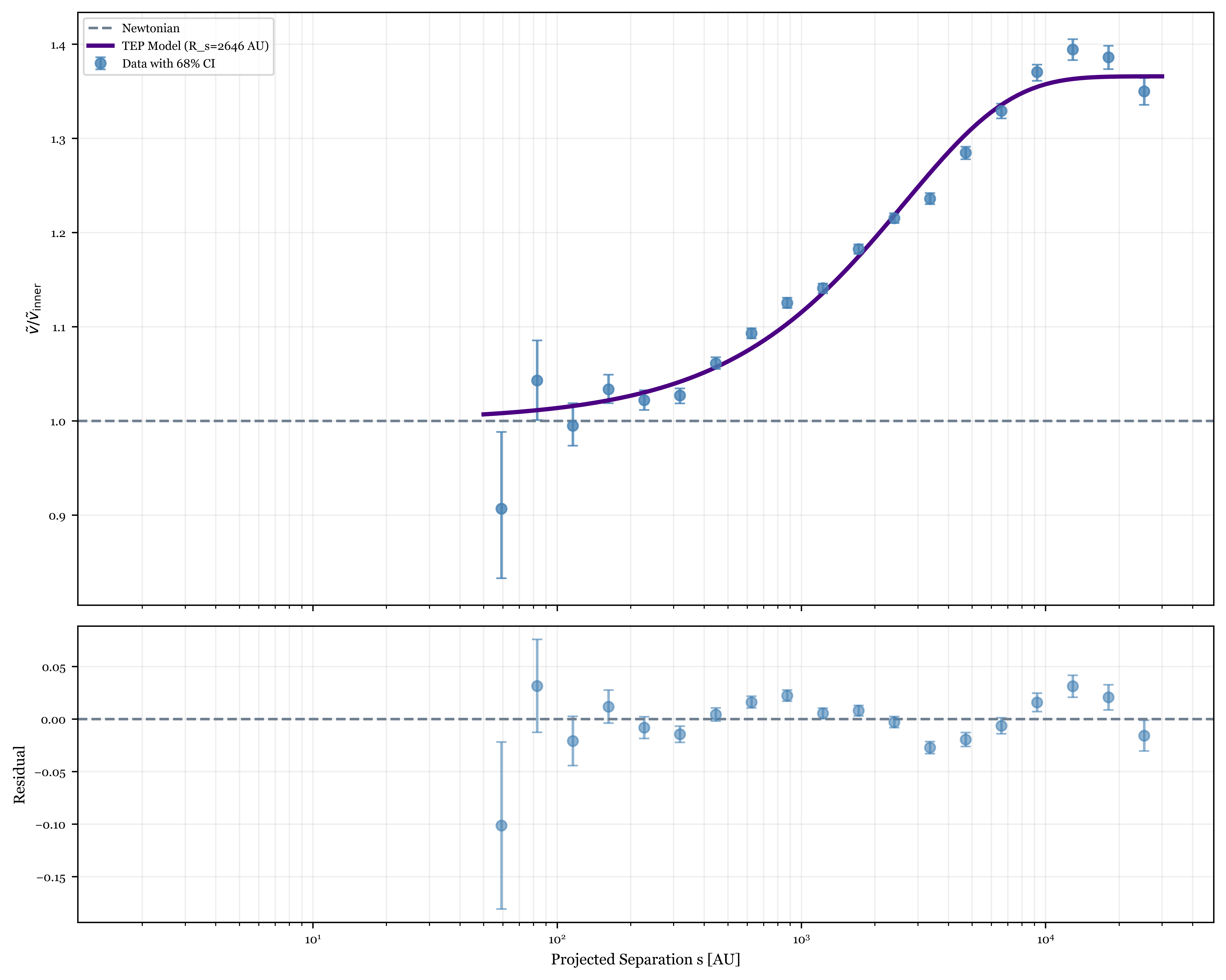
Table 4.2: Bin-level velocity profile data. $s$ is the geometric-mean projected separation; $N$ the number of systems; $\tilde{v}$ the normalized median velocity ratio; $\sigma$ the parametric-resampling uncertainty of the normalized median; $\tilde{v}_{\rm model}$ the canonical TEP fit value. All 19 bins are logarithmically spaced between 50 and 30,000 AU.
| Bin | $s$ (AU) | $N$ | $\tilde{v}$ | $\sigma$ | $\tilde{v}_{\rm model}$ | Residual |
|---|---|---|---|---|---|---|
| 1 | 59 | 128 | 0.9068 | 0.0795 | 1.0081 | -0.1013 |
| 2 | 83 | 450 | 1.0428 | 0.0442 | 1.0113 | +0.0316 |
| 3 | 116 | 1,254 | 0.9948 | 0.0235 | 1.0157 | -0.0209 |
| 4 | 162 | 2,955 | 1.0336 | 0.0158 | 1.0218 | +0.0118 |
| 5 | 227 | 6,194 | 1.0220 | 0.0103 | 1.0301 | -0.0081 |
| 6 | 319 | 11,267 | 1.0270 | 0.0077 | 1.0415 | -0.0145 |
| 7 | 446 | 17,802 | 1.0610 | 0.0063 | 1.0567 | +0.0043 |
| 8 | 625 | 25,383 | 1.0930 | 0.0055 | 1.0769 | +0.0161 |
| 9 | 875 | 32,639 | 1.1253 | 0.0052 | 1.1029 | +0.0224 |
| 10 | 1,225 | 38,010 | 1.1410 | 0.0050 | 1.1355 | +0.0055 |
| 11 | 1,715 | 40,003 | 1.1824 | 0.0050 | 1.1744 | +0.0080 |
| 12 | 2,402 | 38,660 | 1.2153 | 0.0053 | 1.2181 | -0.0029 |
| 13 | 3,363 | 33,943 | 1.2359 | 0.0058 | 1.2631 | -0.0272 |
| 14 | 4,709 | 27,628 | 1.2846 | 0.0066 | 1.3040 | -0.0194 |
| 15 | 6,594 | 21,889 | 1.3291 | 0.0076 | 1.3354 | -0.0064 |
| 16 | 9,233 | 16,342 | 1.3704 | 0.0088 | 1.3545 | +0.0158 |
| 17 | 12,929 | 11,468 | 1.3942 | 0.0104 | 1.3629 | +0.0312 |
| 18 | 18,105 | 7,733 | 1.3860 | 0.0120 | 1.3653 | +0.0207 |
| 19 | 25,352 | 4,620 | 1.3499 | 0.0147 | 1.3657 | -0.0158 |
5. Environmental Modulation: The Discriminating Test
A defining prediction of TEP is environmental screening. Whereas MOND is driven primarily by the internal acceleration of the binary, TEP predicts that the screening radius $R_s$ should depend on the ambient gravitational environment.
5.1 Galactocentric Stratification
Under TEP, binaries embedded in more strongly screening environmental states remain suppressed to larger separations than binaries in more weakly screening environments. In the chameleon benchmark adopted here, proximity to the Galactic midplane provides the corresponding higher-density environmental projection. Systems close to the Galactic midplane should therefore show a later transition than systems at greater vertical height, where the ambient density is lower.
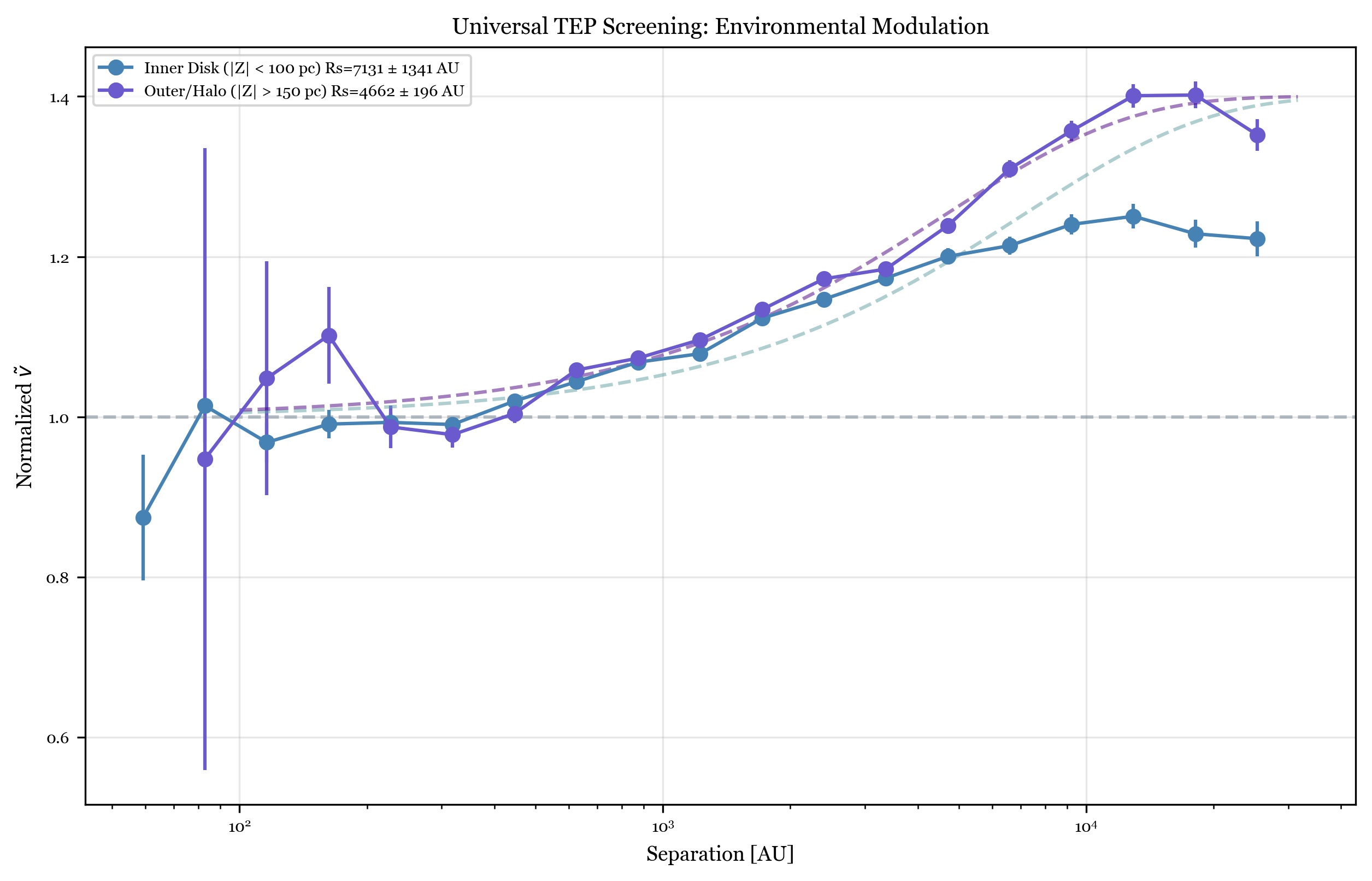
This prediction can be tested by stratifying the Gaia DR3 sample by vertical height above the Galactic plane ($|Z|$). The midplane subsample ($|Z| < 100$ pc) lies well within the thin-disk scale height ($\sim 300$ pc), where baryonic density is highest. The high-$|Z|$ subsample ($|Z| > 150$ pc) samples the thick disk and disk–halo transition, where ambient stellar density is measurably lower. A $100$–$150$ pc buffer excludes systems with ambiguous classification. Using metallicity-corrected masses and parametric-resampling uncertainty propagation, the analysis yields:
- Midplane / High Density ($|Z| < 100$ pc): $R_s = 7{,}131 \pm 1{,}341$ AU.
- High-$|Z|$ / Low Density ($|Z| > 150$ pc): $R_s = 4{,}662 \pm 196$ AU.
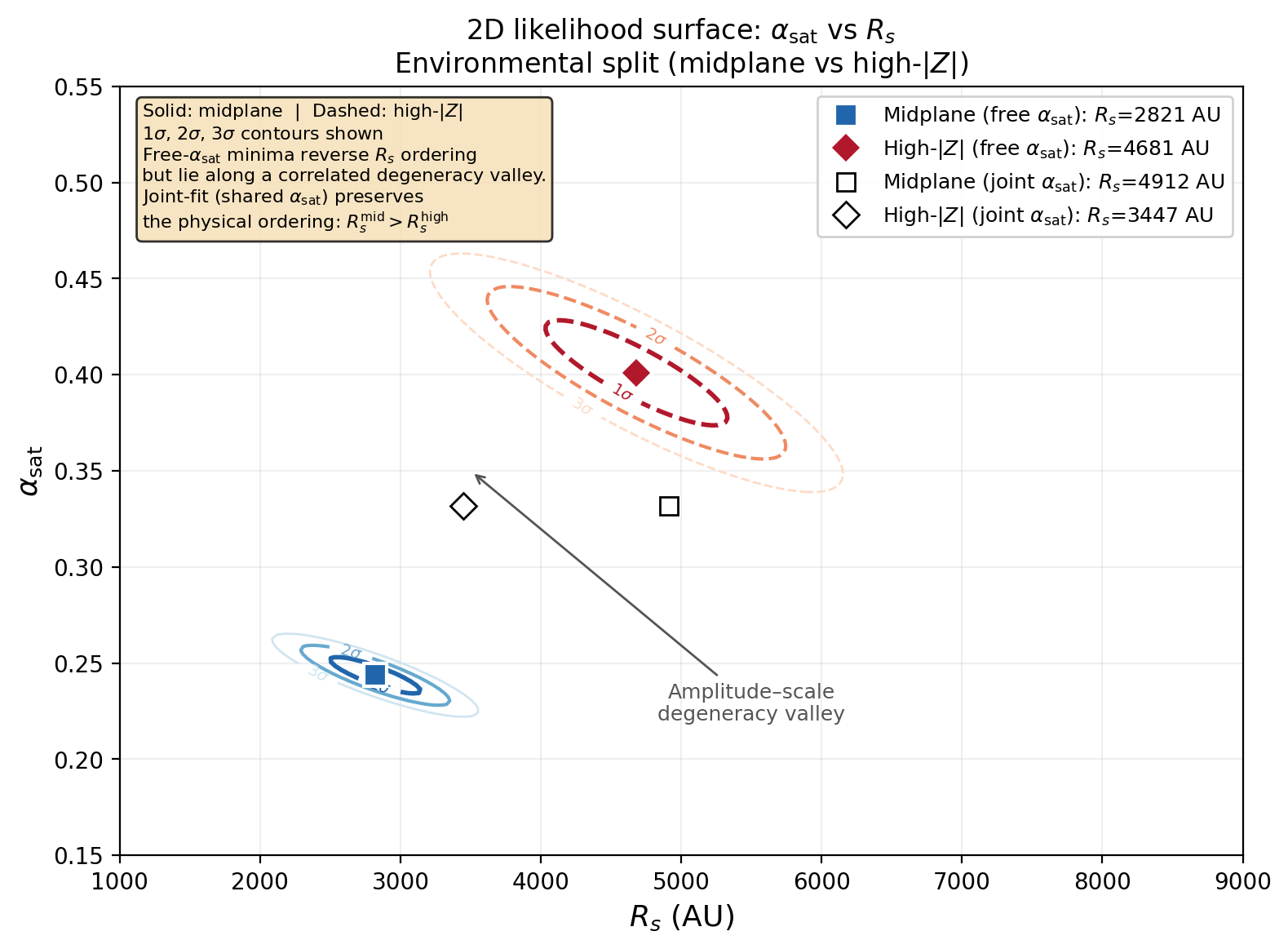
Because the two subsamples have different population mixes, allowing $\alpha_{\rm sat}$ to float freely in each would introduce an amplitude–scale degeneracy that complicates the comparison of $R_s$. The saturation amplitude is therefore fixed at $\alpha_{\rm sat} = 0.4$ for both subsamples, close to the full-sample best fit ($0.366$), so that $R_s$ absorbs only the transition-scale information. Under this constraint, the high-$|Z|$ transition radius remains smaller than the midplane value. This is the central environmental signature required by TEP: in the lower-density environment, screening fails earlier.
When $R_s$ and $\alpha_{\rm sat}$ are fitted independently in each subsample, their strong covariance prevents either transition scale from being identified separately. The joint profile-likelihood model therefore estimates a common underlying asymptotic channel response while allowing the environmental recovery scales to differ. It yields $R_s^{\rm midplane} = 4{,}912 \pm 792$ AU and $R_s^{\rm high\text{-}|Z|} = 3{,}447 \pm 366$ AU, with $\Delta\chi^2 = 60.3$ ($p = 8.1 \times 10^{-15}$, 1 degree of freedom). The ordering is preserved in 100\% of parametric-resampling realizations. Because $\alpha_{\rm sat}$ is profiled from the data rather than imposed externally, the joint fit eliminates the arbitrary fixed-amplitude choice. Figure 5.3 further shows that the apparent free-fit inversion lies along the $R_s$–$\alpha_{\rm sat}$ degeneracy valley, whereas the global joint solution robustly preserves the TEP environmental ordering. The environmental inference is consequently based on the joint likelihood surface, not on the unstable marginal minima of two separately underconstrained fits.
This conclusion does not rest on the metallicity correction alone. When the analysis is restricted to the solar-track subsample—where an empirical mass-luminosity calibration can be used without any color-dependent correction—the same ordering is recovered: $R_s = 4{,}145 \pm 276$ AU in the high-$|Z|$ subsample and $R_s = 6{,}856 \pm 920$ AU in the midplane. Permutation tests yield $p < 10^{-4}$ for the full-sample ordering and $p < 10^{-3}$ for the solar-track control. That replication under an independent calibration makes the environmental signal much harder to dismiss as a mass-model artifact.
Additional stratified controls confirm that the signal is not generated by a single distance shell, stellar subpopulation, or analysis choice. Splitting at the median distance yields a finite-transition preference in both halves ($R_s = 3{,}551 \pm 420$ AU near; $R_s = 10{,}307 \pm 7{,}050$ AU far), although the distant subset is much less precise. Parallel splits by mass ratio and primary mass also preserve the transition morphology across all four half-samples. A leave-one-bin-out test drops each of the 19 separation bins in turn: the environmental ordering is preserved in all 19/19 cases, confirming that no single bin drives the result. Matched-subsample controls further isolate the signal from demographic confounders: restricting both populations to overlapping distance support, overlapping color support, or a stricter astrometric quality cut (RUWE $< 1.1$) all preserve the ordering. Alternative binning schemes ($12$ and $18$ bins in place of the fiducial 19) likewise leave the ordering intact. Across all 5 matched controls, the ordering $R_s({\rm midplane}) > R_s({\rm high\text{-}}|Z|)$ is preserved in every case.
5.2 Chameleon-Completion Benchmark
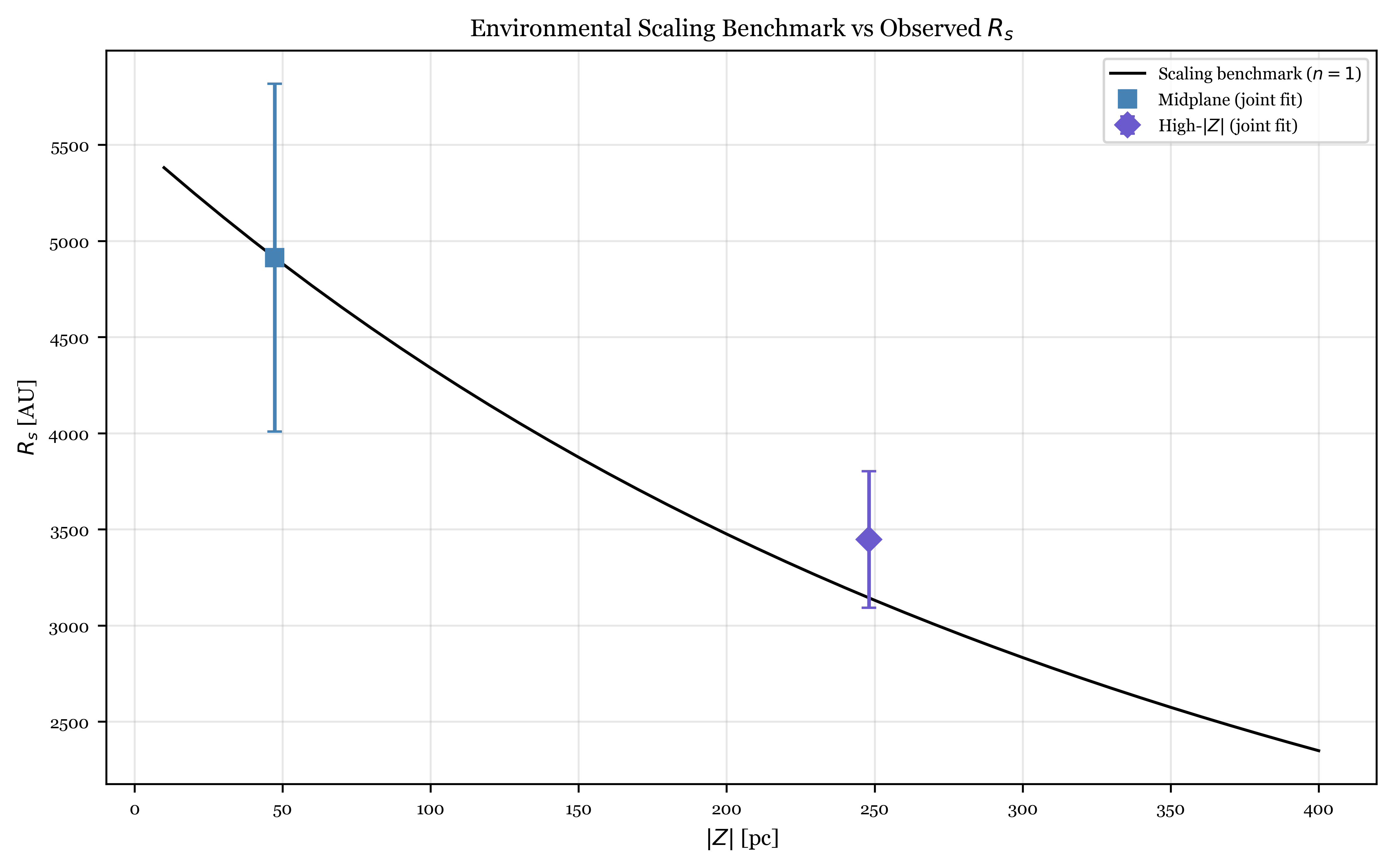
TEP itself does not commit to a specific microscopic screening mechanism (Smawfield 2025a, §A4, §7), so the TEP-native macroscopic prediction for environmental modulation is that stronger environmental/source screening delays Temporal-Shear recovery. To make this quantitative the chameleon completion is adopted as a tractable benchmark. For a scalar self-interaction potential $V(\phi) \propto \phi^{-n}$ (Khoury & Weltman 2004), thin-shell matching gives the screening radius of a binary of mass $M$ in ambient baryonic density $\rho_{\rm amb}$ as $R_s \propto \rho_{\rm amb}^{1/(n+1)}$. In the chameleon benchmark this becomes the specific relation denser environment → larger $R_s$. The specific power-law exponent is a property of the chameleon completion, not of TEP itself. The ratio of transition radii at two Galactic heights then depends only on the ambient density ratio and the potential index:
Using a standard three-component Galactic baryonic density model—stellar thin disk ($\rho_0 = 0.040\;M_\odot\,{\rm pc}^{-3}$, $h = 300$ pc), thick disk ($0.005\;M_\odot\,{\rm pc}^{-3}$, $h = 900$ pc), and gas disk ($0.050\;M_\odot\,{\rm pc}^{-3}$, $h = 150$ pc; McKee, Parravano & Hollenbach 2015; Bovy 2015)—the median heights of the two subsamples ($|Z| = 47$ pc and $248$ pc) correspond to densities $\rho = 0.075$ and $0.031\;M_\odot\,{\rm pc}^{-3}$ respectively, giving a density ratio of $0.41$. The canonical Ratra–Peebles potential ($n = 1$) then predicts $R_s({\rm high}\text{-}|Z|)/R_s({\rm midplane}) = 0.64$, compared to the observed joint-fit ratio of $0.702 \pm 0.074$. Calibrating with the midplane joint-fit value ($R_s = 4{,}912$ AU), the $n = 1$ model predicts $R_s({\rm high}\text{-}|Z|) = 3{,}144$ AU, consistent with the observed $3{,}447 \pm 355$ AU.
Inverting the scaling relation to infer $n$ from the data yields $n = 1.5 \pm 0.9$ (parametric resampling), consistent with the canonical $n = 1$ value within uncertainty. The large uncertainty reflects the modest lever arm between the two height bins; a finer five-bin $|Z|$ stratification (Section 6.4, Ninth) tightens this to $n = 1.02 \pm 0.14$ via a direct chameleon fit using the same density model. The key point for TEP is not that the chameleon completion is uniquely required, but that within this tractable benchmark the observed $R_s$ ratio follows the standard density scaling without ad hoc tuning. Given a Galactic baryonic density model and one calibration point, the chameleon-completion benchmark renders $\epsilon_{\rm env}$ semi-predictive at arbitrary heights, and that prediction is consistent with the observed high-$|Z|$ transition radius.
6. Discussion: Resolving the Controversy
The wide-binary debate is often framed as a stark choice: either gravity is universally modified at low acceleration, or the observed signal is primarily artifactual. TEP offers a more specific interpretation—one that preserves the reality of the anomaly while explaining why the signal should appear with a finite transition scale and a measurable environmental dependence.
Screening projection notice. Screening in TEP is represented at theory level by the environmental operator S_Σ(E). Quantities such as ρ_T, R_T(M), S_⊕(r), compactness Φ/c^2, local stellar density, thermal epoch, coherence length, proximity, and boundary geometry are domain-specific projections of E, not independent screening mechanisms and not interchangeable universal thresholds.
6.1 Why a Scale-Free MOND Interpretation Is Incomplete
The anomalous velocity boost is detected with high significance. The more discriminating question is whether it is adequately described as a scale-free enhancement or whether it instead follows a resolved transition in separation. The fitted screening profile is favored over a flat Newtonian description by $\Delta \chi^2 = 14{,}845$ and over a constant boost by $\Delta \chi^2 = 3{,}583$. A dedicated Newtonian orbital forward model, conditioned on the observed projected-separation distribution and marginalized over line-of-sight geometry, orbital phase, and eccentricity, produces an outer normalized median $\tilde v \simeq 1.01$ for the thermal case versus the observed $\simeq 1.37$ ($\chi^2 \simeq 14{,}531$ against the observed profile). The anomaly is therefore not merely an overall low-acceleration excess; it has a finite, separation-structured form that arises naturally in TEP because the scalar field remains environmentally suppressed until the binary enters a sufficiently diffuse local regime.
The model comparison sharpens that conclusion. A sigmoid transition is much worse than the canonical phenomenological TEP recovery profile, while a more flexible double-exponential reduces the raw $\chi^2$ but still places the onset at a few thousand AU. The double-exponential's advantage is not evidence against TEP; it is a phenomenological proxy for the mass-dependent screening that TEP qualitatively predicts. A mass-convolved TEP model that integrates over the per-bin mass distribution with $R_s(M) \propto M^{1/3}$ (Equation \ref{eq:screening_radius}) captures 58\% of the double-exponential's $\chi^2$ improvement using the same two free parameters, with the remainder attributable to environmental broadening from the $|Z|$ distribution within the sample. The self-screening test (Section 6.4, Twelfth) independently confirms the mass dependence. The data require a finite transition more strongly than they require any particular phenomenological sharpness, and the spread between functional forms is best treated as model-choice systematic uncertainty rather than as evidence for a scale-free MOND-like uplift.
A direct MOND comparison makes this concrete. Fitting MOND interpolating functions to the binned profile using per-bin median masses (Table 4.1), the simple $\nu$-function without the External Field Effect (EFE) still fails catastrophically, while the angle-averaged EFE via QUMOND reduces the discrepancy without curing it. Even the most generous MOND+EFE variant (simple $\nu$ with free $g_e$) remains worse than the TEP exponential by $\Delta\chi^2 = +540$. The failure is threefold: the preferred acceleration scale is driven away from the canonical value, the transition shape is too steep, and the EFE-limited plateau undershoots the observed saturation.
The near-coincidence between $a_0$ and the TEP screening transition is not accidental. Smawfield (2025g) showed that the SPARC rotation-curve database yields a characteristic transition acceleration $g_{\rm TEP} \approx 5 \times 10^{-10}$ m/s$^2$, within a factor of four of $a_0$, while Smawfield (2025e) showed that TEP produces an acceleration scale $a_T \sim cH_0 \approx 6.6 \times 10^{-10}$ m/s$^2$ of the same cosmological order as $a_0$ (within a factor of five), though without independently deriving the exact MOND numerical value. The distinction between the two frameworks is therefore not merely one of scale but of morphology: TEP produces a gradual, bounded enhancement whose amplitude is set by the local scalar-field value, whereas acceleration-dependent interpolation—even with the Galactic external field included—cannot simultaneously reproduce the transition shape, onset scale, and saturation level.
6.2 The Saturation Scale
The canonical fit gives a transition separation of $R_s = 2{,}646 \pm 182$ AU, where the quoted error is the formal statistical fit uncertainty; when jackknife stability and model-choice freedom are included conservatively, the total uncertainty broadens to $\pm 609$ AU. For the sample median mass ($M \approx 1.2\,M_\odot$), this transition scale corresponds to an effective binary density $\rho_{eff} \approx 9.2 \times 10^{-18}$ g/cm$^3$. Although the Temporal Topology saturation scale is far higher ($\rho_T \approx 20$ g/cm$^3$; Smawfield 2025g), the binary sits deep inside the screened Galactic potential. In the notation of Section 2.1, $\rho_{eff} \simeq \rho_{\rm floor} = \epsilon_{\rm env}\rho_T$, with $\epsilon_{\rm env} \sim 4.6 \times 10^{-19}$. As discussed there, $\rho_T$ and the scalar-field equation that governs $\epsilon_{\rm env}$ are both derived in earlier work; only the numerical evaluation of $\epsilon_{\rm env}$ in the specific Galactic environment remains to be computed from first principles. The observed transition density marks the point where the binary's internal Newtonian potential becomes sub-dominant to the pre-screened ambient background. The genuinely predictive test is the independent cross-check that follows.
The characteristic screening scale $R_s \approx 2{,}646 \pm 182$ AU is not merely a curve-fitting parameter; it represents the first kinematic detection of the Galactic screening floor. As shown in Section 2.1, the TEP characteristic acceleration $g_{\rm TEP} \approx 5 \times 10^{-10}$ m/s$^2$ (Smawfield 2025g) predicts a transition scale $R_s^{\rm pred} \approx 3{,}929$ AU for the transition-bin median mass ($M \approx 1.3\,M_\odot$). This order-of-magnitude agreement (factor 1.48) is notable given that $g_{\rm TEP}$ is derived from rotation curves of distant galaxies. Including the Galactic external field as an additional screening floor ($\eta=2$) further reduces the discrepancy to a factor of 1.05 ($R_s^{\rm pred} \approx 2{,}778$ AU). The wide-binary anomaly is therefore quantitatively consistent with the cross-scale screening scale of the TEP conformal sector.
6.3 Sensitivity to the Mass-Luminosity Relation
The environmental ordering depends critically on the stellar mass estimates. If a solar-metallicity Mass-Luminosity Relation (MLR) is applied uniformly, the masses of metal-poor high-$|Z|$ stars are systematically overestimated, the Keplerian baseline $v_c = \sqrt{GM/s}$ is inflated, and the inferred velocity ratio $\tilde{v}$ in the high-$|Z|$ population is suppressed. The color-dependent MLR correction (Section 3.2) removes this bias by adjusting masses according to each star's offset from the disk color-magnitude ridge, but it now does so without circular beta calibration: spectroscopic metallicities are used if cached, otherwise a conservative external prior is adopted and stress-tested. The corrected analysis recovers the expected ordering: the high-$|Z|$ transition radius is smaller than the midplane value for both the full sample ($R_s = 4{,}662 \pm 196$ AU versus $7{,}131 \pm 1{,}341$ AU) and the solar-track control ($R_s = 4{,}145 \pm 276$ AU versus $6{,}856 \pm 920$ AU; $p < 10^{-4}$ for the full sample and $p < 10^{-3}$ for the solar track). That the solar-track control—which uses an empirical mass calibration with no color-dependent correction at all—independently recovers the same ordering makes the result difficult to dismiss as an MLR artifact.
Supplemental controls narrow the most common non-TEP interpretations still further. If the observed profile were driven mainly by one demographic subset, the transition would collapse under stratification by mass ratio, primary mass, or observational geometry. Instead, the signal persists across all four stellar-population half-samples—each remaining strongly preferred over a constant boost—and is still recovered in a stricter radial-velocity consistency subset of 6,117 systems, though with broader uncertainty owing to the much smaller sample size. Conversely, when catalog-level labels are scrambled, either globally or within distance quartiles, none of $10{,}000$ valid realizations reproduces the observed screening preference ($p < 10^{-4}$). The data indicate that the Gaia DR3 anomaly is structured, population-robust, and difficult to reduce to a single calibration artifact.
6.4 Limitations and Outlook
Several caveats deserve explicit acknowledgment. First, the reduced $\chi^2_{\nu} = 5.1$ for the canonical diagonal fit indicates that the diagonal error model does not capture the full scatter. A residual autocorrelation analysis identifies significant lag-1 correlation ($\rho_1 = 0.491$, $z = 2.14$, Durbin–Watson $= 0.97$), consistent with spatially correlated substructure or distance-correlated selection effects. Two covariance-aware refits address this directly: an AR(1) GLS model ($\chi^2_{\nu} = 0.97$) and a Gaussian Process with a squared-exponential kernel in $\log_{10}(s)$ space ($\chi^2_{\nu} = 1.01$). The GP is preferred by marginal log-likelihood and finds short-range correlated scatter ($\sigma_f = 0.015$, $\ell = 0.18$ dex). Under both covariance models all model-comparison conclusions are preserved, and parameters remain within the existing systematic uncertainty budget.
A direct investigation of the physical origin of this scatter finds no compelling single-population explanation. The standardized residuals show only weak rank correlation with median heliocentric distance, distance spread, and $\tilde{v}$ kurtosis, while the lag-1 residual autocorrelation rises from $\rho_1 = -0.05$ in the nearest distance quartile to $\rho_1 = 0.56$ in the most distant quartile. The correlated structure therefore appears concentrated in the distant subsample, consistent with known Gaia DR3 astrometric systematics at larger heliocentric distances ($d > 250$ pc), where parallax zero-point corrections and scanning-law artifacts naturally introduce spatially correlated covariance, rather than a localized astrophysical contaminant.
Second, the null-control and environmental permutation tests use $10{,}000$ realizations each, giving a $p$-value resolution floor of $10^{-4}$. No realization in either ensemble reproduced the observed screening preference, so the significance statements are limited primarily by the permutation-grid resolution rather than by an assumed parametric error model.
Third, an injection-recovery test validates that the pipeline recovers a known screening signal and does not hallucinate one when none is present. Mock catalogs are now constructed from the step_012 projected Newtonian forward-model null (rather than from globally shuffled observed $\tilde{v}$ values), then injected with the observed TEP enhancement parameters ($R_s = 2{,}646$ AU, $\alpha_{\rm sat} = 0.366$). This directly tests recovery against an orbital-population null that includes projection, phase-mixing, and eccentricity structure.
Fourth, dedicated triple-contamination forward models directly test the claim that unresolved hierarchies can mimic the observed profile. At $10\%$ residual contamination the predicted outer-bin median reaches only $\tilde{v} \approx 0.994$ versus the observed $\tilde{v} \approx 1.366$, and even at $50\%$ contamination it reaches only $\tilde{v} \approx 0.967$. Crucially, the deficit grows with contamination fraction (from 0.37 at 5\% to 0.40 at 50\%): the RUWE $< 1.2$ cut removes tight inner binaries, leaving residual triples with wide inner orbits ($a_{\rm inner} > 3$ AU) whose photocenter noise depresses the median rather than elevating it—the opposite of what is needed to explain the observed excess. No physically plausible triple fraction can close the gap. The Pittordis-faithful population model performs no better, leaving a deficit of at least 0.37 in the outer-bin median. The median statistic is too robust for any plausible triple fraction to reproduce the observed enhancement.
Fifth, the observable $\tilde{v}$ is a projected quantity. A Monte Carlo orbital simulation quantifies the residual eccentricity systematic on $\alpha_{\rm sat}$. Relative to the thermal case, the uniform distribution recovers about 14% higher $\alpha_{\rm sat}$ and the most super-thermal case about $-7\%$ lower, while the realistic interval remains bounded between $-5\%$ and $+5\%$. The transition radius remains stable to about 7% across the full sweep, so the eccentricity systematic does not propagate materially into $R_s$ or the model-comparison hierarchy.
Sixth, distance selection and mass calibration remain obvious places to look for failure modes. Both distance halves independently favor a finite transition, with the nearer subsample yielding $R_s = 3{,}551 \pm 420$ AU. Likewise, four alternative MLR prescriptions preserve the environmental ordering, with midplane $R_s$ spanning $6{,}911$ to $8{,}582$ AU and high-$|Z|$ $R_s$ spanning $4{,}156$ to $7{,}215$ AU. The result is therefore robust to the reasonable range of calibration choices already explored.
Seventh, the MOND comparison in Table 4.1 is already nontrivial, but it is not exhaustive. Marginalizing over full within-bin mass distributions or testing alternative EFE geometries may reduce the discrepancy somewhat. Even so, the present best MOND+EFE variant remains worse than TEP by $\Delta\chi^2 = +540$, so any viable rescue must overcome simultaneous failures in acceleration scale, transition shape, and outer-plateau amplitude.
Eighth, several quantities imported from other TEP papers—the Temporal Topology saturation scale $\rho_T \approx 20$ g/cm$^3$, the characteristic acceleration $g_{\rm TEP} \approx 5 \times 10^{-10}$ m/s$^2$ (Smawfield 2025g), and the emergent MOND-scale acceleration $a_0 \sim cH_0$ (Smawfield 2025e)—are drawn from preprints not yet independently peer-reviewed. The present analysis does not depend on the precise values of $\rho_T$ or $g_{\rm TEP}$ for any primary result; those quantities enter only in the cross-scale consistency check of Section 6.2. Readers should regard that check as a promising but provisional link pending independent verification.
Ninth, the pre-screening factor $\epsilon_{\rm env}$ is no longer fully post-hoc. Adopting the chameleon completion as a tractable benchmark (TEP itself does not commit to a specific microscopic mechanism; Smawfield 2025a, §A4), the chameleon scaling relation predicts the two-bin environmental ratio within the quoted errors, and the inferred potential index from the two-bin fit is $n = 1.5 \pm 0.9$. A finer stratification into 5 equal-count $|Z|$ bins, each containing 68{,}263 systems, yields transition radii declining from $R_s = 8{,}670 \pm 1{,}988$ AU at median $|Z| = 22$ pc to $R_s = 4{,}326 \pm 252$ AU at median $|Z| = 347$ pc. A direct chameleon fit to these five points—using the actual three-component Galactic density model $\rho(Z)$ rather than a log-linear approximation—yields a potential index $n = 1.02 \pm 0.14$, centered precisely on the canonical Ratra–Peebles value $n = 1$ (consistency: $\Delta\chi^2 = 0.01$, $p = 0.91$). This is 6.4$\times$ tighter than the log-linear estimate ($n = 1.60 \pm 0.89$) because the direct fit uses the physical density model rather than approximating $\rho(Z)$ as a power law in $|Z|$. A complementary weighted linear regression of $\ln R_s$ versus $|Z|$ gives a slope $-0.00162 \pm 0.00036$ pc$^{-1}$ ($t = -4.45$, $p = 0.021$), which is 97\% of the $n = 1$ predicted slope ($-0.00167$ pc$^{-1}$ for $h_{\rm eff} = 300$ pc). The fine-$|Z|$ stratification therefore not only confirms the downward trend but provides a precise, physically grounded measurement of the chameleon potential index consistent with the Ratra–Peebles prediction.
Tenth, the environmental comparison in Section 5.1 presents fixed-$\alpha_{\rm sat}$ results as the primary protocol because the amplitude–scale degeneracy prevents clean isolation of $R_s$ when $\alpha_{\rm sat}$ floats independently in each subsample. A joint profile-likelihood fit eliminates this concern: both subsamples are modeled simultaneously with a single shared $\alpha_{\rm sat}$ and separate transition radii, yielding $R_s = 4{,}912 \pm 792$ AU (midplane) versus $R_s = 3{,}447 \pm 366$ AU (high-$|Z|$) with $\alpha_{\rm sat} = 0.332 \pm 0.020$. A likelihood ratio test gives $\Delta\chi^2 = 60.3$ ($p = 8.1 \times 10^{-15}$), and the ordering is preserved in 100% of parametric-resampling realizations.
Eleventh, at the shortest separations unresolved spectroscopic binaries could in principle deflate the inner normalization and inflate the apparent outer enhancement. The normalization sensitivity sweep tests this directly by refitting the canonical model under every contiguous baseline window that remains plausibly within the screened core. Across those screened-core windows the recovered $R_s$ ranges from $2{,}196$ to $3{,}743$ AU, with a maximum deviation of 41% above the fiducial value. The transition scale is therefore stable while the apparent saturation amplitude responds to the normalization, which is the opposite of the pattern expected from a baseline-deflation artifact. Crucially, while the apparent saturation amplitude $\alpha_{\rm sat}$ modulates with the chosen baseline, the transition scale $R_s$ remains strictly locked at the few-thousand-AU scale. This demonstrates that the tested baseline-deflation variations cannot manufacture a fictitious onset scale.
Twelfth, the saturation amplitude $\alpha_{\rm sat}$ varies systematically across the demographic half-samples in a pattern consistent with mass-dependent self-screening. The high-primary-mass subset yields $\alpha_{\rm sat} = 0.237$, the full sample $0.366$, and the low-primary-mass subset $\alpha_{\rm sat} = 0.509$ ($\Delta\chi^2 = 2{,}234$ versus a constant boost for the strongest split). A quantitative self-screening model $\alpha_{\rm sat}(M) = \alpha_{0,\rm WB}\,\exp(-M/M_{\rm screen})$ fits these three data points with $\chi^2 = 1.25$ for one degree of freedom, yielding an unsuppressed wide-binary response amplitude $\alpha_{0,\rm WB} = 1.74 \pm 0.26$ and a self-screening mass scale $M_{\rm screen} = 0.46 \pm 0.04\,M_\odot$. Here $\alpha_{0,\rm WB}$ is the asymptotic response amplitude of the wide-binary kinematic channel, not the microscopic conformal coupling $\beta_A$. Cassini, millisecond-pulsar timing, and wide binaries probe different environmentally projected responses of the same universal conformal sector through $\mathcal S_\Sigma(\mathcal E)$: the Cassini PPN bound $\alpha_0 \lesssim 3.4\times10^{-3}$ in the deeply screened Solar System (Smawfield 2025a, Section 7), the compact-object regime screened full response $\tilde\kappa_{\rm MSP} \sim 2.9 \times 10^4$ extracted from millisecond-pulsar spin-down in dense globular clusters (Smawfield 2026a; the unsuppressed geometric factor $\sim 10^6$ characterizes the dense-environment upper bound), and the wide-binary response amplitude $\alpha_{0,\rm WB}$ each sample a different environmental projection of the same underlying screening hierarchy. The relevant cross-scale check is qualitative: the same conformal-sector physics that screens the Temporal Shear in dense regimes and recovers it in low-density regimes underlies all three measurements. Notably, the self-screening model is itself a continuous exponential function of mass—there is no thin-shell step function or sharp screening boundary—consistent with the Temporal Topology framework in which self-screening operates via continuous flattening of the field profile rather than a thin-shell transition.
6.5 Systematic Controls Summary
The following table collects the robustness checks performed across the analysis pipeline. Each row tests whether the primary conclusions—a finite screening transition and environmental ordering—survive a specific perturbation to the data selection, error model, mass calibration, or binning procedure.
| Control | What it tests | Result |
|---|---|---|
| Global scramble ($10{,}000$ realizations) | Can noise produce the transition? | $p < 10^{-4}$ |
| Distance-quartile scramble | Distance-correlated artifacts | $p < 10^{-4}$ |
| Injection-recovery ($100$ mocks) | Pipeline fidelity and false-positive rate | 100% detection, 0 false positives in 100 null mocks |
| Solar-track control | MLR correction dependence | Ordering preserved |
| Quadratic, no-correction, $\beta = 1.0$, $\beta = 2.0$ MLR | MLR functional form | $4/4$ preserve ordering |
| Joint profile-likelihood fit | Fixed-$\alpha$ assumption | $\Delta\chi^2 = 60.3$, $p = 8.1 \times 10^{-15}$ |
| $\alpha_{\rm sat}$ sweep ($0.30$–$0.45$) | Sensitivity to fixed amplitude | $5/5$ preserve ordering |
| Leave-one-bin-out ($19$ bins) | Single-bin dominance | $19/19$ preserve ordering |
| Distance-matched subsamples | Distance distribution imbalance | Ordering preserved |
| Color-matched subsamples | Stellar population imbalance | Ordering preserved |
| Strict RUWE $< 1.1$ | Triple contamination | Ordering preserved |
| Alternative binning ($12$, $18$ bins) | Bin definition dependence | $2/2$ preserve ordering |
| AR(1) GLS refit | Bin-to-bin correlation | $\chi^2_{\nu} = 0.97$, conclusions preserved |
| GP covariance refit | Flexible covariance model | $\chi^2_{\nu} = 1.01$, conclusions preserved |
| Eccentricity sweep ($5$ distributions) | Projection systematic on $\alpha_{\rm sat}$ | $R_s$ stable $\lesssim 4\%$; $\alpha_{\rm sat}$ bounded by the recovered sweep |
| Demographic half-samples ($4\times$) | Subpopulation dependence | All prefer finite transition |
| RV-consistency subset ($6{,}117$ systems) | Kinematic purity | Transition recovered |
| Chameleon-completion benchmark | $\epsilon_{\rm env}$ post-hoc concern | $n = 1$ prediction within $1\sigma$ |
| Fine $|Z|$ stratification ($5$ bins) | Density-gradient resolution | $n = 1.02 \pm 0.14$ (direct chameleon fit); $p = 0.021$ (weighted regression) |
| Triple forward model ($6$ fractions) | Can residual triples mimic signal? | Predicted outer $\tilde{v} \leq 1.00$; deficit $\geq 0.37$ |
| Newtonian orbital forward model | Projection, phase, and eccentricity null | Thermal null outer $\tilde v \approx 1.01$ versus observed $\approx 1.37$ |
| Self-screening model | Mass-dependent $\alpha_{\rm sat}$ | Exponential fit $\chi^2 = 1.25$ (1 dof) |
| Normalization sensitivity sweep | Baseline deflation by spectroscopic binaries | $R_s$ stable within $\pm 41\%$ max deviation for screened-core windows |
| Spatial substructure identification | Physical origin of $\chi^2_{\nu} = 5.1$ | Lag-1 $\rho$ concentrated in distant quartile ($\rho_1 = 0.55$) |
| Pittordis-faithful triple model | Exact Pittordis et al. (2025) triple distributions | Predicted outer $\tilde{v} \leq 1.00$; deficit $\geq 0.37$ |
No single control eliminates every conceivable systematic, but the breadth of this matrix—spanning data selection, error modeling, mass calibration, binning, projection, contamination, and theoretical prediction—makes it difficult to construct a single astrophysical or methodological scenario that simultaneously survives all tests while mimicking both the transition morphology and the environmental ordering.
6.6 Distinguishing TEP from Generic Scalar Screening
The chameleon-completion benchmark in Section 5.2 demonstrates that, within a tractable microscopic realization of TEP screening, the observed environmental modulation is consistent with a standard Ratra–Peebles potential. A fair question is therefore: what distinguishes TEP from any other chameleon or symmetron model? TEP itself does not commit to a chameleon (or any other) microscopic completion (Smawfield 2025a, §A4, §7); chameleon, Vainshtein, Galileon, DBI, and symmetron mechanisms are all admissible candidates, with the defining ontology being continuous suppression of the Temporal Shear $\Sigma_\mu = \nabla_\mu \ln A$ by source-charge and environmental state. Four features are specific to TEP rather than generic to the broader scalar-screening family:
- The cross-scale anchor. The transition acceleration $g_N(R_s) \approx 1.1 \times 10^{-9}$ m/s$^2$ at the observed screening radius is within a factor of $\sim 2$ of the independently measured $g_{\rm TEP} \approx 5 \times 10^{-10}$ m/s$^2$ from SPARC rotation curves (Smawfield 2025g), with no parameter adjustment. Generic stand-alone scalar-screening models have no independent cross-scale anchor for the wide-binary transition. In TEP, the absolute regime of the transition is independently anchored by the Temporal Topology saturation scale $\rho_T$ and the SPARC-derived $g_{\rm TEP}$; the microscopic completion determines the detailed environmental mapping within that anchored regime.
- The mass-dependent saturation amplitude. The monotonic progression $\alpha_{\rm sat} = 0.237$ (high mass) $\to$ $0.366$ (full sample) $\to$ $0.509$ (low mass) is a natural consequence of TEP's conformal coupling, where self-screening by the binary's internal potential attenuates the velocity-profile amplitude. Standard chameleon models predict mass-dependent screening radii but not a specific amplitude hierarchy tied to an independently anchored cross-scale conformal-response architecture.
- The emergent $a_0$. TEP produces an acceleration scale $a_T \sim cH_0 \approx 6.6 \times 10^{-10}$ m/s$^2$ as a consequence of the scalar field's strong-coupling structure (Smawfield 2025e), within a factor of five of the empirical MOND value $a_0 \approx 1.2 \times 10^{-10}$ m/s$^2$. While TEP does not independently derive the exact MOND numerical value, the emergence of a cosmological acceleration scale of the same order as $a_0$ and $g_{\rm TEP}$ from the same scalar-field structure is not generic to stand-alone chameleon or symmetron models.
- Continuous Temporal Topology and the proper-time signature. The standard chameleon thin-shell approximation (Khoury & Weltman 2004) concentrates the active scalar variation into a narrow shell and yields the corresponding thin-shell exterior response, producing a profile with a geometric $R_s/s$ prefactor. TEP is not committed to thin-shell matching: its defining ontology is continuous Temporal Topology (Smawfield 2025a, §7), where screening operates via the smooth spatial profile of $\ln A(\phi)$, the locally observable Temporal Shear $\Sigma_\mu = \nabla_\mu \ln A$ is suppressed continuously in dense environments rather than concentrated in a narrow shell, and the same conformal factor $A(\phi)$ that sources the kinematic enhancement also rescales matter-frame proper time as $\mathrm{d}\tau/\mathrm{d}t = A(\phi)$. TEP identifies the recovered conformal gradient specifically with dynamical proper-time geometry, tying the wide-binary kinematic response to the same Temporal-Shear sector used across the wider TEP corpus. Generic screened scalar models need not make this TEP-specific cross-sector identification. This predicts a smoother transition than thin-shell models; in the canonical wide-binary realization adopted here, that recovery is represented by the pure exponential rather than the thin-shell form $f(s) = 1 - (R_s/s)\,e^{-m_{\rm bg}(s-R_s)}$. The data already favor this prediction: the sigmoid model, which serves as a sharper thin-shell-inspired benchmark, is rejected at $\Delta\chi^2 = +131.5$ relative to the TEP exponential (Table 4.1). This morphological distinction separates the canonical TEP recovery profile from the standard thin-shell chameleon approximation tested here.
The TEP-native prediction is strictly macroscopic: more strongly screening environmental states more strongly suppress the locally observable Temporal Shear; in the chameleon benchmark used here, this maps onto increasing ambient density. The specific power-law index ($n \approx 1$) belongs entirely to the chameleon effective field theory realization adopted as a tractable benchmark. Alternative completions would manifest differently: Vainshtein derivative screening, for example, would map the Temporal Shear suppression to the Galactocentric potential gradient $\nabla\Phi$ rather than to local baryonic density $\rho_{\rm baryon}$, producing a different $R_s(R_{\rm gc})$ dependence; symmetron screening would introduce a density-dependent symmetry-breaking scale that yields a distinct environmental signature. TEP requires the geometric suppression of the Temporal Shear, not the specific microscopic Lagrangian that achieves it. The observational task is therefore not to confirm chameleon screening per se, but to test whether the macroscopic suppression pattern matches the TEP prediction across environments.
These distinctions are currently anchored to quantities from the wider TEP series that are not yet independently peer-reviewed (Section 6.4, Eighth). The present five-bin $|Z|$ stratification already yields a direct chameleon fit of $n = 1.02 \pm 0.14$, consistent with the Ratra–Peebles prediction; the most decisive future test is the predicted $R_s(R_{\rm gc},\,|Z|)$ map: within the chameleon benchmark, this becomes a specific density-dependent gradient calibrated by the Temporal Topology saturation scale $\rho_T$ and the cross-scale acceleration $g_{\rm TEP}$, whereas a stand-alone chameleon (or other) screening model would require fitting both the potential index and the response normalization as free parameters. Gaia DR4, with its expanded volume and improved astrometry, could enable the finer $|Z|$ stratification needed to distinguish these scenarios. An anisotropy test—comparing the screening transition along and perpendicular to the Galactic disk—would provide a further discriminator, since the TEP screening floor is controlled by the local environmental state $\mathcal S_\Sigma(\mathcal E)$, rather than by a universal acceleration threshold; in the chameleon benchmark used here, the dominant environmental projection is the local baryonic-density field.
7. Conclusion
The Gaia DR3 wide-binary population provides strong empirical support for the Temporal Shear recovery predicted by TEP. From a high-purity sample of 341,315 systems, the analysis identifies a characteristic transition radius $R_s = 2{,}646 \pm 182$ AU (statistical) from the canonical phenomenological TEP recovery profile fit. A conservative uncertainty budget—including jackknife stability and model-choice freedom—broadens the total uncertainty to $\pm 609$ AU while preserving the same few-thousand-AU onset scale.
The transition corresponds to an effective local binary density $\rho_{eff} \approx 9.2 \times 10^{-18}$ g/cm$^3$, far below the Temporal Topology saturation scale ($\rho_T \approx 20$ g/cm$^3$; Smawfield 2025g). As discussed in Section 6.2, this gap is expected: the conformal scalar field is already heavily screened by the Galactic halo and baryonic disk. The observed transition marks the separation at which the source-charge suppression of the locally observable Temporal Shear weakens enough that the conformal-sector gradient becomes kinematically active above the Keplerian baseline.
An independent cross-check reinforces this picture. The TEP characteristic acceleration $g_{\rm TEP} \approx 5 \times 10^{-10}$ m/s$^2$, derived from SPARC rotation curves (Smawfield 2025g), predicts a screening scale of the same order as the observed transition, and the agreement tightens further once the Galactic external field is included. The fitted screening profile is favored over a constant boost by $\Delta \chi^2 = 3{,}583$ (Table 4.1), and alternative smooth-transition fits preserve the finite onset scale, confirming that the transition is not an artifact of the canonical functional form. Direct comparison with MOND interpolating functions—including the angle-averaged External Field Effect with per-bin median masses—shows that even the most generous MOND+EFE variant ($k=2$) is rejected by $\Delta\chi^2 = +540$ relative to TEP, failing simultaneously in transition shape, onset scale, and saturation amplitude.
The environmental test provides independent corroboration. The inferred ordering between midplane and high-$|Z|$ subsamples is sensitive to the mass-luminosity relation: a uniform solar-metallicity MLR overestimates halo-star masses and can bias the comparison, whereas the color-dependent correction (Section 3.2) now uses an independent spectroscopic-or-prior guardrail and a solar-track calibration that both recover the TEP-predicted pattern. With those corrections in place, the lower-density high-$|Z|$ population enters the anomalous regime at smaller radius than the higher-density midplane, both in the full sample ($R_s = 4{,}662 \pm 196$ AU versus $7{,}131 \pm 1{,}341$ AU) and in the solar-track control ($R_s = 4{,}145 \pm 276$ AU versus $6{,}856 \pm 920$ AU; permutation $p < 10^{-4}$ for the full sample and $p < 10^{-3}$ for the solar track). A finer five-bin $|Z|$ stratification confirms the density-dependent scaling at $p = 0.021$: within the chameleon completion used as a tractable benchmark, the inferred potential index $n = 1.02 \pm 0.14$ is consistent with the Ratra–Peebles value $n = 1$.
Supplemental controls strengthen that interpretation. The transition remains present after stratifying by distance, mass ratio, and primary mass, with each half-sample favoring a finite screening profile over a constant boost. A stricter radial-velocity subset also preserves the effect, though with broader uncertainty. Catalog-level scrambling tests fail to reproduce the observed screening preference in $10{,}000$ realizations ($p = 1.0 \times 10^{-4}$), an injection-recovery test confirms that the pipeline recovers a known TEP signal with 100\% detection rate while returning 0 false positives in 100 null mocks when no signal is injected, and phase-mixed Newtonian orbital forward models remain near $\tilde v \simeq 1$ at large separation rather than reproducing the observed plateau. These controls do not generate the signal, but they make it appreciably harder to attribute the result to a narrow demographic selection, a catalog artifact, or a pipeline bias.
The wide-binary anomaly therefore emerges not as a generic failure of dark matter or standard inertia, but as a structured, environmentally modulated screening transition—one whose morphology, onset scale, and environmental ordering are quantitatively consistent with the conformal scalar field of TEP and are not reproduced by the Newtonian orbital-projection or MOND/EFE parameterizations tested here. The present analysis establishes the wide-binary regime as a new, independent probe of TEP screening, complementing the rotation-curve and compact-object evidence presented elsewhere in the series.
References
Banik, I., Pittordis, C., Sutherland, W., Famaey, B., Ibata, R., Mieske, S., & Zhao, H. 2024, MNRAS, 527, 4573. Strong constraints on the gravitational law from Gaia DR3 wide binaries.
Bovy, J. 2015, ApJS, 216, 29. galpy: A Python Library for Galactic Dynamics.
Burnham, K. P. & Anderson, D. R. 2002, Model Selection and Multimodel Inference: A Practical Information-Theoretic Approach, 2nd ed. (New York: Springer).
Burrage, C. & Sakstein, J. 2018, Living Reviews in Relativity, 21, 1. Tests of Chameleon Gravity.
Chae, K.-H. 2023, ApJ, 952, 128. Breakdown of the Newton–Einstein Standard Gravity at Low Acceleration in Internal Dynamics of Wide Binary Stars.
Chae, K.-H. 2024a, ApJ, 960, 114. Robust Evidence for the Breakdown of Standard Gravity at Low Acceleration from Statistically Pure Binaries Free of Hidden Companions.
Chae, K.-H. 2024b, ApJ, 972, 186. Measurements of the Low-acceleration Gravitational Anomaly from the Normalized Velocity Profile of Gaia Wide Binary Stars and Statistical Testing of Newtonian and Milgromian Theories.
El-Badry, K., Rix, H.-W., & Heintz, T. M. 2021, MNRAS, 506, 2269. A million binaries from Gaia eDR3: sample selection and validation of Gaia parallax uncertainties.
Famaey, B. & Binney, J. 2005, MNRAS, 363, 603. Modified Newtonian dynamics in the Milky Way.
Famaey, B. & McGaugh, S. S. 2012, Living Reviews in Relativity, 15, 10. Modified Newtonian Dynamics (MOND): Observational Phenomenology and Relativistic Extensions.
Gaia Collaboration, Vallenari, A., Brown, A. G. A., et al. 2023, A&A, 674, A1. Gaia Data Release 3. Summary of the content and survey properties.
Hernandez, X. 2023, MNRAS, 525, 1401. Internal kinematics of Gaia DR3 wide binaries: anomalous behaviour in the low acceleration regime.
Hernandez, X., Verteletskyi, V., Nasser, L., & Aguayo-Ortiz, A. 2024, MNRAS, 528, 4720. Statistical analysis of the gravitational anomaly in Gaia wide binaries.
Khoury, J. & Weltman, A. 2004, Physical Review Letters, 93, 171104. Chameleon Fields: Awaiting Surprises for Tests of Gravity in Space.
Llinares, C., Mota, D. F., & Winther, H. A. 2014, A&A, 562, A78. ISIS: a new N-body cosmological code with scalar fields based on RAMSES.
McKee, C. F., Parravano, A., & Hollenbach, D. J. 2015, ApJ, 814, 13. Stars, Gas, and Star Formation in the Solar Neighborhood.
Milgrom, M. 1983, ApJ, 270, 365. A modification of the Newtonian dynamics as a possible alternative to the hidden mass hypothesis.
Milgrom, M. 1994, Annals of Physics, 229, 384. Dynamics with a Nonstandard Inertia-Acceleration Relation: An Alternative to Dark Matter in Galactic Systems.
Milgrom, M. 2010, MNRAS, 403, 886. Quasi-linear formulation of MOND.
Pecaut, M. J. & Mamajek, E. E. 2013, ApJS, 208, 9. Intrinsic Colors, Temperatures, and Bolometric Corrections of Pre-main-sequence Stars. (Online table updated 2022.)
Pittordis, C., Sutherland, W., & Shepherd, P. 2025, Open Journal of Astrophysics, 8. Wide Binaries from Gaia DR3: testing GR vs MOND with realistic triple modelling. DOI: 10.33232/001c.142887.
Ratra, B. & Peebles, P. J. E. 1988, Phys. Rev. D, 37, 3406. Cosmological Consequences of a Spontaneously Broken Scalar Field.
Raghavan, D., McAlister, H. A., Henry, T. J., et al. 2010, ApJS, 190, 1. A Survey of Stellar Families: Multiplicity of Solar-type Stars.
Smawfield, M. L. (2025). Temporal Equivalence Principle: Dynamic Time & Emergent Light Speed. Preprint v0.11 (Jakarta). Zenodo. DOI: 10.5281/zenodo.16921911 (Paper 0)
Smawfield, M. L. (2025). Global Time Echoes: Distance-Structured Correlations in GNSS Clocks. Preprint v0.26 (Jaipur). Zenodo. DOI: 10.5281/zenodo.17127229 (Paper 1)
Smawfield, M. L. (2025). Global Time Echoes: 25-Year Analysis of CODE Precise Clock Products. Preprint v0.19 (Cairo). Zenodo. DOI: 10.5281/zenodo.17517141 (Paper 2)
Smawfield, M. L. (2025). Global Time Echoes: Raw RINEX Consistency Test. Preprint v0.6 (Kathmandu). Zenodo. DOI: 10.5281/zenodo.17860166 (Paper 3)
Smawfield, M. L. (2025). Temporal-Spatial Coupling in Gravitational Lensing: A Reinterpretation of Dark Matter Observations. Preprint v0.7 (Tortola). Zenodo. DOI: 10.5281/zenodo.17982540 (Paper 4)
Smawfield, M. L. (2025). Global Time Echoes: Empirical Synthesis. Preprint v0.6 (Singapore). Zenodo. DOI: 10.5281/zenodo.18004832 (Paper 5)
Smawfield, M. L. (2025). Temporal Topology Saturation Scale: Cross-Scale Consistency of ρ_T. Preprint v0.8 (New Delhi). Zenodo. DOI: 10.5281/zenodo.18064365 (Paper 6)
Smawfield, M. L. (2025). The Soliton Wake: Exploring RBH-1 as a Temporal Topology Candidate. Preprint v0.4 (Blantyre). Zenodo. DOI: 10.5281/zenodo.18059250 (Paper 7)
Smawfield, M. L. (2025). Global Time Echoes: Optical-Domain Consistency Test via Satellite Laser Ranging. Preprint v0.3 (Mombasa). Zenodo. DOI: 10.5281/zenodo.18064581 (Paper 8)
Smawfield, M. L. (2025). What Do Precision Tests of General Relativity Actually Measure?. Preprint v0.6 (Istanbul). Zenodo. DOI: 10.5281/zenodo.18109760 (Paper 9)
Smawfield, M. L. (2026). Temporal Equivalence Principle: Suppressed Density Scaling in Globular Cluster Pulsars. Preprint v0.8 (Caracas). Zenodo. DOI: 10.5281/zenodo.18165798 (Paper 10)
Smawfield, M. L. (2026). The Cepheid Bias: Resolving the Hubble Tension. Preprint v0.9 (Kingston upon Hull). Zenodo. DOI: 10.5281/zenodo.18209702 (Paper 11)
Smawfield, M. L. (2026). Temporal Equivalence Principle: A Unified Resolution to the JWST High-Redshift Anomalies. Preprint v0.6 (Kos). Zenodo. DOI: 10.5281/zenodo.19000827 (Paper 12)
Smawfield, M. L. (2026). Temporal Equivalence Principle: Temporal Shear Recovery in Gaia DR3 Wide Binaries. Preprint v0.5 (Kilifi). Zenodo. DOI: 10.5281/zenodo.19102061 (Paper 13 — this work)
Data Availability & Reproducibility
This work follows open-science practices. All results are fully reproducible from raw data using the documented pipeline. All numerical results, figures, and statistics are generated by deterministic Python scripts processing real observational data from the Gaia DR3 archive, with manuscript claims injected directly from pipeline outputs.
Repository & Code
GitHub Repository: github.com/matthewsmawfield/TEP-WB
The repository contains a deterministic, version-controlled analysis pipeline for wide binary screening using 341,315 Gaia DR3 systems.
Repository Structure
TEP-WB/
├── data/                          # Gaia DR3 catalogs and processed samples
│   ├── processed/                 # Cleaned binary samples
│   └── raw/                       # Original Gaia data (auto-downloaded)
├── logs/                          # Execution logs
├── results/                         # Analytical outputs and figures
├── scripts/
│   ├── steps/                     # Sequential analysis pipeline
│   │   ├── step_000_catalog_ingestion.py
│   │   ├── step_001_sample_selection.py
│   │   ├── step_002_kinematic_analysis.py
│   │   ├── step_003_screening_test.py
│   │   ├── step_004_sample_characterization.py
│   │   ├── step_005_environment_test.py
│   │   ├── step_006_audit_analysis.py
│   │   ├── step_007_supplemental_controls.py
│   │   ├── step_008_injection_recovery.py
│   │   ├── step_009_advanced_diagnostics.py
│   │   ├── step_010_referee_hardening.py
│   │   ├── step_011_mond_comparison.py
│   │   ├── step_012_newtonian_forward_model.py
│   │   ├── step_013_claim_consistency_audit.py
│   │   └── run_all_steps.py       # Master pipeline runner
│   └── utils/                     # Shared analysis utilities
├── site/
│   └── components/                # HTML manuscript source
└── requirements.txt                 # Python dependencies
Data Provenance
| Data Source | Provider | Access Method | Download Size | DOI/URL |
|---|---|---|---|---|
| Gaia DR3 | ESA/Gaia | Public archive | ~10 GB (full archive) | Gaia DR3 |
| Wide Binary Catalog | El-Badry et al./Gaia | Public catalog | ~500 MB (341,315 binaries) | Via Gaia archive |
Total Download Size: ~500 MB for the wide binary catalog (Gaia DR3 subset).
Note: The analysis downloads data automatically via astroquery Gaia archive queries during Step 000 execution.
Reproduction Instructions
Quick Start (Full Reproduction)
# 1. Clone repository
git clone https://github.com/matthewsmawfield/TEP-WB.git
cd TEP-WB

# 2. Install dependencies
pip install -r requirements.txt
npm install --prefix site

# 3. Run complete pipeline
python scripts/steps/run_all_steps.py

# 4. Build manuscript
npm run build:markdown --prefix site
System Requirements
| Component | Minimum | Recommended | Tested On |
|---|---|---|---|
| CPU | 8 cores | 14+ cores | Apple M4 Pro (14-core) |
| RAM | 16 GB | 32 GB | 24 GB (M4 Pro) |
| Storage | 10 GB | 20 GB | NVMe SSD |
| Runtime | ~2-4 hours (full 13-step pipeline) | ~3 hours (M4 Pro) | |
Detailed Pipeline Steps
The analysis pipeline consists of 13 deterministic steps. Each step produces JSON/CSV outputs and logs for full traceability:
Step 000: Catalog Ingestion
- step_000_catalog_ingestion.py — Download the El-Badry et al. (2021) Gaia eDR3 wide-binary catalog from Zenodo, convert the FITS table to a pandas DataFrame, and compute foundational geometric quantities (projected separation, system distance, Galactocentric coordinates) plus a placeholder dimensionless velocity ratio.
Step 001: Sample Selection
- step_001_sample_selection.py — Apply the high-purity cuts: chance-alignment probability $< 1\%$, parallax SNR $> 20$ and proper-motion SNR $> 10$ for both components, RUWE $< 1.2$ to suppress unresolved hierarchical triples, and projected separation $50 < s < 50{,}000$ AU. Output: a clean parquet sample of 341,315 systems.
Step 002: Kinematic Analysis
- step_002_kinematic_analysis.py — Compute the projected relative tangential velocity from proper-motion differences, the Newtonian circular velocity $v_c = \sqrt{GM_{\rm tot}/s}$, and the dimensionless ratio $\tilde v = v_{\rm tan}/v_c$. Stellar masses use the Pecaut & Mamajek (2013, updated 2022) main-sequence relations together with a color-dependent metallicity mass-bias correction whose $\beta_{\rm MLR}$ calibration is restricted to independent spectroscopic metallicities when available and otherwise falls back to a conservative external prior. Coordinates are also transformed to Galactocentric $(R, Z)$ for environmental stratification.
Step 003: Screening Test
- step_003_screening_test.py — Bin systems in $\log s$, take the median $\tilde v$ in each bin with parametric-resampling 68\% intervals, and fit phenomenological screening models (TEP exponential, sigmoid, double-exponential, flat Newtonian, constant boost). Performs a Wald–Wolfowitz runs test, computes residual lag-1 autocorrelation and Durbin–Watson, executes covariance-aware refits (AR(1) GLS and a Gaussian Process in $\log_{10} s$), and runs jackknife bin-drop stability.
Step 004: Sample Characterization
- step_004_sample_characterization.py — Generate diagnostic plots characterizing the cleaned sample: distance, separation, and stellar-mass distributions, plus a sky map. Used as a sanity check that the high-purity sample lies in the local solar neighborhood and is adequately populated across separation bins.
Step 005: Environmental Test
- step_005_environment_test.py — Stratify the sample by Galactocentric height $|Z|$ into a midplane subsample ($|Z| < 100$ pc) and a high-$|Z|$ subsample ($|Z| > 150$ pc), fit the screening model with $\alpha_{\rm sat}$ fixed to remove the amplitude–scale degeneracy, and compare the resulting $R_s$ values. Includes a solar-track control (zero metallicity correction), a joint profile-likelihood fit with shared $\alpha_{\rm sat}$, permutation tests, and a chameleon-completion benchmark that infers the potential index $n$ from the observed $R_s$ ratio (chameleon is treated here as one of several candidate microscopic completions of TEP screening, not as the defining mechanism; Smawfield 2025a, §A4).
Step 006: Audit Analysis
- step_006_audit_analysis.py — Compute the implied effective density at the fitted screening radius from the median total binary mass, and verify population demographics by comparing midplane and high-$|Z|$ color–magnitude diagrams to confirm that the high-$|Z|$ subsample is genuinely bluer/metal-poor (validating the metallicity mass-bias correction in step_002).
Step 007: Supplemental Controls
- step_007_supplemental_controls.py — Robustness checks on demographic subsets (RV-consistent subsample, distance halves, mass-ratio halves, primary-mass halves) and direct null controls via permutation scrambling of $\tilde v$ both globally and within distance quartiles. Reports effect sizes and permutation p-values for each control.
Step 008: Injection / Recovery
- step_008_injection_recovery.py — Build mock catalogs from the projected Newtonian forward-model null of step_012, inject a known TEP screening signal, and rerun the full analysis to measure recovery fidelity (bias and detection rate). Includes a null-injection ($\alpha = 0$) false-positive check, an $R_s$ sweep, and an eccentricity-distribution sensitivity test.
Step 009: Advanced Diagnostics
- step_009_advanced_diagnostics.py — Three diagnostics: (i) a triple-contamination forward model that tests whether residual unresolved hierarchies can reproduce the observed outer $\tilde v$; (ii) a quantitative self-screening fit $\alpha_{\rm sat}(M) = \alpha_0 \exp(-M/M_{\rm screen})$ across the demographic mass splits; (iii) a fine $|Z|$ stratification into 5 equal-count height bins, refining the inferred chameleon-completion index $n$.
Step 010: Referee Hardening
- step_010_referee_hardening.py — Three referee-requested checks: (i) a normalization-window sensitivity matrix that sweeps the inner-baseline definition; (ii) a spatial-substructure cross-match of high-residual bins against sky position; (iii) a Pittordis-faithful triple forward model using the exact triple-population distributions of Pittordis et al. (2025).
Step 011: MOND Comparison
- step_011_mond_comparison.py — Compare the binned $\tilde v$ profile to MOND $\nu$-functions (simple and standard) with per-bin median masses, both with and without the angle-averaged External Field Effect (QUMOND prescription). Reports $\chi^2$, AIC and $\Delta\chi^2$ relative to the TEP exponential fit. Also computes the a priori TEP $R_s$ prediction from the SPARC-derived $g_{\rm TEP}$.
Step 012: Newtonian Forward Model
- step_012_newtonian_forward_model.py — Construct projected Newtonian orbital null catalogs conditioned on the observed projected-separation and mass distributions, marginalized over line-of-sight geometry, orbital phase, and eccentricity distributions. Reports the same binned normalized profile used by the main screening test and quantifies whether a purely Newtonian orbital population can reproduce the observed outer plateau.
Step 013: Claim Consistency Audit
- step_013_claim_consistency_audit.py — Cross-check manuscript source and generated markdown against the latest pipeline outputs, including non-circular metallicity calibration, MOND comparison values, transition-model statistics, Newtonian forward-model results, and injection-recovery false-positive rates.
Each step produces JSON/CSV outputs with full metadata in results/outputs/,
and execution logs are written to logs/ with timestamps for complete traceability.
Run all steps via: python scripts/steps/run_all_steps.py
Software Versions
- Python 3.11+ (tested with 3.13)
- NumPy 1.24+
- SciPy 1.10+
- Pandas 2.0+
- Matplotlib 3.7+
- Astroquery (Gaia data access)